

Why are your engineers spending forty hours a week chasing low-priority CVEs while your profit margins vanish into the noise? Most MSPs treat security as a defensive hurdle; a series of fires to put out before the next client call. It's a reactive cycle that breeds alert fatigue and kills your bottom line. You know the struggle of managing thousands of vulnerabilities across multiple tenants without a clear roadmap. A broken vulnerability management process doesn't just leave clients at risk. It drains your resources, hides your value, and stalls your growth.
We agree that the status quo is unsustainable. You need a way to prove impact without burning out your best talent. This guide delivers a repeatable, high-margin vulnerability management process that scales across your entire client base without adding engineering overhead. Stop guessing; start prioritizing; start winning. We'll explore a streamlined workflow for identifying risks, the shift toward risk-based prioritization required by 2026 standards like CISA BOD 26-04, and the path to total visibility across every tenant you manage.
Key Takeaways
- Eliminate the alert noise that kills profit margins by shifting from reactive scanning to strategic risk management.
- Implement a repeatable vulnerability management process that allows your team to manage more clients with fewer engineering resources.
- Prioritize threats based on real-world exploitability and business impact rather than relying on outdated, static severity scores.
- Build a foundation for high-value vCISO services by operationalizing remediation and delivering professional, white-labeled reports.
- Centralize control through a multi-tenant platform to achieve total visibility and streamline M365 security hardening across your portfolio.
Why Traditional Vulnerability Scanning Is a Margin-Killer for MSPs
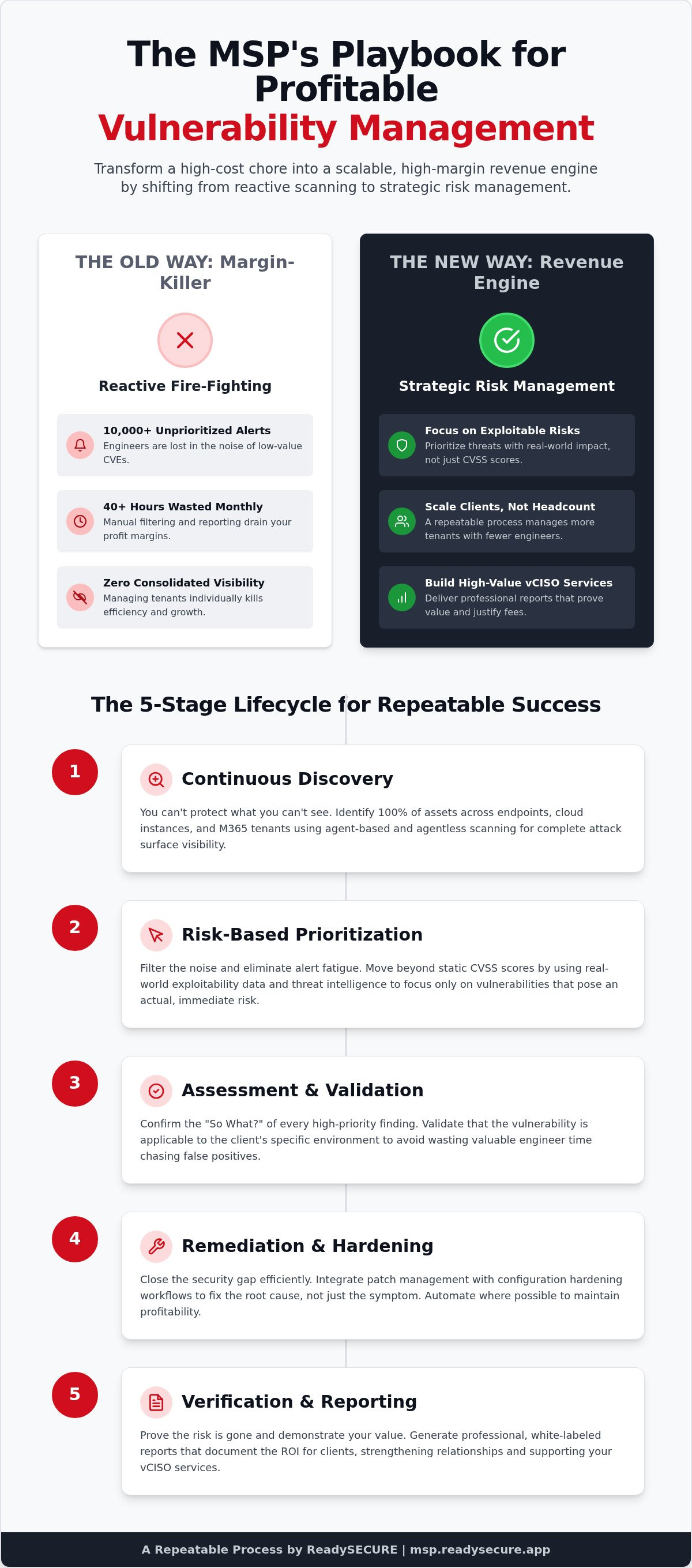
Traditional vulnerability scanning is a trap. It promises visibility but delivers chaos. For many MSPs, a security service is little more than an automated email containing 10,000 unprioritized alerts. This isn't a service; it's a liability. When your engineers spend forty hours a month manually filtering "Critical" vulnerabilities that aren't even exploitable, your margins evaporate. You aren't selling security. You're subsidizing technical debt.
A scan is a snapshot. A professional vulnerability management process is a strategy. To scale, you must move beyond the scan and patch loop. You need a system that identifies, prioritizes, and remediates risks across every client tenant without requiring a dedicated engineering team for every account. If your current workflow relies on manual reporting and individual dashboard logins, you're hitting a ceiling that will eventually stall your growth.
The High Cost of Low-Value Alerts
Alert fatigue is the silent killer of MSP profitability. With the CVE database now tracking tens of thousands of new vulnerabilities annually, traditional tools flood your dashboard with noise. Most of these alerts pose zero actual risk to your client's specific environment. This volume creates vulnerability blindness. Your team stops looking for the needle because the haystack is too big. If an engineer spends five hours a week chasing false positives, you're losing thousands in billable overhead every month. Traditional tools fail the multi-tenant test because they force you to manage these fires individually, client by client, with zero consolidated oversight.
From Technical Debt to High-Margin Revenue
Security should be your most profitable service line. To get there, you must reframe the conversation. Stop positioning yourself as a vendor who fixes broken things. Start acting as an ally who manages business risk. A robust vulnerability management process serves as the foundation for your vCISO offering. It allows you to present high-level, white-labeled reports that prove value to stakeholders without drowning them in jargon. You transition from a defensive posture to a growth-oriented strategy. By automating the noise and focusing on high-impact risks, you reclaim engineer hours and justify premium service fees. This is how you transform a technical necessity into a strategic revenue engine.
The 5-Stage Lifecycle: Building a Repeatable Vulnerability Management Process
A repeatable vulnerability management process is the backbone of a profitable security engine. It transforms a chaotic technical chore into a predictable, billable service. To scale across dozens of clients, you must move beyond the "scan-and-hope" model. You need a modular system that functions without constant manual intervention. This five-stage lifecycle ensures your engineers focus on high-impact results while you maintain total control over your margins.
- Stage 1: Continuous Discovery. Identify every asset, cloud instance, and M365 tenant.
- Stage 2: Risk-Based Prioritization. Filter the noise using exploitability data and threat intelligence.
- Stage 3: Assessment and Validation. Confirm the "So What?" of every finding to avoid chasing ghosts.
- Stage 4: Remediation and Hardening. Apply patches and configuration changes to close the gap.
- Stage 5: Verification and Reporting. Prove the risk is gone and document the ROI for the client.
This cycle is not a one-time project. It's a continuous loop that aligns with authoritative vulnerability management standards. By following this structure, you shift from a reactive fire-fighter to a proactive security partner.
Continuous Discovery Beyond the Perimeter
Visibility is the first law of security. You can't protect what you can't see. In 2026, discovery must go beyond simple network sweeps. Your vulnerability management process must account for hybrid workforces, shadow IT, and sprawling M365 environments. Modern MSPs utilize a mix of agent-based and agentless discovery to ensure 100% visibility. Agents provide deep telemetry on endpoints, while agentless scans capture cloud assets and guest devices. This multi-layered approach ensures no corner of the client attack surface remains hidden.
Remediation and Hardening Workflows
Remediation is where most MSPs lose money. Manual patching is slow and error-prone. To stay profitable, you must integrate patch management with configuration hardening. This is especially critical for M365 environments where identity protection and data governance are often overlooked. Automate the low-hanging fruit. Set policies for routine updates and reserve your engineers for complex configuration changes. By consolidating your security stack into a single command surface, you can deploy hardening policies across multiple tenants with a few clicks. This efficiency is the difference between a break-fix struggle and a high-margin security service.
Risk-Based Prioritization: Solving the Volume Problem
Volume is the enemy of profitability. With tens of thousands of new vulnerabilities tracked annually, your team cannot patch their way to security. A vulnerability management process that treats every "Critical" alert as an immediate emergency is a process destined for failure. You don't need more engineers; you need a better filter. Risk-based prioritization allows you to ignore the noise and focus on the subset of vulnerabilities that actually pose a threat to your client's business. It's about working smarter, not harder.
To win in 2026, you must integrate real-world exploitability data and threat intelligence into your workflow. Most vulnerabilities are never actually exploited. Chasing them is a waste of your most expensive resource: engineering time. By shifting your focus, you transform your service from a technical chore into a strategic risk reduction engine. You stop being a "patch-monkey" and start being a business protector.
CVSS vs. Risk-Based Prioritization
CVSS scores are a baseline, not a roadmap. They measure theoretical severity, not real-world risk. A vulnerability might have a score of 9.8 but require physical access to a machine that's locked in a vault. In contrast, a score of 7.0 might be actively exploited in the wild right now. Risk-based prioritization in 2026 is the dynamic alignment of vulnerability data with real-world exploitability and business impact to ensure every engineering hour generates maximum risk reduction. This approach aligns with NIST's Guide to Enterprise Patch Management, which emphasizes prioritizing actions based on the likelihood of exploitation. Stop letting static scores dictate your team's schedule.
The Power of Business Context
Not all assets are equal. A vulnerability on a public-facing web server is a crisis; the same vulnerability on a guest-network printer is a footnote. You must identify the "Crown Jewel" assets within each client environment. This is where your vulnerability management process meets GRC. Mapping risks to compliance requirements and business continuity needs allows you to justify your actions to non-technical stakeholders. When you explain that you're protecting the payroll database rather than just "fixing a CVE," you prove your value as a strategic ally. This context allows you to build a prioritized action plan that secures the client's most critical data while maintaining your profit margins through efficient resource allocation.
Operationalizing Remediation and Verification
Remediation is the stage where your vulnerability management process either generates profit or burns cash. Identification is easy. Execution is where most MSPs stumble. You must build a "get-to-work" pragmatism within your technical team. This means moving past the desire to fix every minor flaw. Instead, focus on decisive action that moves the needle for the client's risk profile. Your team should know exactly when to deploy a patch, when to implement a compensating control, and when to simply accept a low-level risk. This tiered approach keeps your engineers focused on high-margin work rather than endless, low-value busywork.
Remediation Strategies for the Modern MSP
Balance emergency patching with scheduled maintenance cycles. Zero-day threats require immediate intervention, but routine updates should be batched to preserve engineer bandwidth. When dealing with legacy systems that cannot be patched, use configuration hardening or network isolation to shield the asset. This approach maintains security without breaking critical business functions. By integrating Incident Response support into your remediation workflow, you ensure that even if a patch causes an issue, your team is ready to respond instantly. This level of oversight is a premium service that justifies higher professional service fees.
Verification and Proof of Value
You haven't solved a problem until you've proven it's gone. Automated rescanning is non-negotiable. It closes the loop by verifying that every remediation action was successful. This isn't just about technical accuracy. It's about professional branding. Use these results to generate executive-ready, white-label reports. These documents transform invisible technical work into visible business value. Show your clients the "before and after" of their risk posture. When you can present a clear, documented reduction in exploitable vulnerabilities, you justify your monthly fees and solidify your position as an indispensable partner. This data also serves as critical evidence for compliance audits, adding another layer of value to your offering.
To start building a more profitable security engine, deploy a multi-tenant command surface that automates your reporting and verification workflows today.
Scaling Your Security Revenue with the ReadySECURE Platform
Execution at scale is the final frontier for the modern MSP. You've mastered the theory; now you need the engine. Tool sprawl is the primary barrier to growth. Managing ten clients with ten different dashboards is a recipe for operational collapse. To achieve true brand dominance, you must consolidate your security stack into a single, multi-tenant command surface. This isn't just about convenience. It's about building a high-margin revenue engine that functions with military precision.
The ReadySECURE platform is built specifically for the channel. It eliminates the manual struggle of jumping between tenants. By centralizing your vulnerability management process, you gain total oversight of your entire client base. You stop wasting time on administrative overhead and start focusing on strategic service delivery. This is where you transition from a technician to a high-value business partner.
Total Control via a Single Command Surface
Operational efficiency is your greatest lever for profit. ReadySECURE allows you to manage vulnerability management and M365 hardening in one unified view. You can see risks across every tenant, prioritize them based on real-world exploitability, and deploy hardening policies with a few clicks. This consolidated approach reduces tool sprawl and ensures your engineers spend their time on billable actions. You gain a birds-eye view of your entire operation. Identify trends; deploy global fixes; maintain total control. It's a platform designed to let you manage more assets with fewer people.
Unlocking New Revenue Streams
Vulnerability management is the foundation, but it isn't the ceiling. Use the platform to bundle high-value services that clients crave. Integrate automated GRC and mail security to create a comprehensive protection package. This allows you to sell strategic assurance rather than just technical fixes. Leverage integrated vCISO support to tackle complex risks that your competitors can't handle. You can also offer professional penetration testing to validate your work and justify premium fees. Every report you generate is white-labeled, ensuring your brand stays front and center. You aren't just selling a tool; you're selling a position of market dominance.
Ready to transform your security offering into a scalable profit center? Ready to scale? Join the ReadySECURE platform today.
Dominate Your Market with a High-Margin Security Engine
Security is no longer a defensive hurdle; it's your most powerful engine for financial growth. By moving from reactive scanning to a risk-based vulnerability management process, you reclaim your engineers' time and protect your profit margins. You stop being a technical vendor and start being an elite strategic partner. The transition from manual struggle to automated mastery is the only way to scale in a competitive landscape. You have the roadmap; now you need the vehicle.
Efficiency is the key to true scalability. You need a single command surface to manage complex multi-tenant environments without the engineering overhead. ReadySECURE provides the tools to dominate your market. Leverage our white-label multi-tenant console to provide total visibility across every client. Utilize integrated vCISO and IR support to solve complex risks that other MSPs ignore. Automate your M365 hardening and GRC tasks to ensure consistent, high-margin delivery. Stop guessing. Start prioritizing. Start winning. Take control of your service delivery today and build a practice that is both effective and exceptionally profitable.
Build Your High-Margin Security Stack with ReadySECURE
Frequently Asked Questions
What is the difference between vulnerability scanning and vulnerability management?
Vulnerability scanning is a point-in-time technical check; vulnerability management is a continuous strategic lifecycle. A scan identifies flaws; a managed process prioritizes them, tracks remediation, and verifies the fix. You don't get paid for a list of problems. You get paid for a documented reduction in risk. Management transforms a technical task into a high-margin service that protects the client's bottom line while ensuring your team remains productive.
How often should an MSP perform vulnerability scans for clients?
MSPs should move from monthly sweeps to continuous discovery to maintain 100% visibility. New vulnerabilities emerge daily; waiting thirty days to find them is a liability. For high-value assets, daily scans are the standard. For general endpoints, weekly discovery suffices. This constant oversight allows you to catch threats before they're exploited. It also provides the real-time data needed to justify your recurring monthly fees to stakeholders.
Is vulnerability management a profitable service for smaller MSPs?
Vulnerability management is exceptionally profitable for smaller MSPs when powered by automation. You don't need a massive engineering team to deliver elite security. By using a multi-tenant platform, you consolidate your workflow and eliminate tool sprawl. This allows you to bill for premium security services without increasing your headcount. It's about leveraging software to perform the heavy lifting. Small teams can achieve high margins by focusing on risk-based results.
Can I automate the vulnerability management process in M365?
You can and should automate the vulnerability management process within M365 environments. Modern platforms allow you to harden identities, secure data, and manage devices from a single command surface. Automation handles the low-hanging fruit like configuration drift and routine policy enforcement. This frees your engineers to focus on complex security architecture. By centralizing these tasks, you ensure consistent protection across every client tenant while drastically reducing the time spent on manual audits.
How do I handle vulnerabilities that cannot be patched?
When a patch isn't available, you must implement compensating controls to shield the asset. This involves network isolation, configuration hardening, or enhanced monitoring. You don't leave the risk open. You document the mitigation strategy and move on. This pragmatic approach is a core part of a mature vulnerability management process. It shows clients you understand their business continuity needs. You protect legacy systems without breaking the workflows that generate their revenue.
What should be included in a vulnerability management report for clients?
An executive-ready report must include a risk summary, a remediation timeline, and proof of verification. Skip the technical jargon. Focus on the before and after of the client's risk posture. Highlight the "Crown Jewel" assets you've secured. Include compliance evidence to show they're audit-ready. Use white-label branding to keep your MSP front and center. A great report doesn't just list vulnerabilities; it proves the ROI of your security services.
How does risk-based prioritization reduce engineer burnout?
Risk-based prioritization eliminates the noise that leads to engineer burnout. Instead of chasing 10,000 low-priority alerts, your team focuses on the subset of vulnerabilities that are actually exploitable. This "get-to-work" pragmatism ensures every hour worked has a measurable impact. It stops the cycle of endless, low-value busywork. By filtering for real-world threat intelligence, you protect your team's morale. You ensure they spend their time on high-impact, high-margin tasks.
What is the role of a vCISO in the vulnerability management process?
A vCISO provides the strategic leadership needed to translate technical risks into business decisions. They guide the prioritization process and help clients navigate complex compliance requirements. In a managed service model, a vCISO uses vulnerability data to build long-term security roadmaps. This elevates your relationship from a vendor to a trusted advisor. You aren't just fixing bugs. You're providing high-level governance that secures the client's future and justifies premium fees.

