

The test itself isn’t what makes white-label penetration testing work for an MSP. The model scales when testing, client ownership, and remediation fit together. White label penetration testing for MSPs can expand your security offering without requiring you to build every capability in-house, but it still needs a clear delivery process and client-ready communication.
It’s reasonable to worry that another security service could mean more coordination, unclear boundaries, and technical findings clients struggle to act on. A well-defined workflow helps keep the engagement focused: set the scope, coordinate the assessment, then turn the results into practical next steps. Penetration testing can complement ongoing vulnerability management, while giving clients a focused view of security risks that routine scanning alone may not address.
This guide explains what white-label testing involves, where its practical boundaries sit, and how to build it into a repeatable MSP client workflow. You’ll also see how to present findings in clear business terms and assess whether the model fits your existing security services and revenue plans. ReadySECURE provides on-demand penetration testing alongside an MSP-focused security platform, giving you a coordinated foundation for the conversation.
Key Takeaways
- White label penetration testing for MSPs keeps your client relationship at the center while separating service ownership from who performs the technical testing.
- Build a repeatable engagement around clear objectives, defined asset scope, written authorization, testing, reporting, and follow-up.
- Understand how penetration testing differs from vulnerability scanning, and weigh delivery control against the staffing demands of an in-house team.
- Set client expectations before testing, then translate findings into clear business priorities without losing technical accuracy.
- See how ReadySECURE connects on-demand penetration testing with vulnerability management, Microsoft 365 security, mail security, and compliance.
White-Label Pen Testing for MSPs: What It Is and Isn't
White-label penetration testing lets an MSP include a security assessment in its client offering while keeping the MSP’s client relationship at the center. The MSP can own the engagement from the client’s perspective, while technical testing is delivered as part of the service. Keep those roles clear: branding and account ownership don’t, by themselves, explain who conducts the assessment or what it covers.
For an MSP, white label penetration testing for MSPs is a delivery model, not a fixed test package. Scope, methods, objectives, and deliverables depend on the engagement. Set those boundaries clearly so your client understands what the assessment will examine, who is responsible for each part, and what falls outside the agreed work.
What does white-label penetration testing mean for an MSP?
The MSP integrates a testing service into its own client offering and manages the client-facing relationship. Technical delivery is handled through the testing service. Both roles need clear ownership: the MSP coordinates expectations and communication, while testing stays within the agreed assessment scope. White-label reporting tools can support a consistent client experience, but branding does not change the test’s objectives or prove that every part of an environment was assessed.
How is a penetration test different from vulnerability scanning?
Vulnerability scanning checks defined assets for potential weaknesses. Penetration testing goes further by assessing whether scoped weaknesses can be exploited, within the agreed rules of engagement. A scan can help surface issues across an asset set; a penetration test examines selected risks in greater depth. Neither answers every security question, and neither should be treated as a substitute for the other. For a practical look at scan planning, see this practical vulnerability scanning guide.
Think of the distinction as breadth versus validation, not “basic” versus “complete.” A vulnerability scan might flag a possible weakness on a public-facing system. A penetration test can assess whether that weakness is exploitable within the authorized scope and what access or impact it could create. The exact conclusions depend on the assets, objectives, and methods agreed for that engagement. For a foundational overview of the concept and common approaches, see What is Penetration Testing?.
Don’t assume every security assessment tests the same systems or risks. One engagement might focus on a defined application; another might examine a different set of assets against different objectives. A test’s findings speak to the work performed, not automatically to systems or scenarios outside its scope. That’s why written authorization, clear boundaries, and agreed objectives are essential before testing begins.
Used together, scanning and penetration testing provide distinct kinds of insight. Scanning can support ongoing visibility into potential weaknesses, while a scoped penetration test can help determine whether selected weaknesses are practically exploitable. Keeping those roles clear helps you explain the value of each service without overstating what either assessment proves.
How an MSP White-Label Penetration Test Moves from Scope to Findings
A smooth engagement starts before anyone tests a system. The MSP, client, and testing team need a shared view of the business question, authorized assets, boundaries, and responsibilities. That preparation keeps the assessment focused and gives the client a clearer path from testing activity to decisions.
Define the client objective and test boundaries
Start with the question the client needs answered. Is the priority to assess a particular system, understand exposure in a defined environment, or support a broader security discussion? Translate that objective into an agreed scope. Record the systems included and excluded, testing window, authorization, rules of engagement, and who communicates with whom. Keep the boundaries explicit before technical work begins.
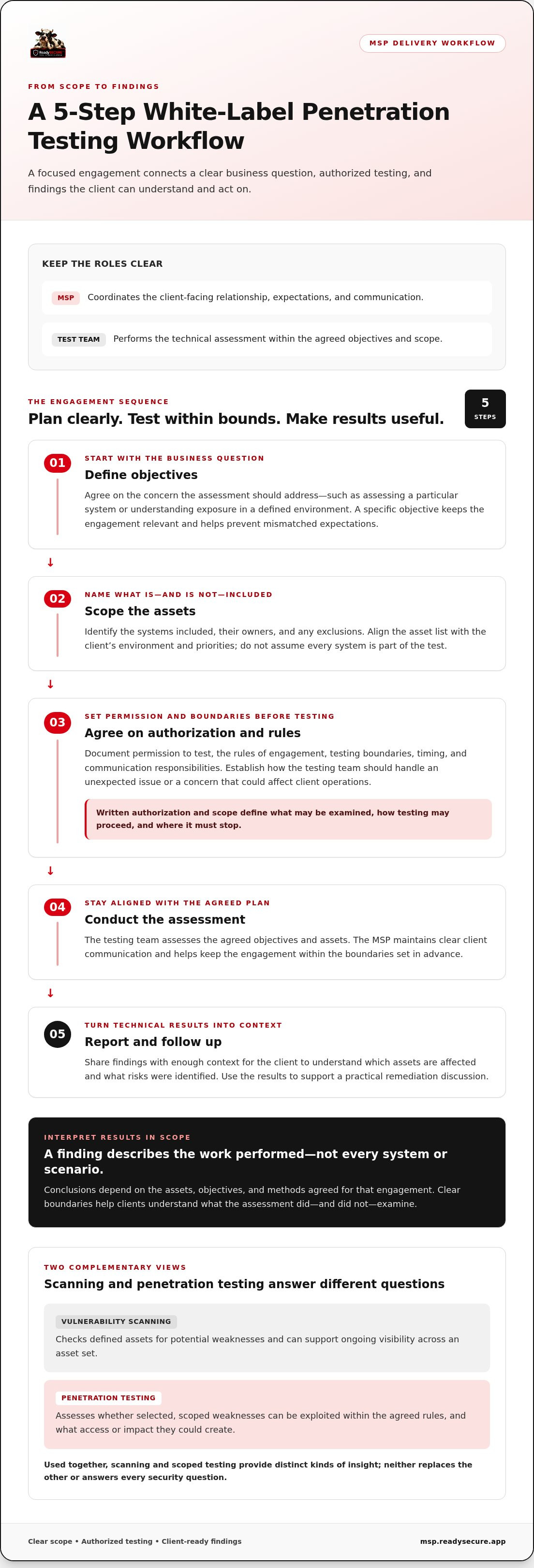
Scope and written authorization define what a penetration test is permitted to examine, how it may proceed, and where it must stop.
Use this sequence to move from planning to useful findings:
- Define objectives. Agree on the business concern the assessment should address. A specific question helps keep the engagement relevant and prevents mismatched expectations.
- Scope assets. Identify the systems included, their owners, and any exclusions. Align the asset list with the client’s environment and priorities, rather than assuming every system is part of the test.
- Agree on authorization and rules. Document permission to test, boundaries, timing, and communication responsibilities. Establish how the testing team should handle an unexpected issue or a concern that could affect the client’s operations.
- Conduct the assessment. The testing team works against the agreed objectives and scope. The MSP helps maintain clear client communication and keeps the engagement aligned with the boundaries set in advance.
- Report and follow up. Share findings with enough context for the client to understand affected assets and risk. Treat remediation discussion as a follow-on activity, not as an assumption that every issue is fixed when the report is delivered.
Turn testing activity into findings and next steps
A useful finding connects the technical issue to the affected asset and explains what was validated during the assessment. Keep verified results distinct from assumptions, general observations, or items outside scope. This helps clients prioritize action without implying that the test examined systems it didn’t cover. After reporting, a separate follow-up can review remediation priorities and clarify what further assessment may be appropriate.
For the MSP, this distinction turns a technical deliverable into a practical client conversation: what was tested, what the evidence shows, and what action the client can consider next. A consistent workflow also makes white label penetration testing for MSPs easier to manage across client engagements, while preserving scope-specific outcomes. MSPs building a coordinated security service can explore ReadySECURE’s MSP security platform alongside on-demand penetration testing.
White-Label Pentesting vs. Building an In-House Team or Reselling Tools
There’s no single delivery model that fits every MSP. The right choice depends on client demand, internal expertise, available capacity, and how consistently you can deliver the service. Compare what each approach asks of your team, and what responsibility stays with you.
| Delivery model | Control | Staffing demands | Service breadth | Engagement ownership |
|---|---|---|---|---|
| In-house team | Direct control over delivery and client coordination | Requires dedicated testing expertise and delivery capacity | Depends on the team’s skills and resources | MSP manages technical delivery and the client relationship |
| White-label specialist | MSP owns the client experience; technical delivery is coordinated with a specialist | Less need to build testing capability internally, but oversight remains essential | Can extend the offering through specialist delivery | MSP leads the client relationship; technical responsibilities are defined for the engagement |
| Tool resale | Control over how the tool is presented and incorporated into services | Requires staff to configure, interpret, and communicate results | Bound by the tool’s capabilities and the MSP’s expertise | MSP owns the client relationship and tool-led service |
A tool can support security work, but reselling access alone doesn’t create a complete penetration-testing service. The engagement also needs a defined objective, authorized scope, technical execution, interpretation of results, and clear client communication. Without those elements, a tool’s output shouldn’t be presented as proof that a scoped penetration test took place.
When does a specialist delivery partner fit an MSP?
A specialist model may suit an MSP whose clients want testing but whose team lacks the expertise or capacity to deliver it consistently in-house. It can extend the security offering without transferring away the MSP’s responsibility for client context and communication. The MSP still helps frame the client’s objective, coordinate expectations, and connect findings to relevant security priorities.
White label penetration testing for MSPs can also give an MSP room to build demand before investing in an internal team. But it isn’t a hands-off arrangement. Someone must coordinate the relationship, keep the client informed, and make sure the engagement fits the agreed scope. If client demand grows and internal capability develops, the MSP can reassess its delivery mix.
Where do scanning and other security services fit?
Vulnerability scanning and penetration testing answer related but different questions. Scanning helps identify potential weaknesses across defined assets. A scoped penetration test assesses whether selected weaknesses can be exploited. Neither replaces the other, and a point-in-time test doesn’t provide ongoing vulnerability management.
Use the findings to inform the next client conversation, not to imply broader coverage than the assessment supports. A validated issue may prompt remediation planning or a discussion about related security and compliance priorities. Ongoing vulnerability management can then help the MSP maintain visibility as the environment changes. The strongest model is the one that fits your maturity and client demand, while keeping each service’s purpose clear.
Build a Repeatable MSP Workflow for Client Communication and Remediation
A penetration test creates value when the client knows what to expect before testing and what to do after the findings arrive. A repeatable communication process reduces confusion, keeps the right people involved, and helps turn technical results into managed work. It also makes the MSP’s role clear without suggesting that testing removes risk or guarantees a particular security outcome.
Prepare clients and internal teams before testing
Brief the client on the assessment’s purpose and agreed scope, planned timing, communication approach, and stakeholder responsibilities. Internally, coordinate the account team and any MSP staff who support the affected environment. Record key decisions, operational considerations, and escalation contacts in the engagement process so the client and testing team have a shared reference point.
- Confirm the purpose and boundaries. Restate the agreed objective, included systems, exclusions, and any relevant timing constraints.
- Identify the people involved. Name the client contact, MSP coordinator, technical stakeholders, and escalation contacts, along with their responsibilities.
- Set communication expectations. Agree how updates will be shared and who should receive them. Clarify how an unexpected issue or concern should be raised.
- Align internal teams. Give relevant MSP staff enough context to understand the engagement and route questions without disrupting the agreed process.
Keep the briefing practical. For example, explain that a finding applies to the asset and conditions described in the assessment, not automatically to every system in the client’s environment. That distinction protects accuracy and gives everyone a common basis for discussing results.
Make findings actionable after the assessment
Present each finding with its technical basis, affected asset, and business context. Explain what the evidence supports, what the potential impact could mean for the client, and which next action is recommended. Preserve technical detail; translate it rather than watering it down. If an issue is an observation or an assumption rather than a validated finding, label it accordingly.
A report creates value when each finding leads to an owned action, a clear priority, and a way to track progress.
Use a follow-up review to turn the report into a working remediation plan. For each agreed action, record:
- Owner: who is responsible for coordinating or completing the action.
- Priority: how urgently to address it, based on the documented risk and the client’s operational context.
- Status: what has been agreed, what is underway, and what remains open.
- Next review: when the MSP and client will revisit progress or discuss further assessment needs.
Priorities should reflect evidence and business context, not a promise that completing a list will eliminate risk. A clear review cadence keeps responsibility visible and gives the MSP a structured basis for ongoing security and remediation conversations. To put that workflow alongside coordinated MSP security services, explore ReadySECURE’s MSP platform.
Extend Your MSP Security Offering with ReadySECURE
Penetration testing is most useful as part of a broader security service, not a replacement for ongoing security work. ReadySECURE provides on-demand penetration testing alongside an MSP-focused, multi-tenant security platform. This gives MSPs a way to connect a focused assessment with services that support clients’ continuing security and compliance conversations.
Connect penetration testing to a broader MSP security service
A penetration test offers a focused assessment within its agreed scope. Vulnerability management supports ongoing visibility into potential weaknesses. Keep the roles distinct: a test doesn’t replace continuous vulnerability management, and vulnerability management doesn’t automatically validate whether a scoped weakness can be exploited.
ReadySECURE brings together vulnerability management, Microsoft 365 security, mail security, and compliance. These capabilities can help an MSP place test findings in a wider client context. For example, a finding may prompt a discussion about remediation priorities or a related security or compliance concern. The right follow-up depends on the assessment evidence and the client environment. Define each engagement’s test methods, report format, and expected outcomes as part of its scope.
Expert-led vCISO support and incident response add further options to the service mix. Together, these capabilities can help an MSP connect assessment findings to strategic security discussions and incident-related needs, while keeping the purpose of each service clear.
Explore the ReadySECURE MSP platform
Managing security across multiple client environments calls for a service model that can support consistent oversight and communication. ReadySECURE’s multi-tenant platform is designed for MSP resale and includes white-label reporting tools. Alongside on-demand penetration testing, it brings together vulnerability management, Microsoft 365 security, mail security, and compliance in an MSP-focused offering.
This combination can support a more coordinated client conversation: use testing to examine a defined scope, connect relevant findings to broader security priorities, and use ongoing services to support continuing work. The platform’s capabilities don’t change the boundaries of an individual test. They give the MSP a broader service context for discussing what the assessment found and what the client may address next.
- Use penetration testing for a focused, scoped assessment.
- Use vulnerability management to support ongoing visibility into potential weaknesses.
- Connect related services to wider Microsoft 365, mail security, and compliance conversations.
- Bring in expert-led support through vCISO services or incident response when relevant.
For MSPs assessing white label penetration testing for MSPs as part of a broader security offering, map the service to your client workflow: define where testing fits, how findings connect to existing services, and how your team will communicate follow-up. Explore ReadySECURE for MSPs to see how its platform and on-demand penetration testing can fit your service model.
Make Your Next Security Move Count
Make white label penetration testing for MSPs a deliberate part of your service strategy. Decide which client needs it, how it fits alongside your existing security work, and how your team will carry the conversation from assessment to action. Those choices give you a practical foundation for growing the offering at a pace that fits your business.
ReadySECURE brings together an MSP-focused, multi-tenant security platform built for resale with on-demand penetration testing. Expert-led vCISO support and incident response can also complement the services you deliver, helping you shape a broader security offering around client needs.
Map the service to your client workflow and explore ReadySECURE’s MSP security platform.
Frequently Asked Questions
What is white-label penetration testing for MSPs?
White-label penetration testing for MSPs lets an MSP present testing as part of its own client offering while ReadySECURE provides on-demand penetration testing. The MSP remains central to the client relationship, setting context and coordinating communication; technical delivery responsibilities are defined separately. Scope and deliverables depend on the engagement. For example, a test focused on one client system shouldn’t be presented as an assessment of the client’s entire environment.
How does white-label penetration testing differ from vulnerability scanning?
Vulnerability scanning identifies potential weaknesses across defined assets, while penetration testing assesses whether selected weaknesses can be exploited within an agreed scope. A scan might flag a possible issue on a server; testing can examine that issue further, if the server is in scope and the rules permit it. Use scanning to support broader discovery and testing to investigate defined risks. Together, they provide different, complementary views rather than interchangeable results.
Can an MSP offer penetration testing without building an in-house testing team?
Yes. An MSP can include ReadySECURE’s on-demand penetration testing in its client offering without staffing every technical testing role internally. The MSP still owns important parts of the service: explaining why the client needs the test, providing environment context, setting expectations, coordinating communication, and guiding follow-through. For example, the MSP can help connect a finding to the client’s operational priorities while technical testing is delivered as part of the service.
What should an MSP define before a penetration test begins?
Define the objective, written authorization, in-scope assets, exclusions, rules of engagement, timing, contacts, and communication plan. Be specific: identify the system being assessed, name any connected assets that are out of scope, and document who receives updates or escalations. Agree how results will be shared and who will participate in the review. This preparation gives the client and testing team a common reference before assessment activity starts.
How should MSPs present penetration-test findings to clients?
Describe the affected asset, what the assessment validated, why the issue may matter to the client, and the recommended next action. Prioritize using documented risk and business context, then assign an owner and track progress. Keep confirmed findings distinct from assumptions or general observations. For example, state that a specific weakness was demonstrated on an in-scope system, rather than implying that the same issue exists across untested systems.
Does penetration testing replace ongoing vulnerability management?
No. Penetration testing assesses selected weaknesses within a defined scope, while vulnerability management supports ongoing discovery, prioritization, and remediation across client environments. A test can investigate whether a scoped weakness is exploitable; vulnerability management helps the MSP maintain visibility as assets and conditions change. Use both where they fit the client’s needs. A completed test doesn’t provide continuous coverage, and ongoing scanning doesn’t automatically validate exploitability.


