

Auditing cloud configurations without direct multi-tenant enforcement is a labor trap that quietly drains your margins. When weighing Augmentt vs Liongard for M365 posture management, most MSP leaders ask which tool logs more alerts. That's the wrong target. The real battle is choosing an engine that stops unbillable engineering churn and protects your bottom line.
You already know the drag of logging into separate client portals just to verify basic baseline policies. Point tools that report configuration drift without remediating it only create ticket backlogs, leaving senior technicians stuck doing repetitive cleanup instead of high-value billable projects.
This guide evaluates Augmentt and Liongard head-to-head on tenant posture management to help you lock in the most profitable operational model. We compare their underlying architectures, deep remediation capabilities, and MSP packaging models so you can turn routine Microsoft 365 governance into a repeatable, high-margin recurring revenue stream.
Key Takeaways
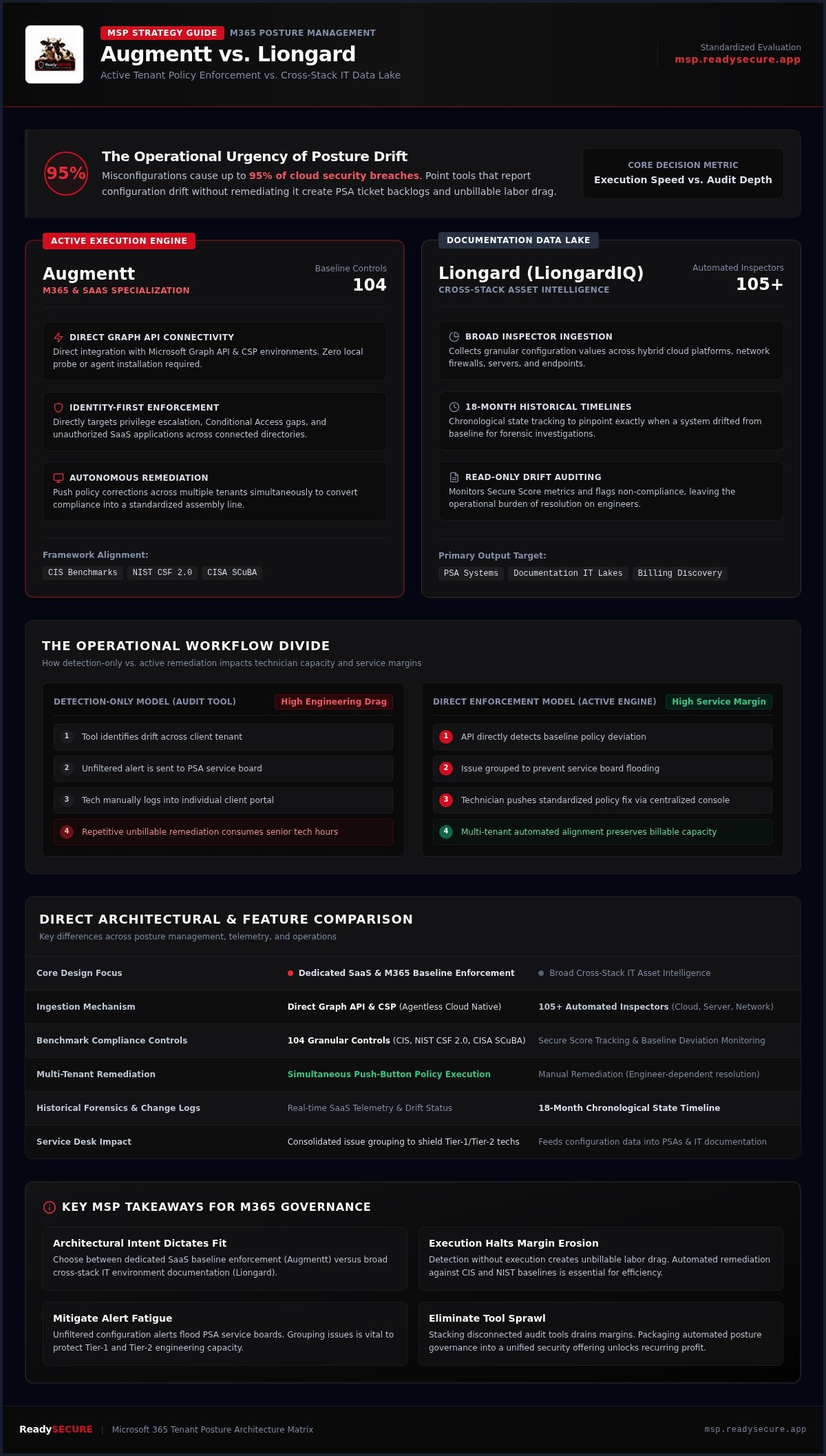
- Choosing Augmentt vs Liongard for M365 posture management comes down to architectural intent: dedicated SaaS baseline enforcement versus broad, cross-stack IT environment visibility.
- Detection without execution creates unbillable labor drag, making automated remediation against CIS and NIST baselines essential for operational efficiency.
- Unfiltered configuration alerts quickly flood PSA service boards, requiring consolidated issue grouping to protect tier-1 and tier-2 engineering time.
- Stacking disconnected audit tools erodes service margins, whereas packaging automated posture governance into a unified security offering unlocks recurring profit.
Architecture Breakdown: Augmentt vs Liongard for M365 Posture Management
Tool architecture dictates engineering velocity. Choose the wrong underlying structure, and your service desk spends hours navigating clunky interfaces instead of closing tickets. When evaluating Augmentt vs Liongard for M365 posture management, you aren't just comparing feature checklists. You are choosing between an active execution engine and a passive documentation warehouse.
Your technicians need speed. Every manual click through client tenants drains billable capacity. Aligning your stack with established configuration management principles requires knowing whether your primary operational goal is remediating security posture or logging configuration changes for audit trails.
Augmentt Architectural Focus: M365 and SaaS Specialization
Augmentt takes an API-native approach built specifically around cloud applications. It communicates directly with Microsoft Graph API and CSP environments without requiring cumbersome agent installs. Its design centers on three operational pillars:
- Direct Graph connectivity: Pulls real-time tenant telemetry instantly without relying on local probe infrastructure.
- Identity-first enforcement: Targets privilege escalation, Conditional Access gaps, and unauthorized SaaS applications across connected directories.
- Lightweight footprint: Operates entirely in the cloud, allowing service teams to stand up posture oversight across multiple tenants within minutes.
This narrow focus turns Augmentt into a rapid execution surface. Technicians log in, review security baselines, and push policy corrections across tenants without jumping through on-premises infrastructure hurdles.
Liongard Architectural Focus: Deep Cross-Stack Asset Intelligence
Liongard prioritizes full-stack visibility over narrow SaaS execution. Branded as LiongardIQ, it uses over 105 automated inspectors across cloud platforms, network firewalls, servers, and endpoints. It functions as an IT estate data lake, capturing daily configuration states across your entire client base.
- Inspector-driven ingestion: Collects granular configuration values across hybrid cloud and on-premise hardware.
- 18-month historical timelines: Tracks state changes chronologically, proving exactly when a system drifted from baseline.
- Broad asset telemetry: Feeds critical change data into PSAs and documentation systems for billing reconciliation and discovery.
Liongard treats Microsoft 365 as one data source among dozens. It delivers exceptional forensic history and asset tracking, but it stops short of acting as a dedicated, cloud-first security engine. Deciding between Augmentt vs Liongard for M365 posture management hinges on this trade-off: do you need an active tenant intervention tool, or an enterprise-wide asset documentation lake?
Configuration Auditing vs Active Remediation: The Core Feature Showdown
Misconfigurations cause up to 95% of cloud security breaches. Finding those vulnerabilities is only half the battle. Fixing them without burning expensive engineering hours is where your service margins survive or die. The real test in evaluating Augmentt vs Liongard for M365 posture management lies in the operational gulf between read-only drift inspection and autonomous baseline remediation.
Baseline Hardening: CIS and Microsoft Secure Score Alignment
Standardizing security controls across disparate client environments demands recognized benchmarks. Augmentt evaluates tenants against 104 granular technical controls mapped directly to CIS benchmarks, NIST CSF 2.0, and the CISA Secure Cloud Business Applications (SCuBA) baselines. Its policy engine lets technicians enforce standardized configurations across multiple tenants simultaneously, turning compliance into an operational assembly line.
Liongard excels at broad asset telemetry, tracking baseline deviations over time through its automated inspectors. It monitors Secure Score metrics and flags non-compliant configurations reliably. However, it approaches baselines primarily as an auditor rather than an active enforcer. You gain total visibility into where your tenants fail to meet compliance benchmarks, but your engineering staff still bears the operational burden of resolving those gaps.
The Remediation Divide: Push-Button Action vs Alert Generation
Alerts don't fix posture. Execution fixes posture. The fundamental operational friction in MSP service delivery stems from tools that flag errors without providing a direct path to resolve them:
- Ticket generation vs resolution: Liongard identifies configuration drift and pushes tickets to your PSA. Technicians must open client tenants manually, verify access, and apply changes line by line. Liongard introduced automated fixes through its RemediateIQ beta, but deep tenant-wide remediation remains outside its core architecture.
- Bulk multi-tenant execution: Augmentt allows engineers to fix failing controls across every non-compliant tenant with a single console action. This eliminates repetitive administrative overhead and cuts configuration drift response times from hours to minutes.
- Labor overhead: Toggling between vendor consoles and individual Microsoft 365 admin centers burns billable hours. A technician handling manual drift checks across 20 tenants easily loses a full workday each month just executing routine fixes.
Discovery without execution creates unbillable service desk drag. When structuring your service offerings, pairing baseline auditing with an integrated multi-tenant Microsoft 365 security platform ensures policy enforcement protects engineering capacity instead of burying it under change tickets.
Operational Workflows: Alert Fatigue, Reporting, and Daily MSP Usability
Daily operational friction kills MSP profitability faster than bad pricing. When your service desk spends half its shift triaging notifications, labor costs spike and customer satisfaction collapses. Comparing Augmentt vs Liongard for M365 posture management requires looking past feature matrices to evaluate how each platform impacts your daily ticketing rhythm and tier-1 service capacity.
Every alert sent to your PSA must demand action. If an alert simply confirms that something changed without requiring engineering intervention, it is noise. Managing that noise determines whether your technicians protect critical baselines or ignore alerts altogether.
Filtering the Signal: Managing Configuration Change Noise
Liongard captures massive amounts of system state telemetry. Its inspectors detect minute configuration adjustments, from mailbox forwarding tweaks to updated user profile attributes. Without precise alert tuning via custom expressions, this deep visibility floods service boards. Tier-1 technicians find themselves triaging hundreds of tickets that reflect harmless operational updates rather than active security risks.
Augmentt approaches alerting through a narrower, threat-oriented lens. It focuses alerts primarily on high-impact identity events, MFA status changes, and deviations from the CIS Microsoft 365 Foundations Benchmark. Technicians receive alerts grouped by policy failure across tenants instead of a raw feed of disparate configuration changes. This targeted filtering keeps tier-1 focus locked on genuine posture failures rather than routine administrative activity.
Demonstrating Value: QBR Dashboards and Client Deliverables
Executive reporting turns technical labor into retained revenue. If you cannot show your clients why baseline posture management matters, they will treat it as a line-item expense ripe for cutting:
- Strategic compliance scorecards: Augmentt delivers visual, client-ready reports that grade tenants against recognized frameworks. These dashboards let account managers prove baseline hardening progress directly to stakeholders during Quarterly Business Reviews.
- Granular forensic documentation: Liongard provides deep chronological change logs and configuration histories. These detailed records excel during cyber insurance audits, compliance certifications, and billing reconciliation reviews where auditors demand proof of historical state.
- Packaging recurring compliance: Both tools generate audit trails, but your presentation dictates your margins. Transforming raw posture data into branded, executive-level summaries positions your MSP as an indispensable strategic advisor rather than a reactive IT mechanic.
Choosing the right tool comes down to daily operational tempo. Augmentt optimizes your board for immediate policy compliance, while Liongard delivers the forensic paper trail required for cross-stack environment accountability.
The Hidden Costs: Tool Sprawl, Labor Overhead, and Margin Erosion
Software licensing is only the surface cost of your security stack. The real financial drain happens underneath, driven by operational drag, engineer context-switching, and disconnected vendor subscriptions. When weighing Augmentt vs Liongard for M365 posture management, you must evaluate total operational overhead, not just the monthly vendor invoice.
Every isolated portal you hand your engineering team introduces unbillable hours. Technicians jump between separate tabs for SaaS baselines, infrastructure audits, patch tracking, and email protection. That constant fragmentation destroys service gross margins.
The Problem with Point Tools: Fragmented Portals and Vendor Stack Creep
Point solutions promise rapid fixes for discrete gaps, but stacking them creates operational gridlock. Deploying a dedicated tool solely for Microsoft 365 configuration auditing leaves critical blind spots across the rest of the attack surface:
- Subscription bloat: Purchasing isolated SaaS governance tools alongside separate scanners for vulnerability management and mailbox defense multiplies licensing commitments across your client base.
- Context-switching penalties: Tier-2 engineers waste hours reconciling alerts between divergent dashboards that fail to share threat context or risk scoring.
- Fragmented service delivery: Operating multiple narrow consoles complicates technician onboarding, inflates standard operating procedures, and slows resolution times during critical security incidents.
When you maintain isolated point systems, posture management becomes an administrative tax rather than a profitable service tier.
White-Label Branding: Positioning Your MSP as the Security Authority
Client loyalty depends on perceived enterprise value. When an MSP delivers reports plastered with third-party vendor watermarks, it advertises the underlying software instead of showcasing its own technical mastery. True white-labeling transforms routine baseline compliance into proprietary intellectual property.
Custom-branded posture scorecards reinforce your authority during executive reviews. Instead of appearing as a reseller marking up commercial point tools, your firm presents a bespoke, unified security service. This positioning lets you defend premium retainers and command higher recurring contract values.
Stop letting point tools chew up your operational capacity and dilute your client relationships. Consolidate your security stack with ReadySECURE to unify multi-tenant Microsoft 365 security, vulnerability management, and executive compliance reporting under your own brand.
Consolidating the Stack: Elevating M365 Posture Beyond Isolated Audits
Modern security posture does not stop at Microsoft 365 tenant boundaries. A hardened tenant running CIS baselines means little if unpatched workstations or rogue mail rules sit adjacent to it. Framing your tooling decision as strictly Augmentt vs Liongard for M365 posture management limits your operational perspective. The real competitive advantage comes from eliminating isolated point products altogether.
Security delivery breaks down when telemetry remains siloed. Unifying tenant configuration oversight with proactive scanning protects engineering capacity and eliminates the blind spots that fragmented stacks leave wide open.
Unified Telemetry: Bridging Cloud Hardening and Vulnerability Management
Microsoft 365 misconfigurations represent only one operational vector. When identity drift occurs alongside an unpatched network exploit, disjointed tools fail to flag the compound risk. Aligning Microsoft 365 Security with active Vulnerability Management gives your technicians complete visibility across identity and infrastructure.
Reviewing insights from a white label security platform for MSPs reveals why consolidation wins. Single-pane governance allows technicians to triage vulnerabilities alongside identity misconfigurations without swapping consoles. This structural integration turns disconnected posture audits into a focused remediation pipeline.
Building High-Margin Recurring Security Revenue with ReadySECURE
ReadySECURE replaces multi-tool sprawl with a unified operational engine built specifically for MSP growth. Instead of juggling point solutions that drive up licensing costs, you gain complete multi-tenant control from a single interface:
- All-in-one governance: Combines Microsoft 365 Security hardening, Vulnerability Management, Mail Security, and Information Security GRC within one console.
- High-margin compliance packaging: Eliminates stacked per-tenant subscription costs, allowing you to wrap baseline security into a profitable, recurring compliance service.
- Proprietary white-label reporting: Delivers polished, executive-level reports under your own brand to cement client trust and support higher retainer pricing.
- Enterprise-grade escalation: Provides on-demand access to vCISO Support and Incident Response teams to help you close and retain complex client accounts.
Choosing between Augmentt vs Liongard for M365 posture management highlights the trade-off between dedicated cloud remediation and broad asset inspection. ReadySECURE solves this puzzle by pairing multi-tenant baseline hardening with full-spectrum vulnerability management and compliance governance. Schedule a platform walk-through today to streamline your operations and expand your service margins.
Scale Your Managed Security Margins and Eliminate Stack Sprawl
Choosing between Augmentt vs Liongard for M365 posture management comes down to your primary operational goal. Liongard delivers comprehensive historical state tracking across your entire hybrid estate. Augmentt provides fast, targeted cloud baseline enforcement. Yet deploying either system as an isolated point tool forces technicians to juggle disconnected portals and bleeds billable hours.
Sustainable growth requires eliminating stack fragmentation. ReadySECURE combines Microsoft 365 hardening, vulnerability management, and information security GRC within a single multi-tenant console. Equipped with a 100% white-label reporting engine, you preserve your brand authority, establish deep client trust, and package continuous posture management into an elite, recurring compliance service.
Stop trading technician capacity for manual alert triaging. Consolidate your security stack and claim higher margins with ReadySECURE to build a resilient, high-yield security practice today.
Frequently Asked Questions
Is Augmentt or Liongard better for enforcing Microsoft 365 security baselines?
Augmentt is better suited for direct baseline enforcement, while Liongard excels at tracking historical configuration changes. Augmentt connects natively via Microsoft Graph API to apply and lock down standardized CIS policies across multiple tenants simultaneously. Liongard audits state changes across broader infrastructure, but its remediation capabilities are more limited. When evaluating Augmentt vs Liongard for M365 posture management, choose Augmentt if your engineers need push-button enforcement rather than deep estate-wide documentation.
Can Liongard automatically fix M365 configuration drift when detected?
Historically, Liongard operated as a read-only audit engine that pushed alerts into your PSA for manual intervention. With its RemediateIQ module, Liongard introduced automated fixes for specific identity hygiene risks like missing MFA or disabled users holding active licenses. However, broad, one-click baseline remediation across entire M365 tenants is not its primary focus. Technicians still handle most complex tenant drift manually inside individual Microsoft admin portals.
How does Augmentt handle multi-tenant M365 policy templates?
Augmentt uses a centralized policy engine mapped directly to frameworks like CIS Foundations and CISA SCuBA. Technicians create or customize baseline templates once and push them across every connected tenant from a single screen. When drift occurs or a new benchmark requirement is introduced, engineers can execute a bulk fix across all failing tenants at once. This multi-tenant template structure cuts administrative setup time down to minutes.
Why do MSPs experience alert fatigue with automated M365 monitoring tools?
Alert fatigue happens when tools trigger tickets for benign configuration updates rather than verified security risks. Deep inspectors track every minute attribute modification, from routine user profile edits to mailbox forwarding rules. Without strict threshold filtering, this flood of non-critical telemetry swamps PSA boards. Tier-1 technicians burn hours sorting routine changes from actual policy breaches, which slows response times and increases the risk of missing critical threats.
What is the difference between read-only posture auditing and active posture management?
Read-only posture auditing detects and logs misconfigurations, generating reports or tickets that require human intervention to fix. Active posture management combines continuous auditing with direct policy enforcement and remediation. Instead of saddling your service desk with manual repair tickets, an active management engine enforces baselines automatically or allows technicians to resolve failures across tenants with a single click, protecting billable engineering capacity.
How does stack consolidation improve MSP gross profit margins on security services?
Consolidating your stack eliminates overlapping vendor software subscriptions and cuts unbillable technician labor. Operating isolated point tools for M365 posture, vulnerability management, and mail defense drains engineering hours through constant context-switching. A unified platform reduces per-seat licensing costs, streamlines onboarding, and packages posture management with comprehensive vulnerability oversight into a single high-margin recurring compliance service that commands higher retainer rates.
Can I white-label M365 posture management reports under my MSP brand?
Augmentt provides executive reporting options, but some point platforms still display vendor watermarks that dilute your brand authority. Consolidating with a platform like ReadySECURE delivers fully white-labeled reporting across Microsoft 365 security, vulnerability management, and information security GRC. Presenting proprietary, co-branded compliance scorecards proves direct business value to clients during QBRs, turning routine posture audits into a premium service that elevates your market presence.


