

Configuration tracking isn't an administrative tax; it's the most overlooked recurring revenue engine in your stack. Yet, too many IT leaders still treat multi-tenant security posture management for msps as a defensive burden. Technicians burn billable hours manual-swapping between isolated client admin portals, chasing silent configuration drift, and hoping an overlooked setting won't trigger a compliance failure. It's inefficient, unscalable, and quietly bleeds operational margins.
You already know that portal fatigue and fragmented per-user licensing kill technician efficiency while holding back your high-tier security offerings. In this guide, we compare the top posture management platforms for 2026 and reveal the ideal high-margin alternative for configuration tracking. You'll learn how to enforce unified baselines across every managed environment, produce white-label compliance reporting, and convert routine posture management into a profitable service tier without hiring additional senior engineers.
Ahead, we break down how the market leaders stack up on architecture, drift remediation, and bottom-line impact so you can scale your practice with total command.
Key Takeaways
- Eliminate portal fatigue by centralizing baseline governance, automated drift remediation, and client auditing within a single operational command plane.
- Discover how modern multi-tenant security posture management for msps transforms routine configuration audits into a scalable, high-margin monthly security deliverable.
- Evaluate the leading 2026 posture tools across multi-tenant visibility, drift control, deployment speed, and technician overhead to uncover the best fit for your stack.
- Leverage automated white-label compliance reporting and on-demand professional services to unlock executive-tier vCISO revenue without adding engineering headcount.
Why Multi-Tenant Security Posture Management Governs MSP Scalability in 2026
Manual audits are dead. Quarterly reviews cannot keep pace with continuous cloud updates, permission changes, and identity compromises. True multi-tenant security posture management for msps replaces snapshot spot-checks with real-time configuration oversight and automated baseline control. Built on modern software multitenancy architecture, an effective command platform lets service providers govern hundreds of customer tenants through one central engine. It isolates customer data while aggregating policy enforcement, turning complex administration into a standardized operational machine.
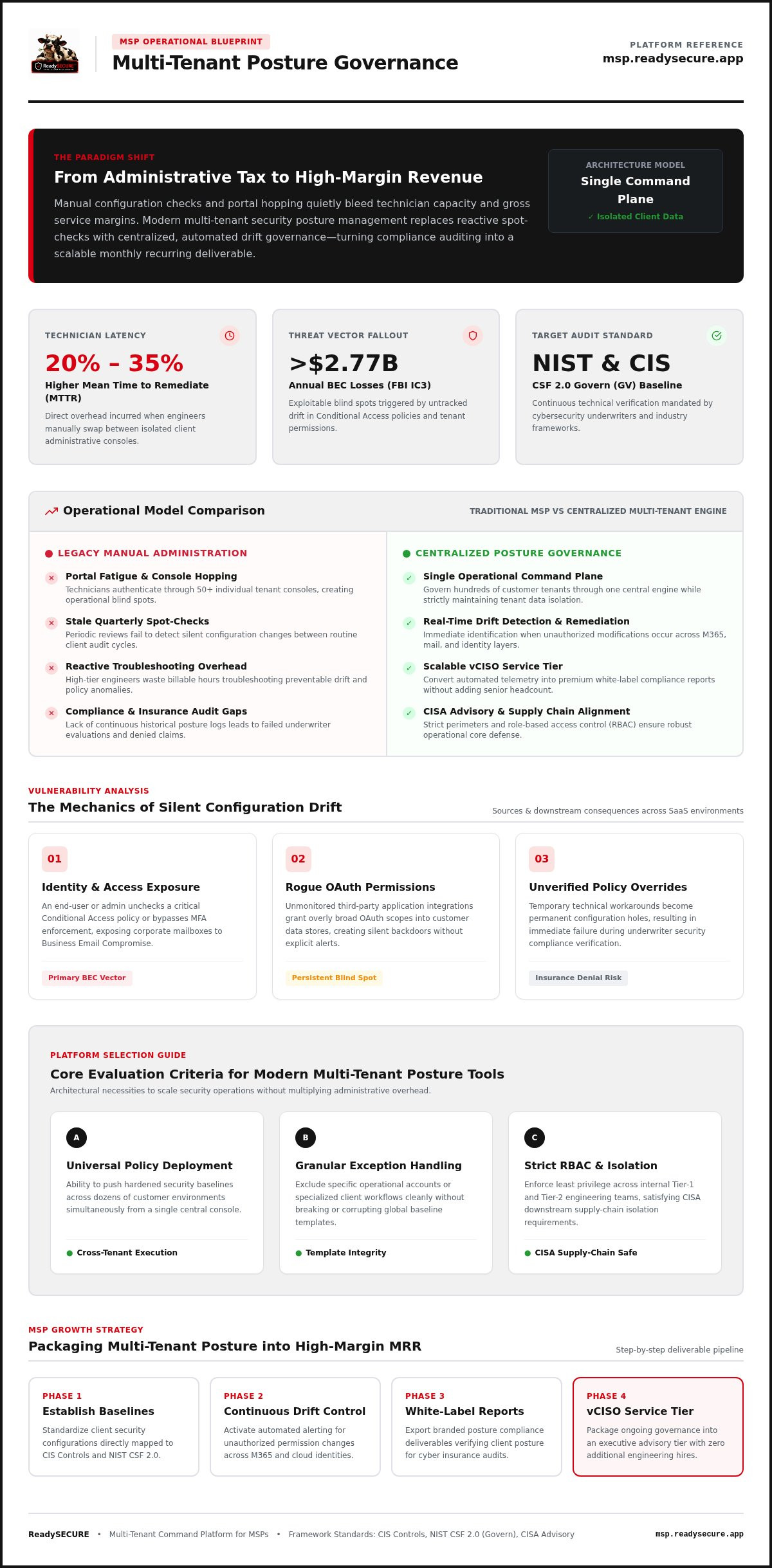
Fragmented point solutions bleed technician time. Logging into fifty distinct customer portals creates blind spots, slows incident response, and spikes labor costs. Research indicates technicians manual-swapping between admin consoles experience 20% to 35% higher Mean Time to Remediate (MTTR). Centralized posture management eliminates this friction, transforming a chaotic support desk into an organized delivery engine.
The Hidden Cost of Configuration Drift Across Multiple Client Environments
Configuration drift represents an immediate, high-risk breach vector across SaaS, identities, and endpoints. A single end user unchecks a Conditional Access policy. A rogue admin grants broad OAuth permissions to an unsanctioned application. These unmonitored changes accumulate silently:
- Exploitable blind spots: Drift leaves mailboxes exposed to Business Email Compromise (BEC), which accounted for over $2.77 billion in losses in FBI IC3 reports.
- Wasted engineering hours: Technicians burn billable time chasing unexplained anomalies caused by inconsistent client configurations.
- Audit and insurance failures: Underwriters now demand continuous technical verification. Untracked drift results in failed compliance audits and denied insurance claims.
From Reactive IT Troubleshooting to Continuous Posture Governance
Reactive firefighting destroys service margins. When your team merely responds to tickets, you absorb the financial burden of routine maintenance. Shift your operational model to continuous posture governance. Lock down standardized client security baselines mapped directly to CIS Controls and NIST CSF 2.0, which added the critical Govern (GV) function to enforce organizational oversight.
Automate baseline enforcement across Microsoft 365, mail configurations, and identity frameworks. When unauthorized modifications occur, your system detects and flags the violation immediately. You protect client infrastructure before incidents happen, eliminate unnecessary ticket escalations, and protect gross margins across every managed account.
Core Evaluation Criteria for Modern Multi-Tenant Posture Management Tools
Selecting the right platform dictates whether your security practice scales profitably or collapses under administrative overhead. Modern multi-tenant security posture management for msps requires more than basic alerting. You need absolute operational control. A high-performing engine must ingest configuration state, evaluate baseline deviations without generating alert fatigue, and convert raw posture telemetry into immediate, billable proof.
Adhering to strict architectural standards is essential. As outlined in the joint CISA cybersecurity advisory for MSPs, managing downstream client environments introduces systemic supply-chain exposure if administrative access and tenant perimeters lack stringent isolation. Your tooling must secure your operational core while keeping clients cleanly segregated.
Granular Multi-Tenant Architecture vs. Aggregated Dashboard Views
Superficial dashboards that merely summarize alerts across accounts fall short. You need true multitenancy. That means robust logical data isolation paired with cross-tenant policy execution:
- Universal policy deployment: Push hardened security baselines across dozens of customer environments simultaneously.
- Granular exception handling: Exclude specific operational accounts or specialized tenant workflows without breaking global baseline templates.
- Role-based access control (RBAC): Enforce least privilege within your internal tier-1 and tier-2 engineering teams to prevent configuration errors.
Holistic Stack Coverage: Cloud Identities, Endpoints, and Mail Security
Most commercial posture tools suffer from a fatal flaw: they isolate cloud configurations from broader system vulnerabilities. Hardening Microsoft 365 identity settings means little if unpatched endpoint vulnerabilities expose admin sessions, or if unmonitored mailbox rules enable credential harvesting.
Demanded by 2026 threats, holistic posture management unites identity baselines, mailbox security settings, and underlying operating system vulnerabilities. When your team evaluates overall client posture, you need an integrated view spanning M365 policies, mail configurations, and endpoint risk within a single pane of glass.
Automated Evidence Collection and Actionable Compliance Readiness
Compliance preparation remains a massive sink of engineering time. Platforms must automate evidence collection continuously rather than forcing staff to assemble manual screenshots for audits. Multi-tenant configuration checks must map automatically to governing frameworks, including HIPAA, ISO standards, and CMMC Level 2 requirements ahead of the November 10, 2026 phase 2 third-party certification deadline.
High-margin delivery hinges on packaging this telemetry effectively. Delivering clear, branded reports allows your firm to run a scalable white label security platform for MSPs that justifies recurring advisory fees. If your goal is total operational efficiency across audits and posture tracking, explore how ReadySECURE multi-tenant management consolidates these critical governance controls into one frictionless console.
Comparing the Top Multi-Tenant Security Posture Management Alternatives
Every platform approaches posture from a distinct angle, but not all protect your margins. Native utilities like Microsoft 365 Lighthouse offer zero-license cost for CSP partners, yet cap baseline deployment at customer tenants with 2,500 licensed users. Community-driven platforms like CIPP provide scriptable M365 execution, while Liongard focuses on eighteen months of historical configuration tracking. Augmentt audits shadow AI and SaaS sprawl across thousands of applications. However, choosing the right multi-tenant security posture management for msps demands looking beyond single-purpose features to evaluate total stack efficiency.
Feature Breakdown: Tracking Depth, Drift Remediation, and Automation
Snapshot-based scanners alert you to drift hours after it happens. That's too slow. Modern security management requires real-time configuration tracking paired with active drift control. Platforms must distinguish between deliberate client changes and unauthorized deviations. Demand cross-tenant bulk remediation. When a policy slips, your technicians shouldn't log into twenty consoles to fix it. One-click remediation across every tenant stops configuration drift instantly and cuts ticket escalation times.
Stack Consolidation vs. Single-Purpose Configuration Scanners
Single-purpose posture tools worsen software sprawl. Managing separate vendors for SaaS posture, endpoint vulnerability management, mail security, and compliance tracking drains technician focus. It also piles on per-user licensing fees that devour your gross profit. Unified platforms consolidate these disjointed workflows into one command pane. That consolidation reduces cognitive fatigue, eliminates duplicate vendor overhead, and creates a streamlined delivery engine.
White-Label Reporting and Client-Facing Security Posture Scores
Raw configuration telemetry doesn't close contracts. Clear business value does. If your posture tool can't translate technical controls into an intuitive executive score, you can't monetize it. Modern platforms generate automated, white-label proof packs branded entirely under your MSP. Deliver these during Quarterly Business Reviews to prove continuous baseline hardening, demonstrate compliance adherence, and justify premium recurring fees without burning engineering hours.
How to Package and Monetize Multi-Tenant Posture Tracking into High-Margin Services
Stop treating baseline configuration maintenance as an internal overhead expense. Most providers absorb posture audits into their basic operational agreements, effectively giving away high-value technical governance for free. Repositioning your delivery model unlocks substantial monthly recurring revenue. When executed correctly, multi-tenant security posture management for msps acts as a direct profit driver rather than an administrative line item. Package these capabilities into billable tiers that client executives readily fund.
Continuous configuration oversight transforms routine IT maintenance into executive-level risk management. Build structured commercial tiers that anchor technical controls directly to business outcomes, insurance underwriting requirements, and regulatory survival.
Constructing Lucrative Security Tiers Around Continuous Posture Auditing
Structure your service packages to turn configuration governance into an upsell vehicle across your client base:
- Core Managed IT Tier: Bundle foundational identity safeguards, basic endpoint hygiene, and scheduled posture health checks.
- Advanced Security & Compliance Tier: Deliver real-time drift remediation, automated mailbox security monitoring, and continuous technical verification for cyber insurance policies.
- Executive Governance Tier: Include continuous regulatory mapping, policy distribution, and structured audit defense delivered through automated white-label reports.
Use visual baseline tracking to anchor Quarterly Business Reviews. Showing a prospective or current client how their security score systematically improved eliminates contract pushback and defends your recurring retainer.
Unlocking High-Margin vCISO Consulting Without Adding Expensive Headcount
Mid-market clients desperately need strategic cybersecurity leadership, but severe engineering shortages make hiring in-house security analysts cost-prohibitive. Centralized posture intelligence bridges that gap instantly. Instead of drowning in technical weeds, your team leverages aggregated tenant telemetry to lead high-level risk advisory sessions.
Automate governance, risk, and compliance (GRC) workflows by deploying standard policy templates across tenants. When accounts encounter advanced requirements, tap into on-demand professional services for penetration testing, comprehensive vulnerability assessments, and incident response. You capture top-tier consulting margins without taking on permanent payroll liabilities. Ready to transform your security stack into a scalable revenue engine? Explore partner onboarding with ReadySECURE to launch your high-margin posture tiers today.
Scale Your Security Practice with the ReadySECURE Multi-Tenant Command Platform
Channel growth demands operational simplicity and ruthless margin discipline. Piecing together disparate tools for cloud hardening, vulnerability scanning, and compliance tracking guarantees technician burnout and ballooning software overhead. ReadySECURE delivers purpose-built multi-tenant security posture management for msps, consolidating your operational core into a unified command platform. You eliminate tool sprawl, centralize oversight across every client environment, and unlock high-margin recurring security offerings from day one.
Transform technical hygiene into immediate enterprise value. By wrapping posture intelligence in your own brand identity, your MSP positions itself as an indispensable governance authority while driving predictable monthly profitability.
Unified Command: M365 Hardening, Vulnerability Scanning, and GRC in One Console
Fragmented dashboards slow your technicians down. ReadySECURE brings your entire posture surface into one centralized multi-tenant console:
- Multi-vector configuration tracking: Audit Microsoft 365 tenants, enforce mailbox security standards, and surface unpatched operating system vulnerabilities in real time.
- Automated risk prioritization: Target active configuration drift and exploitable flaws without sifting through false positives or non-critical alert floods.
- Centralized policy execution: Enforce standardized baselines across all managed environments simultaneously, eliminating repetitive tenant hopping.
Fast-Track Deployment with Expert Professional Support
Building high-tier cybersecurity offerings typically requires months of operational prep and rare, expensive talent. ReadySECURE eliminates those barriers. Deploy standardized governance baselines instantly, backed by automated, white-label client reports that prove regulatory alignment and secure recurring retainer approvals.
When clients present complex regulatory mandates or high-risk requirements, scale your delivery using integrated on-demand expert services. Access specialized vCISO support, penetration testing, and incident response readiness without hiring permanent senior analysts. You deliver elite security capabilities under your own brand, protect your partners' environments, and scale top-line service revenue with complete operational command.
Take Command of Your Security Posture and Margins
Manual tenant checks and fragmented portals don't just waste engineering hours; they cap your firm's growth. Mastering multi-tenant security posture management for msps is your fastest route to operational scale. Standardize your client baselines. Automate drift control. Turn tedious administrative maintenance into predictable monthly recurring revenue.
You don't need a bloated vendor stack or an inflated payroll to deliver enterprise governance. Consolidate vulnerability management, M365 hardening, and GRC tracking into one unified console. Generate turnkey, white-label reporting that immediately proves value to client stakeholders and justifies your recurring retainers. When specialized client demands arise, deploy on-demand expert services like vCISO support and incident response under your own banner.
Stop reacting to configuration chaos. Own your stack, command your delivery, and capture the margins your team deserves. Scale your MSP security margins with the ReadySECURE multi-tenant platform and build a resilient, highly profitable managed security practice today.
Frequently Asked Questions
What is multi-tenant security posture management for MSPs?
It's a centralized software architecture that enables service providers to monitor, audit, and remediate security baselines across multiple client organizations from a single console. Modern multi-tenant security posture management for msps continuously enforces identity settings, mailbox controls, and device configurations. Instead of logging into separate client tenants manually, technicians govern all accounts collectively while maintaining strict data isolation.
How does multi-tenant configuration tracking stop security drift across clients?
It compares live client environments against pre-approved baseline templates in real time. When an end user disables multifactor authentication, grants rogue application permissions, or alters mailbox routing, the platform detects the deviation immediately. Technicians can either configure automated self-healing policies or deploy cross-tenant bulk remediation commands, closing security exposures before threat actors discover them.
Can posture management tools audit Microsoft 365 tenants and local endpoints together?
Unified platforms audit both vectors simultaneously within a shared data model. While single-purpose SaaS posture utilities only track cloud identity permissions, integrated channel platforms evaluate Microsoft 365 hardening alongside underlying operating system vulnerabilities. This holistic approach prevents blind spots where a compromised local endpoint could otherwise bypass hardened cloud identity controls.
How do MSPs package and monetize security posture management services?
MSPs package posture management by bundling continuous configuration tracking into premium recurring tiers or positioning it as an executive governance deliverable. Embedding automated drift remediation into an advanced compliance plan allows providers to command higher retainers. Providers also monetize one-time posture assessments to audit prospective clients and justify project-based remediation fees.
What is the difference between an RMM tool and a dedicated posture management platform?
Remote Monitoring and Management (RMM) platforms prioritize tactical operational tasks, such as script execution, patch installation, and hardware health tracking. A dedicated posture platform focuses on strategic security governance. It measures configurations against formal security frameworks, audits identity permissions across SaaS environments, and tracks compliance readiness across the client base.
Why is white-label reporting essential for multi-tenant posture management?
White-label reporting reinforces your brand identity while proving the continuous value of your managed security retainers. Delivering professional, branded security summaries during Quarterly Business Reviews translates complex technical configurations into clear risk metrics. This tangible proof demonstrates active risk reduction, answers client executive inquiries, and protects service margins against commoditization.
Can posture management platforms assist clients with regulatory compliance audits?
Yes, by automating continuous evidence collection mapped to standards like NIST CSF 2.0, HIPAA, and CMMC. Instead of spending days pulling manual screenshots for compliance assessors or insurance underwriters, the platform logs historical configuration states and control verifications automatically. This streamlined telemetry allows your team to deliver defensible audit reports with minimal engineering overhead.


