

Configuration drift across dozens of client tenants isn't just an administrative headache; it's a direct leak in your gross margins. When senior engineers spend billable afternoons clicking through disparate admin centers to fix rogue settings, you aren't delivering strategic value; you're absorbing dead labor. Mastering m365 governance for msps flips this dynamic entirely, transforming chaotic portal hopping into an automated, high-margin machine.
You already know the pain of manual oversight. A client-side co-admin disables a baseline setting, an upcoming compliance audit exposes critical blind spots, and your team burns unbillable hours scrambling for historical change records they never had. You don't have to burn technician payroll to maintain tenant integrity. By establishing continuous enforcement, you can eliminate manual drift, audit settings automatically, and package baseline security into recurring compliance revenue that clients actively prioritize.
Here is your blueprint to eliminate manual configuration drift, deliver automated evidence that proves ongoing value, and scale your cloud practice profitably without expanding engineering headcount.
Key Takeaways
- Establish a standardized architecture for m365 governance for msps across identity, endpoints, and data access to eliminate brittle custom scripts.
- Automate continuous drift detection and policy enforcement to protect gross margins against unbillable administrative cleanup.
- Package tenant hardening and continuous GRC alignment into distinct recurring service tiers instead of absorbing security as unbilled support.
- Generate automated, white-label compliance reports that prove ongoing security value and eliminate audit-season panic.
- Consolidate multi-tenant operations into a unified command console to scale client capacity without inflating engineering headcount.
The Multi-Tenant Crisis: Why Traditional M365 Management Fails MSPs
Traditional cloud administration is broken. For modern service providers, true m365 governance for msps means continuous, programmatic policy enforcement across every managed environment. It replaces sporadic checklist reviews with synchronized baselines. When your technicians waste hours hopping between fragmented Entra ID, Intune, and Defender consoles, your gross margins erode. This manual clicking drains technical payroll and creates severe configuration blind spots.
Standard information technology governance requires absolute operational control and systematic accountability. Manual portal hopping delivers neither. Undocumented changes made by internal client co-admins quietly strip away defenses, exposing both the customer and your firm to regulatory scrutiny. Continuous policy synchronization isn't a luxury; it's the operational foundation required to run a scalable, profitable cloud practice.
The High Cost of Tenant Configuration Drift
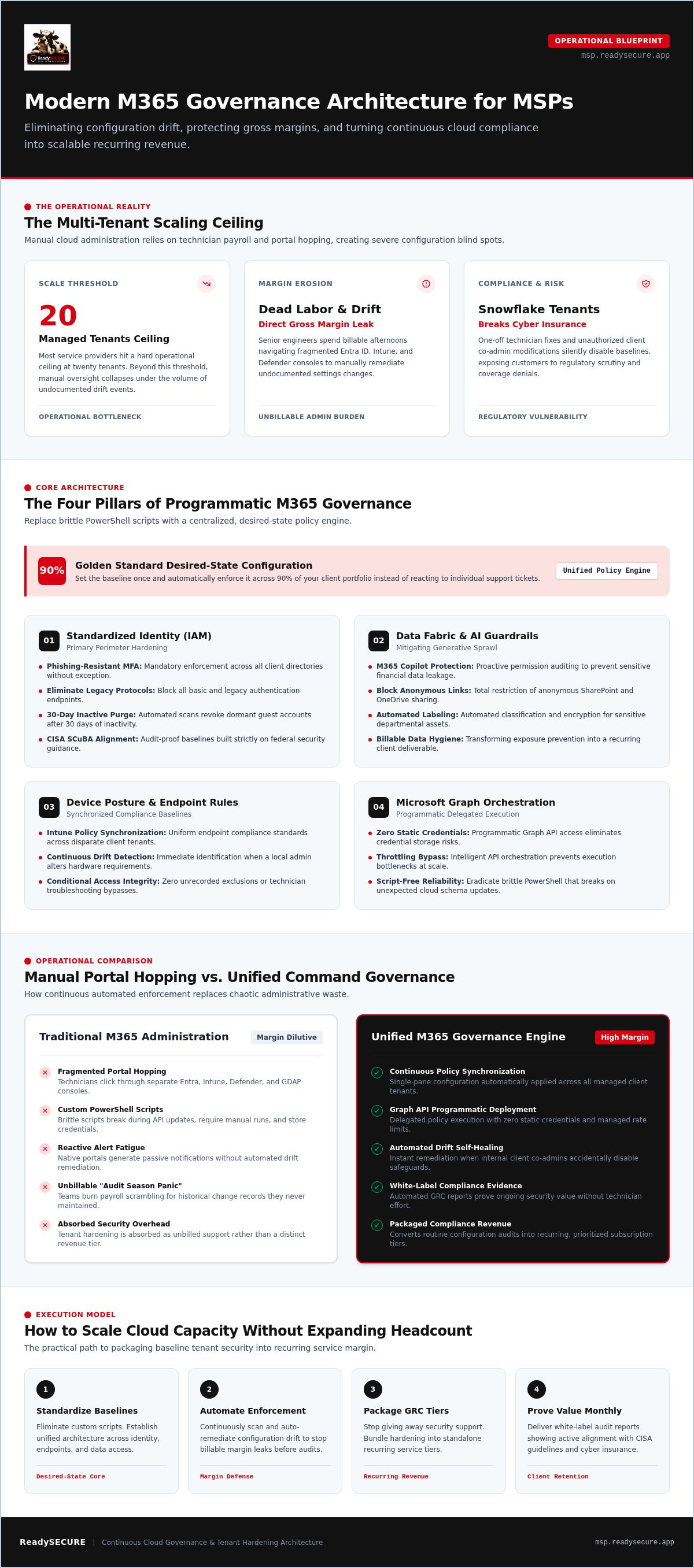
One-off technician fixes are margin killers. A technician disables a conditional access policy to troubleshoot an urgent ticket, forgets to re-enable it, and the environment drifts out of alignment. Over time, every tenant becomes a custom, fragile snowflake. Unmanaged drift instantly breaks cyber insurance criteria, leaving clients uncovered when incidents strike. Most service providers hit a hard operational ceiling around twenty managed tenants. Beyond that threshold, manual oversight collapses under the sheer volume of undocumented drift events.
Limitations of Native Microsoft Multi-Tenant Portals
Native tools offer visibility, but they don't solve the management bottleneck. Microsoft 365 Lighthouse provides multi-tenant views, yet it struggles in mixed licensing environments where legacy tiers and disparate subscriptions collide. Similarly, navigating Granular Delegated Admin Privileges (GDAP) introduces substantial overhead. Technicians spend billable hours managing time-bound access roles rather than securing environments. Most critically, native portals generate reactive alerts without automated remediation. Delivering elite m365 governance for msps demands automated policy correction, not another disconnected notification dashboard.
Core Architecture of Modern M365 Governance for MSPs
Bespoke PowerShell scripts cannot scale your business. While custom scripts feel cheap initially, they break during API updates, require manual execution, and introduce credential liability. High-margin m365 governance for msps relies on a unified policy engine built on four pillars: identity protection, device posture, data access, and telemetry. Instead of reacting to individual support tickets, forward-thinking providers establish a continuous desired-state configuration. You set the golden standard once, map it to 90% of your client base, and automate enforcement across every tenant.
Standardizing Identity and Access Management (IAM)
Identity is your primary perimeter. Modern IAM baselines begin by completely eliminating legacy authentication protocols. Enforce phishing-resistant multi-factor authentication across all client directories without exception. To prevent privilege creep, configure automated routines that scan for and revoke dormant guest accounts after 30 days of inactivity. Establishing these parameters using the CISA Secure Cloud Business Applications (SCuBA) project guidelines guarantees defensible, audit-proof access baselines across your entire tenant portfolio.
Securing the Data Fabric and Mitigating AI Sprawl
Data exposure expands exponentially when organizations enable generative tools without strict boundaries. Restrict anonymous SharePoint and OneDrive sharing links across all client workspaces immediately. Proactively auditing permission sprawl is necessary to mitigate emerging microsoft 365 copilot security risks before sensitive financial data surfaces in unauthorized search queries. Deploy automated classification labels to encrypt sensitive departmental assets, turning data hygiene into a billable deliverable.
Programmatic API Orchestration via Microsoft Graph
Reliable automation requires robust API architecture. Interfacing directly with Microsoft Graph endpoints allows programmatic, delegated policy deployment without storing static credentials. Smart orchestration engines bypass throttling constraints by batching Graph requests and handling token rotations securely. When configuration deviations trigger an API alert, the system should map the payload directly into remediation workflows. To simplify multi-tenant management and eliminate brittle scripting entirely, MSPs turn to unified security platforms that centralize compliance controls and baseline enforcement under one pane of glass.
How to Implement Automated M365 Governance: A 5-Step MSP Workflow
Stop running onboarding checklists manually. Achieving profitable m365 governance for msps requires an industrial assembly line: discover current states, align entitlements, push immutable baselines, detect drift, and export audit proof. This predictable five-step operational sequence turns chaotic tenant onboarding into a high-margin onboarding machine, shielding your technicians from endless admin portal clicking.
Step 1 and 2: Discovery and Baseline Alignment
Execute an initial microsoft 365 security assessment for msps to uncover existing tenant exposures. Audit licensing entitlements across Business Premium, E3, and E5 seats to determine feature support for Conditional Access and Intune. Document legacy line-of-business exceptions before pushing global templates, ensuring operational continuity while closing unnecessary security loopholes.
Step 3: Deploying Multi-Tenant Policy Baselines
Deploy your hardened golden configuration fleetwide using automated multi-tenant pipelines. Follow the CISA advisory on protecting against cyber threats to managed service providers by strictly enforcing least-privilege architecture across all client directories. Key operational baselines to apply include:
- Entra ID App Consent: Restrict user consent permissions to prevent malicious enterprise app registrations and OAuth token abuses.
- Mail Defense Rules: Lock down Exchange Online with strict SPF, DKIM, and DMARC enforcement, anti-phishing policies, and automated external mail forwarding blocks.
- Access Controls: Mandate continuous session monitoring, risk-based access revocation, and trusted-device compliance parameters fleetwide.
Step 4 and 5: Drift Detection and Continuous Audit Evidence
Implement real-time monitoring to catch unauthorized modifications the instant they occur. When an unauthorized user creates a global admin account, your automation must flag the discrepancy immediately and alert your team. Capture daily configuration snapshots mapped against CIS and NIST control frameworks. Package this telemetry into white-label executive scorecards for Quarterly Business Reviews. Clear audit evidence proves continuous service value, justifies premium managed service retainers, and transforms your compliance team from a defensive cost center into an indispensable growth driver.
Monetizing M365 Governance: Turning Routine Audits into High-Margin Revenue
Stop treating tenant security configuration as unbilled overhead. Bundling deep policy management into standard helpdesk agreements drains your margins and trains clients to undervalue your expertise. Cloud security isn't basic IT maintenance; it's specialized risk management. High-performing service providers monetize this gap directly. When you package m365 governance for msps into structured commercial tiers, you convert routine operational tasks into dependable monthly recurring revenue.
Packaging Tiered Governance Offerings
Never present clients with an all-or-nothing binary choice. Structure three clear, profitable tiers that align with organizational risk profiles:
- Baseline Security: Mandate core identity protection across all accounts. Enforce multi-factor authentication, secure default Exchange rules, and automated configuration drift tracking.
- Advanced Protection: Introduce contextual Conditional Access policies, data loss prevention (DLP) parameters, endpoint compliance baselines, and proactive permission auditing for generative AI tools.
- Continuous GRC: Deliver audit-ready compliance posture management. Provide automated evidence gathering, continuous framework mapping against CIS controls, and strategic vCISO support.
Executing Quarterly Business Reviews (QBRs) That Close Deals
Raw configuration telemetry doesn't sell upgrades; executive risk reduction does. Don't drown business owners in technical logs. Transform complex tenant events into high-level executive risk indices during your quarterly reviews. Show clients exactly how their posture improved month-over-month. Highlight neutralized drift events, blocked credential compromises, and resolved policy exceptions.
Demonstrating continuous security progress establishes undeniable value. When clients see tangible evidence of protected assets and ongoing compliance alignment, upsell conversations shift from defensive negotiations into strategic investments. To turn automated tenant oversight into high-margin recurring services without adding headcount, explore the ReadySECURE platform.
Scaling Your Security Stack: Moving from Manual Scripts to Unified Command
Custom scripts inevitably hit a wall. When your operation scales past twenty tenants, the fragile collection of PowerShell runbooks and scheduled tasks starts breaking down. Senior engineers burn billable hours debugging deprecated commands rather than driving revenue. True command over m365 governance for msps requires consolidating disconnected tools into a centralized management plane. Replacing disjointed point products with unified orchestration turns weeks of manual onboarding into automated minutes.
The Hidden Liabilities of In-House Script Maintenance
Maintaining bespoke scripts carries massive business liabilities. Whenever Microsoft modifies Graph API endpoints, your automation pipeline fractures, pulling top engineers away from client delivery to rewrite syntax. Storing automation tokens and app secrets across local machines or unmanaged repositories creates major attack paths. Worse, relying on scripts creates toxic key-person dependencies. When the engineer who wrote your custom tenant-management scripts departs, your operational foundation goes out the door with them.
Accelerating MSP Growth with Unified Multi-Tenant Platforms
Transitioning to a command platform eliminates maintenance drag entirely. By leveraging a proven white label security platform for MSPs, your team standardizes tenant configurations instantly across your entire roster. Instead of juggling separate consoles for identity hardening, vulnerability management, and GRC tracking, a unified command surface converges these functions into a single workflow.
Consolidation drives measurable commercial leverage across your practice:
- Accelerated Client Velocity: Deploy audit-ready baseline policies to new client directories in minutes rather than weeks.
- Stack Consolidation: Merge M365 hardening, vulnerability management, and continuous compliance into one console.
- Brand Dominance: Deliver fully branded, executive-facing reports that validate your recurring value and position your firm as an elite managed security authority.
To eliminate fragile automation, safeguard technician margins, and scale your client roster effortlessly, explore the ReadySECURE multi-tenant platform.
Turn Desired-State Governance into Your Most Profitable Service Engine
Manual tenant administration is an operational dead end. Every hour your technicians spend cross-checking admin portals is lost margin. By transitioning to continuous, programmatic policy enforcement, you safeguard your technical payroll and permanently eliminate configuration drift. Scalable m365 governance for msps turns standard cloud hygiene into an indispensable, high-margin revenue engine.
Take command of your client fleet. Replace fragile scripts with a unified command surface that consolidates M365 hardening, vulnerability management, and compliance into a single operational interface. Leverage automated continuous evidence collection and instant drift detection to keep every tenant audit-ready. Deliver 100% white-label executive reporting and branded portals that prove your security value directly to client leadership.
Stop absorbing unbilled cloud maintenance. It's time to build a scalable, predictable security practice. Automate M365 governance and protect your margins with ReadySECURE today.
Frequently Asked Questions
What is M365 governance for MSPs and how does it differ from traditional administration?
M365 governance for msps is the continuous, automated enforcement of standardized security, identity, and compliance baselines across all client tenants. Traditional cloud administration is reactive; technicians respond to user tickets, manually click through separate portals, and implement one-off configuration changes. Modern governance replaces manual intervention with programmatic policy synchronization. It ensures every tenant adheres to an immutable desired state while continuously collecting proof for audits.
Can MSPs rely solely on Microsoft 365 Lighthouse for complete tenant governance?
No, Microsoft 365 Lighthouse cannot deliver complete multi-tenant governance on its own. While Lighthouse offers valuable centralized visibility, it requires specific Microsoft licensing tiers that many small-to-midsize business clients don't carry. It also lacks automated cross-tenant self-healing, third-party vulnerability management integration, and executive-ready compliance reporting. Effective governance requires a dedicated multi-tenant command platform capable of enforcing baselines across mixed licensing environments without manual portal navigation.
How do you handle configuration drift across multiple client tenants efficiently?
Eliminate manual reviews by implementing automated desired-state configuration engines that continuously monitor tenant settings. When an unauthorized user or rogue technician alters a Conditional Access rule, Exchange setting, or sharing permission, the system detects the deviation instantly. Advanced platforms automatically revert unapproved changes to the approved baseline and log the event. This closed-loop self-healing stops configuration drift in near-real-time without requiring technician triage or unbillable hours.
Is custom PowerShell scripting sufficient for managing M365 governance at scale?
Custom PowerShell scripts fail quickly once your MSP scales beyond twenty managed tenants. Scripts introduce severe operational bottlenecks: they break when Microsoft updates Graph API endpoints, lack enterprise logging, and create dangerous key-person dependencies. Running scripts locally also creates credential exposure risks. Replacing custom runbooks with an enterprise multi-tenant security platform provides reliable API orchestration, secure workload identities, and continuous policy enforcement without constant code maintenance.
How should MSPs price and package M365 governance services for maximum profitability?
Package m365 governance for msps into tiered recurring security offerings rather than bundling it into generic helpdesk support. Structure three clear tiers: Baseline Security covering identity and MFA, Advanced Protection adding DLP and device compliance, and Continuous GRC delivering automated compliance evidence. Charge on a predictable per-user, per-month basis. Use automated monthly posture scorecards during Quarterly Business Reviews to prove ongoing risk reduction and drive natural tier upgrades.
What security controls must MSPs implement in M365 before clients deploy Microsoft Copilot?
Lock down tenant data architecture before enabling Copilot licenses to prevent internal data leaks. Mandate strict SharePoint and OneDrive external sharing restrictions to halt oversharing. Audit departmental permissions across all document repositories to prevent sensitive financial or HR files from indexing into generative AI prompts. Finally, deploy automated sensitivity labels and conditional access policies to restrict unmanaged devices from querying corporate data stores.
How does automated M365 governance support client cyber insurance requirements?
Insurers now demand continuous proof of defensive controls rather than annual self-attestations. Automated governance provides continuous evidence logging that validates phishing-resistant MFA, least-privilege administrative access, and strict email protections. When an insurer audits a client or evaluates a renewal policy, automated platforms export historical snapshot logs proving continuous compliance. This eliminates last-minute audit scrambles, protects clients from denied claims, and proves your firm's commercial value.


