

Manual security management is actively eroding your bottom line. Technicians waste billable hours logging in and out of separate Microsoft admin portals every day, only for silent configuration drift to leave identities vulnerable to business email compromise. You shouldn't have to burn elite engineering talent on repetitive manual checks. Selecting the right M365 security hardening tools for MSPs instantly eliminates this operational drag, transforming routine defense into a high-margin growth engine.
You already know that protecting clients requires continuous baseline enforcement rather than chaotic project work, yet clients still push back on retainers without clear proof of value. This 2026 guide shows you exactly how to evaluate, select, and deploy multi-tenant M365 security hardening tools to maximize recurring margins and client defense. We break down leading multi-tenant platforms, continuous remediation workflows aligned to CIS and NIST standards, and executive white-label reporting that turns security baselines into undeniable retainer revenue.
Key Takeaways
- Deploying purpose-built M365 security hardening tools for MSPs eliminates manual portal hopping and stops configuration drift before it threatens client networks.
- Automating baseline enforcement against CIS, NIST, and CISA SCuBA standards converts complex security tasks into a continuous, self-healing operational process.
- Relying on custom PowerShell scripts generates fragile technical debt, while true multi-tenant platforms protect engineering capacity when Microsoft APIs change.
- Executive-ready white-label reports transform baseline enforcement into tangible proof, empowering you to justify and win premium recurring security retainers.
- Consolidating tenant posture, mail defense, and vulnerability management into a unified console unlocks maximum operational efficiency and drives higher service margins.
The Operational Reality of M365 Security for Modern MSPs
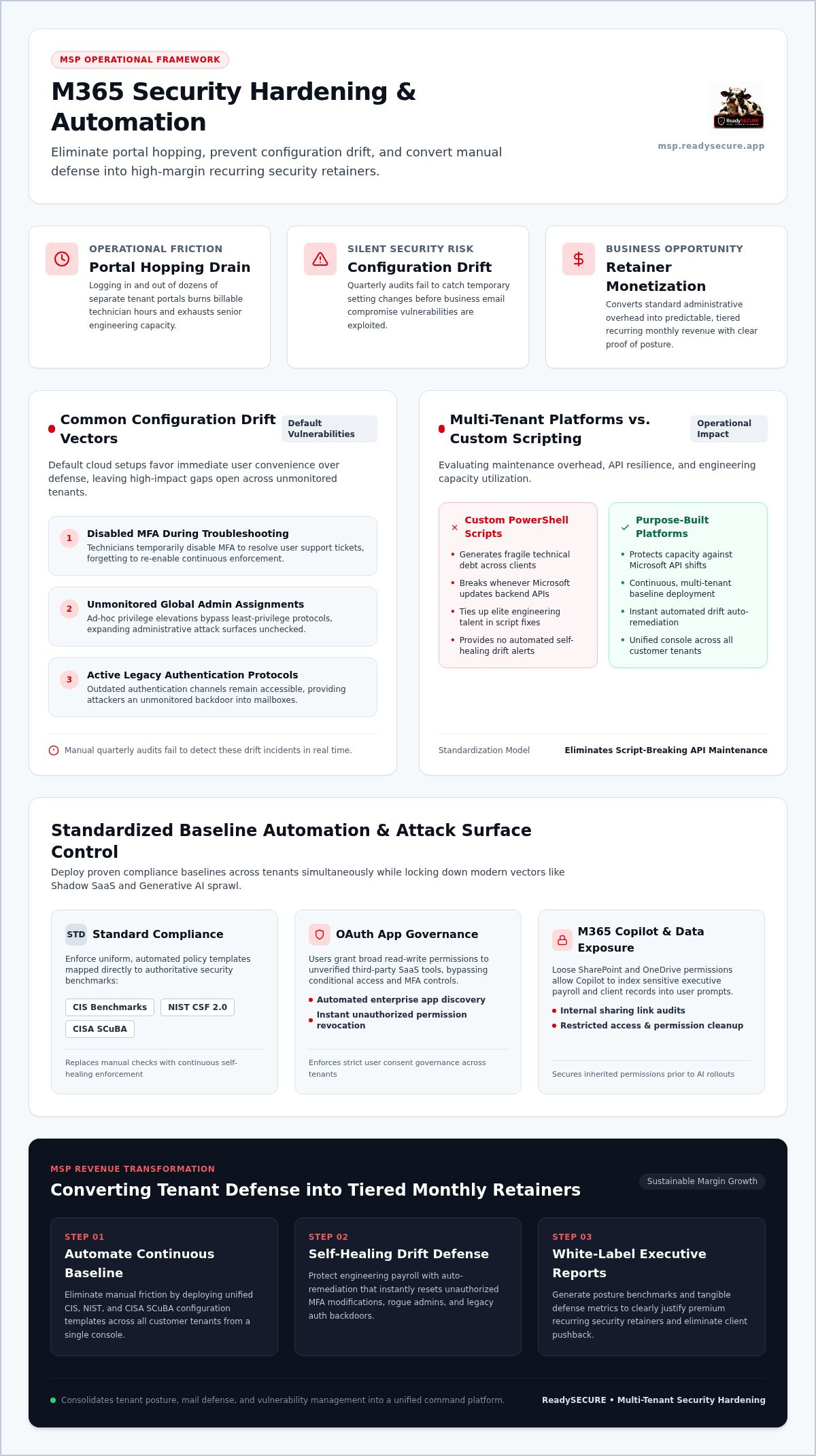
Managing dozens of cloud tenants manually is operational suicide. Every time an engineer juggles separate tenant portals, your service delivery margin takes an immediate hit. Default cloud configurations leave critical vectors wide open, including legacy authentication and unauthorized external sharing. Dedicated M365 security hardening tools for MSPs fix this structural vulnerability, replacing chaotic technician friction with automated control.
The Drain of Portal Hopping and Technician Burnout
Context switching destroys engineering velocity. For a modern Managed Service Provider (MSP), logging into fifty individual Microsoft admin centers burns valuable billable time on routine navigation and authentication prompts alone. Fatigue sets in fast. Technicians rush through policy changes, miss critical conditional access misconfigurations, and delay incident triage. This operational drag frustrates senior talent while shrinking your deliverable margins.
Configuration Drift and the Silent Threat of Default Settings
Default Microsoft tenants prioritize immediate end-user convenience over defensive strength. Out-of-the-box configurations leave business email compromise vectors completely unguarded. Worse, configuration drift occurs silently:
- A junior technician temporarily disables multi-factor authentication to troubleshoot a user ticket, then forgets to re-enable it.
- Unmonitored global admin assignments bypass standard least-privilege protocols.
- Legacy authentication protocols remain active, granting attackers an unmonitored backdoor.
Quarterly manual audits can't catch these shifts in time. By the time someone opens a review ticket, the breach has already occurred.
Transforming Administrative Overhead into Billable Security Tiers
Defensive maintenance shouldn't be treated as non-billable overhead. It is your most lucrative service asset. Packaging standardized tenant hardening into tiered monthly security packages converts endless reactive firefighting into recurring cash flow. Utilizing specialized M365 security hardening tools for MSPs allows your team to enforce continuous compliance baselines, generate clear posture benchmarks, and validate premium retainers without multiplying your engineering payroll.
Core Architecture Requirements for M365 Hardening Tools
Point-solution tools create operational friction. Modern service delivery requires an integrated architecture that deploys proven defensive baselines, auto-remediates drift, and locks down application permissions across every client environment. Elite M365 security hardening tools for MSPs must solve configuration challenges instantly while addressing the modern attack surface, including generative AI sprawl and unauthorized cloud integrations.
Baseline Automation: CIS, NIST, and CISA SCuBA Frameworks
Stop writing and troubleshooting fragile custom PowerShell scripts. Effective platforms push standardized configuration baselines aligned with CIS benchmarks, NIST CSF 2.0, and CISA SCuBA guidelines across dozens of tenants simultaneously. You can explore playbooks like how to master multi-tenant Microsoft 365 security to see how automated templates replace manual policy drift checks. This unified posture gives technicians immediate operational clarity and eliminates script-breaking API maintenance.
OAuth App Governance and Shadow SaaS Discovery
Unmonitored third-party integrations represent a massive vector for enterprise compromise. Users routinely grant broad read-write OAuth permissions to unverified SaaS tools, completely bypassing standard conditional access and MFA controls. Effective security baselines must include automated enterprise app discovery, instant permission revocation, and strict consent governance across all managed tenants.
Securing Microsoft 365 Copilot and Sensitive Data Permissions
Generative AI features accelerate internal data exposure when baseline tenant permissions remain loose. If SharePoint libraries and OneDrive shares have open internal access, Copilot indexes sensitive executive payroll files and client records, delivering confidential data straight into end-user prompts. Modern M365 security hardening tools for MSPs audit internal sharing links, enforce restricted access policies, and clean up inherited permissions before AI rollouts. Reviewing detailed Microsoft 365 Copilot security risks helps your engineers establish safe AI deployment standards.
Consolidating tenant posture, mail defense, and application discovery into a single interface protects your engineering capacity. To see how pre-built templates simplify these controls across all your accounts, explore unified multi-tenant security automation.
Evaluation Framework: Multi-Tenant Platforms vs. Native Scripting
Every service provider reaches an operational fork in the road: keep maintaining home-grown scripts or deploy a standardized commercial platform. Relying on custom code feels free on paper, but it drains payroll in practice. Dedicated M365 security hardening tools for MSPs deliver operational stability by replacing unpredictable manual maintenance with automated, scalable baseline controls across all client tenants.
The Hidden Payroll Cost of In-House PowerShell Scripts
Internal scripts represent expensive technical debt. Microsoft regularly deprecates modules and modifies Graph API endpoints, breaking custom automation overnight. Senior engineers must drop billable client work to debug lines of code. Consider the hidden payroll traps:
- Key-person risk leaves your business stranded if the script author exits the company.
- Undocumented script errors fail silently, leaving customer baselines unapplied without alerts.
- Non-billable developer hours accumulate rapidly just to keep custom tooling functional.
Custom scripts don't scale. Commercial tools eliminate this maintenance tax entirely.
Feature Matrix: Commercial Tools vs. Microsoft Lighthouse
Microsoft 365 Lighthouse offers basic cross-tenant visibility, but it comes with strict structural constraints. It requires specific customer licenses like Business Premium or E5, locking out clients on standard plans. The operational gap is clear:
- Licensing Freedom: Commercial platforms manage any Microsoft tenant regardless of base SKU; Lighthouse enforces rigid license prerequisites.
- Drift Remediation: Dedicated platforms automatically roll back unapproved tenant changes; Lighthouse relies heavily on manual intervention.
- Executive Reporting: Purpose-built tools generate client-facing, white-label proof; Lighthouse offers zero customizable branding.
Purpose-built M365 security hardening tools for MSPs bridge these native blind spots, ensuring total coverage across your entire portfolio.
Stack Consolidation: Unifying Posture, Mail, and Vulnerability Data
Fragmented point solutions erode operating margins. Forcing technicians to cross-reference tenant settings in one dashboard, email security alerts in another, and endpoint patch status in a third wastes critical hours. Consolidating cloud posture management, mail security, and vulnerability management into a single interface simplifies service delivery. Technicians resolve gaps faster, operational clarity surges, and your business captures higher net margins on every managed seat.
Monetizing M365 Hardening: Packaging High-Margin Retainers
Stop treating tenant hardening as an unbilled setup task. When you package security baselines into structured monthly deliverables, you transform technical labor into predictable recurring cash flow. Utilizing specialized M365 security hardening tools for MSPs provides the automation engine required to deliver these services at scale, allowing your practice to capture elite margins without increasing engineering overhead.
Structuring Tiered Security Offerings for Maximum Adoption
Ditch all-inclusive IT contracts that hide your security value. Segment your services into three distinct, profitable tiers:
- Core Security: Standard MFA enforcement, baseline Conditional Access, and automated mail security configurations.
- Advanced Defense: Continuous configuration drift auto-remediation, strict third-party OAuth app governance, and weekly posture audits.
- Strategic Governance: Continuous compliance monitoring aligned to NIST CSF 2.0, external vulnerability scans, and dedicated vCISO advisory support.
Make the advanced tier the default onboarding baseline. This draws a bright line between general helpdesk maintenance and proactive enterprise defense.
White-Label Reporting that Validates Service Retainers
Clients cancel services they don't see. Raw technical telemetry and PowerShell error logs mean nothing to a non-technical executive. High-margin retention hinges on clear, branded visibility. Deliver polished monthly reports that highlight specific risk reductions, remediated configuration drifts, and current compliance benchmarks. Reviewing the profitable MSP guide to white label security platforms provides actionable frameworks for turning operational data into undeniable client proof during business reviews.
Upselling from Configuration Audits to Strategic vCISO Retainers
Every prospect meeting should begin with objective data. Run automated discovery assessments to expose open legacy protocols, dormant global admins, and overshared sensitive files. Following our blueprint for a Microsoft 365 security assessment arms your sales team with indisputable audit findings that command immediate attention.
Once you expose these vulnerabilities, offer the strategic remedy. Transition baseline hardening findings directly into lucrative, ongoing governance advisory contracts. The right M365 security hardening tools for MSPs handle continuous policy enforcement automatically, freeing your leadership to act as a compensated virtual CISO. To start turning tenant baselines into recurring revenue, deploy your branded security console today.
Deploying ReadySECURE: The Multi-Tenant Command Platform
Fragmented stacks cripple your operational efficiency. Moving beyond ad-hoc scripts requires a consolidated infrastructure engineered to command dozens of client environments at once. Leading M365 security hardening tools for MSPs should eliminate tool sprawl rather than add to it. ReadySECURE delivers this exact architectural advantage, uniting tenant hardening, vulnerability management, mail security, and governance policies into a single multi-tenant pane of glass.
Frictionless Multi-Tenant Onboarding and Rapid Baseline Deployment
Tenant onboarding shouldn't take days of manual checklist execution. Connect new client tenants securely through automated modern authentication workflows, eliminating shared admin credentials forever. Once authenticated, instantly push standardized baseline policies across identity, Exchange Online, and Teams configurations. Check out our comprehensive operational manual on M365 governance for MSPs to access tested framework templates that slash deployment timelines from hours to seconds.
The Complete Multi-Tenant Security Stack Under Your Brand
Shed the overhead of disjointed point tools. ReadySECURE unifies critical security controls into one consolidated workflow:
- Microsoft 365 Security: Enforce zero-trust baselines and auto-remediate configuration drift continuously.
- Vulnerability Management: Identify network weaknesses and prioritize external exposure before adversaries find it.
- Mail Security: Lock down SPF, DKIM, and DMARC settings alongside modern inbound threat filters.
- Information Security GRC: Map operational configurations directly to established frameworks like NIST and CIS.
Every report, dashboard, and executive scorecard carries your brand identity exclusively. By consolidating these functions, your team cuts software sprawl while reinforcing client trust.
Expert Backup: On-Demand vCISO, Pentesting, and Incident Response
Selling high-tier strategic retainers requires expertise that many MSPs struggle to staff internally. ReadySECURE bridges this operational gap. Channel partners gain on-demand access to certified security professionals for strategic vCISO support, formal penetration testing, and rapid incident response escalation. You can confidently close complex, regulated enterprise accounts without taking on full-time engineering payroll. Move past manual configuration checks, accelerate service delivery, and explore the ReadySECURE platform to command your client security today.
Scale Your Cloud Defense and Lock In Higher Margins
Manual administrative audits and fragile PowerShell scripts can't keep pace with modern cloud threats. Relying on them burns billable engineering hours while leaving your clients exposed to silent configuration drift. Purpose-built M365 security hardening tools for MSPs change the game. By automating continuous baseline remediation across all tenants, you protect client identities, eliminate administrative friction, and capture predictable service margins.
Winning modern cybersecurity retainers requires operational dominance and visible client proof. ReadySECURE unifies Microsoft 365 hardening, vulnerability management, and GRC policies into a single multi-tenant console under your brand. Deliver executive white-label reports that validate premium pricing, backed by on-demand access to certified vCISO support and incident response specialists when you need them. Take control of your portfolio, eliminate point-tool waste, and automate your multi-tenant M365 defense with ReadySECURE today.
Frequently Asked Questions
Why is Microsoft Lighthouse insufficient for complete MSP security hardening?
Microsoft Lighthouse enforces rigid customer licensing prerequisites, excluding clients on basic plans. It lacks automated drift remediation to roll back unauthorized changes without technician intervention. Lighthouse also provides zero white-label reporting capabilities, preventing providers from branding the deliverable. Commercial M365 security hardening tools for MSPs remove these licensing barriers, automate policy enforcement across all accounts, and generate executive-ready proof of protection.
How do M365 security hardening tools prevent configuration drift across clients?
Modern platforms continuously poll tenant configurations via modern authentication and Graph APIs against established golden templates. When an unauthorized user or unmonitored administrator disables multi-factor authentication, alters conditional access rules, or activates legacy mail protocols, the system detects the anomaly instantly. Leading platforms automatically alert technicians or immediately roll back the modification, keeping customer environments aligned with required security baselines.
Can automated M365 hardening tools protect against Microsoft Copilot data oversharing?
Yes. Specialized hardening platforms audit tenant data governance settings before AI tools index sensitive business files. They discover overshared SharePoint sites, flag public OneDrive links, and enforce strict least-privilege access across files and groups. Addressing these permission gaps before activating generative AI features prevents Copilot from serving internal payroll records or confidential executive data straight into standard user queries.
How does multi-tenant M365 security software handle rogue OAuth enterprise apps?
Purpose-built software continuously catalogs every third-party application granted consent within connected client tenants. It flags excessive permission scopes, such as read-write access to inboxes or directory data, that bypass standard MFA policies. Security teams can instantly revoke hazardous consents across all managed accounts simultaneously and establish automated rules to block unverified marketplace software from gaining entry.
What security compliance baselines should an MSP hardening tool support out of the box?
Any commercial platform must support CIS Microsoft 365 Foundations Benchmarks, NIST CSF 2.0, and CISA SCuBA standards out of the box. These recognized frameworks ensure rigorous tenant defense across identity, email, and collaboration services. Deploying pre-configured templates mapped directly to these standards allows service providers to satisfy cyber insurance underwriting requirements and fulfill strict industry compliance mandates effortlessly.
How quickly can an MSP onboard and enforce baselines across 50 client tenants?
With purpose-built M365 security hardening tools for MSPs, engineers can onboard fifty tenants in hours rather than weeks. Modern authentication allows rapid delegated connection without handling shared credentials. Once connected, standardized baseline templates deploy across all fifty environments simultaneously, replacing days of manual configuration with scalable, one-click policy distribution.


