

Approximately 74% of IT infrastructures harbor at least one critical vulnerability at any given moment, yet technical teams continually waste billable hours sifting through unprioritized alert queues. You already know that manual audits and sporadic checks can't protect modern hybrid environments. To eliminate blind spots, satisfy strict compliance mandates, and protect client trust, you need to understand exactly what is a vulnerability scan and how automated inspection works under the hood.
Vulnerability assessment should drive decisive business action, not administrative drag. When executed with precision, continuous asset visibility transforms chaotic fire-fighting into an efficient, repeatable defense engine. In this comprehensive guide, you'll master the mechanics of external, internal, and cloud scanning, clearly separate automated sweeps from manual penetration testing, and convert raw CVSS scores into prioritized remediation tasks that engineering can execute immediately. Here is your operational blueprint to scan faster, eliminate risk, and maintain total environment control.
Key Takeaways
- Understand what is a vulnerability scan by examining how automated engines interrogate network perimeter assets, internal endpoints, and cloud configurations against known exposure databases.
- Compare the four vital scan variants, contrasting non-credentialed external assessments with credentialed deep-host inspection to eliminate operational blind spots.
- Distinguish high-frequency automated vulnerability assessments from targeted manual penetration testing to align security spending with precise risk objectives.
- Execute a structured five-step lifecycle that moves your technical team from initial asset discovery to decisive, risk-ranked patching.
- Scale managed delivery across multiple client environments using multi-tenant consolidation to capture recurring revenue without inflating engineering headcount.
What Is a Vulnerability Scan and How Does It Work?
Security failures rarely happen because teams lack tools. They happen because teams lack visibility. At its foundation, answering what is a vulnerability scan comes down to automation: it is an automated inspection process that systematically probes networks, endpoints, operating systems, and applications to identify known security flaws. Unlike passive firewall logs that merely record inbound traffic, or reactive endpoint alerts that trigger only after malicious code executes, an automated scanner takes the offensive. It maps your digital terrain, tests system reactions, and pinpoints structural gaps before attackers find them.
Every commercial-grade vulnerability scanner relies on authoritative global repositories to evaluate risk. The engine queries the Common Vulnerabilities and Exposures (CVE) list and the National Vulnerability Database (NVD). By indexing these standardized dictionaries, the tool matches observed system configurations against tens of thousands of cataloged bugs, unpatched libraries, and weak security controls.
The Core Mechanics of Automated Scanning Engines
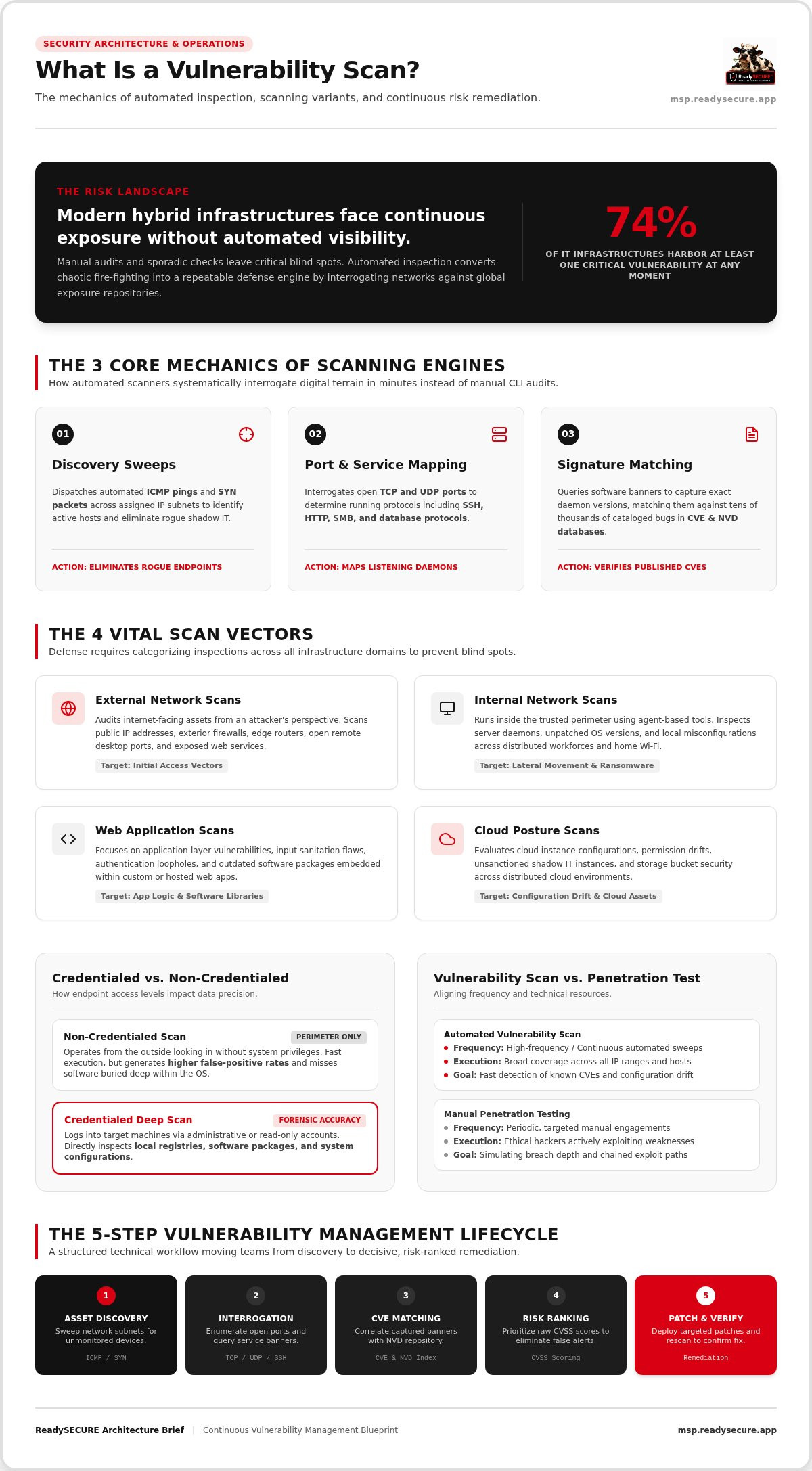
Scanning engines operate with methodical precision, breaking down network inspection into three structured phases:
- Discovery sweeps: The scanner dispatches ICMP pings and automated SYN packets to discover active hosts across assigned IP subnets, eliminating rogue endpoints.
- Port enumeration and service mapping: The tool interrogates open TCP and UDP ports, determining whether a listening port runs SSH, HTTP, SMB, or database protocols.
- Banner grabbing and signature matching: It sends targeted protocol queries to elicit software banners. By reading exact daemon versions, it flags mismatches against published flaw signatures.
This automated interrogation replaces days of manual CLI inventory with minutes of structured digital intelligence.
Why Real-Time Vulnerability Discovery Matters
The weaponization timeline has collapsed. Threat actors routinely operationalize proof-of-concept exploits within hours of public CVE disclosures. An annual audit or quarterly assessment is obsolete the moment a junior administrator alters a firewall rule or provisions an unmonitored cloud instance. Automated discovery guarantees that configuration drift, unsanctioned shadow IT, and missed patch cycles are caught immediately, turning vulnerability detection into an active, repeatable business control.
The 4 Core Types of Vulnerability Scans Explained
Executing security without scoping your attack surface is just guesswork. To master what is a vulnerability scan in an enterprise context, you must recognize that one scan type cannot cover every digital asset. True defense requires categorizing inspections across four specific domains: perimeter infrastructure, internal host networks, web applications, and cloud configurations.
External vs. Internal Network Scanning Vectors
External network scans audit your internet-facing assets from an attacker's perspective. The scanner targets public IP addresses, evaluating exterior firewalls, edge routers, open remote desktop ports, and exposed web services. It flags weaknesses that allow initial access.
Internal network scans run inside the trusted boundary. They identify local server daemons, unpatched operating systems, and misconfigurations that enable lateral movement and ransomware proliferation. Modern distributed workforces mandate agent-based internal scanning to inspect remote laptops whether they sit in corporate headquarters or on home Wi-Fi networks.
Credentialed vs. Non-Credentialed Scanning Approaches
How your scanner accesses an endpoint determines data quality. Non-credentialed sweeps operate from the outside looking in, probing exposed listening ports without system privileges. They execute quickly but generate higher false-positive rates and miss software buried deep within the OS.
Credentialed scans log directly into the target machine using dedicated administrative or read-only accounts. The engine inspects local registries, software package inventories, and internal system configurations with forensic accuracy. Understanding these operational mechanics provides a clear framework for vulnerability scanning versus penetration testing, ensuring technical teams don't waste engineering hours validating false alerts.
Specialized Scans: Web Applications and Cloud Posture
Modern attack surfaces extend far beyond traditional host boundaries. Dynamic Application Security Testing (DAST) inspects custom web applications and APIs, testing inputs against OWASP Top 10 risks such as SQL injection, broken access control, and cross-site scripting.
Cloud posture scans interrogate identity access management (IAM) permissions, public storage buckets, and virtual network security groups across cloud infrastructures. Combining these four scanning vectors gives you unified, layered visibility across every digital touchpoint. Service providers can manage these distinct vectors across their entire client portfolio through a consolidated multi-tenant vulnerability management platform, turning comprehensive hygiene into a scalable, high-margin service offering.
Vulnerability Scan vs. Penetration Test: The Critical Differences
Conflating automated scans with hands-on penetration testing wastes capital and leaves severe operational exposures unaddressed. When establishing what is a vulnerability scan versus an offensive exercise, the core distinction centers on intent: scanning identifies potential weaknesses across broad digital terrain, while penetration testing actively proves whether an attacker can exploit those weaknesses to compromise critical assets.
Industry standards reflect this operational separation. The CIS Critical Security Controls designate continuous vulnerability management as an essential defensive safeguard, while reserving penetration testing as a targeted exercise to evaluate operational resilience under active assault.
Scope, Depth, and Execution Methods
The operational mechanics of these two methodologies diverge across three fundamental vectors:
- Breadth versus depth: Vulnerability scans execute automated checks across thousands of IP addresses, ports, and software packages in hours. Penetration tests focus deeply on narrow targets, using lateral movement, privilege escalation, and business logic flaws.
- Execution engine: Scanners rely on automated algorithms querying vulnerability databases. Penetration testing leverages manual human creativity, contextual intuition, and custom-written exploit payloads.
- Operational impact: Scanners identify theoretical exposures passively or through non-destructive queries. Penetration testers actively simulate adversary behavior, chain multiple low-level flaws together, and demonstrate tangible business impact.
One process catalogs potential doorways. The other kicks them open.
Cost, Frequency, and Strategic Application
Timing dictates security ROI. Vulnerability scans are automated, software-driven routines built for high frequency. You run them continuously, weekly, or after system modifications to catch zero-day exposures and configuration drift before attackers weaponize them.
Penetration tests require dedicated human operators, making them resource-intensive engagements. Organizations deploy them annually, prior to major compliance milestones, or following major infrastructure overhauls. Regular automated scanning lays the foundation for productive manual testing. Resolving basic unpatched flaws through regular scans ensures your ethical hacking investment evaluates complex architecture flaws instead of flagging elementary patch oversights.
Both disciplines serve distinct purposes within a mature program. Continuous scanning provides the baseline operational visibility required to maintain day-to-day hygiene. Penetration testing validates that your protective controls actually withstand determined human compromise.
How to Build a Repeatable Vulnerability Management Workflow
Running isolated scans without a structured remediation plan produces nothing but technical noise. True operational security requires converting raw scanner output into a predictable, revenue-protecting machine. Knowing what is a vulnerability scan is only the starting line; real leverage comes from wrapping automated tools inside a disciplined five-stage lifecycle: Discover, Prioritize, Remediate, Verify, and Report.
You can't secure what you can't see. Discovery must precede execution. Automated network discovery identifies rogue endpoints, unauthorized SaaS connections, and shadow virtual machines before scanning engines fire a single query. Once all assets are mapped, the scanner interrogates each target systematically, feeding reliable data into the triage pipeline.
Moving Beyond CVSS: Context-Driven Prioritization
Relying exclusively on base CVSS scores paralyzes technical teams. When a scanner flags hundreds of "Critical" ratings across an environment, engineering resources stall under alert fatigue. You must cut through that friction using real-world risk metrics:
- Exploit Prediction Scoring System (EPSS): Track the statistical likelihood that a specific software bug will face active exploitation in the wild over the next 30 days.
- Asset business criticality: Prioritize an externally exposed customer portal running a moderate vulnerability over an isolated, air-gapped staging server running a severe one.
- Threat intelligence feeds: Identify whether active exploit kits or ransomware payloads currently target the identified CVE.
Filtering through operational context shrinks sprawling alert lists down to the handful of exposures that actually threaten operations.
Remediation, Rescanning, and Audit-Ready Reporting
Prioritized findings demand strict service-level agreements. Establish non-negotiable remediation windows, requiring engineering teams to patch weaponized perimeter vulnerabilities within 48 to 72 hours. Less accessible internal issues follow a standard rolling 14-day schedule.
Never assume an applied patch solved the underlying flaw. Patch installers fail, services fail to restart, and registry keys frequently remain unmodified. Close the operational loop by triggering an immediate, automated verification rescan. Once confirmed, output executive dashboards that track exposure remediation velocity over rolling quarters to prove compliance to stakeholders.
Stop drowning in unranked alert queues. Deploy our unified vulnerability management engine to automate discovery, streamline risk prioritization, and deliver transparent posture reporting across every client system.
Operationalizing Multi-Tenant Scanning: The MSP Growth Strategy
For managed service providers, understanding what is a vulnerability scan is worthless if operational execution destroys your margins. Juggling legacy, single-tenant scanning tools across dozens of client networks creates administrative chaos. Technicians waste billable hours logging in and out of disconnected portals, stitching together disparate reports, and manually verifying patch status. Scaling your practice requires turning automated vulnerability assessment into a centralized, repeatable delivery engine.
Eliminating Tool Sprawl with Consolidated Command Surfaces
Managing individual console instances for each account kills technician efficiency. Software silos create visibility blind spots and increase operational overhead. Modern multi-tenant management engines eliminate this friction by consolidating distributed client environments into a single operational command center.
From one central interface, your engineering team can audit perimeter exposures, run deep endpoint checks, evaluate identity risks, and monitor Microsoft 365 security postures across your entire client base. Standardizing on a multi-tenant platform streamlines technician workflows, accelerates triage times, and eliminates the need to maintain multiple standalone assessment products.
Packaging Vulnerability Scanning into Profitable Retainers
Continuous vulnerability oversight represents a high-margin recurring revenue stream. Elite service providers don't treat scanning as an occasional, unbilled troubleshooting task. They wrap continuous scanning, prioritization, and remediation reporting into tiered cybersecurity retainers.
Communicating value requires speaking the language of business risk rather than technical jargon. Delivering raw scanner exports during quarterly business reviews confuses executives and undermines your credibility. Deploying a purpose-built white label security platform for MSPs allows your team to generate branded, executive-ready posture reports that clearly document ongoing risk reduction and regulatory compliance.
ReadySECURE delivers the exact foundation service providers need to dominate their market. Built specifically for MSP scale, ReadySECURE unifies vulnerability management, Microsoft 365 security auditing, and compliance governance into one seamless, multi-tenant ecosystem. You gain full visibility across every client boundary, protect billable margins, and scale recurring cybersecurity revenue without adding engineering headcount.
Take Command of Your Security Operations Today
Building a resilient, profitable security posture requires moving beyond reactive fire drills. Mastering what is a vulnerability scan and establishing a structured assessment lifecycle gives your business permanent visibility over expanding attack surfaces. By clearly separating routine automated scans from manual penetration testing and replacing raw CVSS noise with context-driven prioritization, you convert vulnerability assessment into an actionable risk mitigation engine.
Scaling these operations without inflating headcount is how elite providers capture lasting market advantage. ReadySECURE delivers a purpose-built multi-tenant platform unifying vulnerability management and M365 hardening across your entire customer footprint. Deploy turnkey white-label reporting engines engineered to accelerate recurring MSP revenue and demonstrate clear, measurable risk reduction during every client review.
Stop reacting to digital risk. Launch your multi-tenant security stack with ReadySECURE and turn automated vulnerability intelligence into your firm's most dependable growth driver.
Frequently Asked Questions
What is the difference between a vulnerability scan and a penetration test?
A vulnerability scan uses automated tooling to identify known security weaknesses across your infrastructure without actively exploiting them. A penetration test is an authorized, manual simulation where ethical hackers actively exploit those weaknesses to access sensitive systems or escalate privileges. Scans deliver high-frequency, broad baseline visibility across your environment, while penetration tests prove real-world breach impact on critical business assets.
How often should an organization run vulnerability scans?
Organizations should run automated scans continuously or at least weekly across external attack surfaces and internal endpoints. Compliance frameworks and modern threat velocity make quarterly sweeps inadequate. When teams evaluate what is a vulnerability scan routine that works, weekly scans catch zero-day exposures and unauthorized configuration drift before attackers weaponize them. Run supplemental scans immediately following major network upgrades or application releases.
Can running an automated vulnerability scan bring down network systems?
Production outages from scans are rare with modern tools, but legacy industrial controllers, fragile IoT devices, and overwhelmed web servers can occasionally crash under heavy packet floods. Professional vulnerability engines allow administrators to tune packet concurrency, adjust request timeouts, and throttle bandwidth. Schedule intrusive scans during maintenance windows, and run non-credentialed discovery sweeps during business hours to protect uptime and maintain system stability.
What is the difference between credentialed and non-credentialed scans?
Non-credentialed scans inspect your targets from the outside without system privileges, evaluating listening ports and internet-facing services like a remote adversary. Credentialed scans log directly into endpoints using administrative or read-only service accounts. Understanding this distinction clarifies what is a vulnerability scan capable of achieving. Credentialed scans deliver forensic precision, verifying registry keys, missing security patches, and internal software configurations with minimal false positives.
How do security teams prioritize thousands of discovered scan vulnerabilities?
Modern security teams abandon raw CVSS scores in favor of contextual risk metrics. Prioritization combines the Exploit Prediction Scoring System (EPSS), active threat intelligence, and internal asset criticality. An unpatched bug on a public payment portal demands immediate remediation within 48 hours. The same vulnerability sitting on an isolated staging server receives a lower priority, ensuring engineering resources focus strictly on weaponized exposures that threaten revenue.
What happens after an automated vulnerability scan identifies a critical CVE?
Identifying a critical CVE initiates an automated remediation workflow. The platform assigns the ticket to engineering with an aggressive SLA, such as a 48-hour resolution window. Technicians deploy the relevant vendor patch, adjust firewall configurations, or implement temporary compensating controls. Once completed, the team runs an automated verification rescan to confirm the vulnerability is closed before logging the resolution for compliance audits.


