

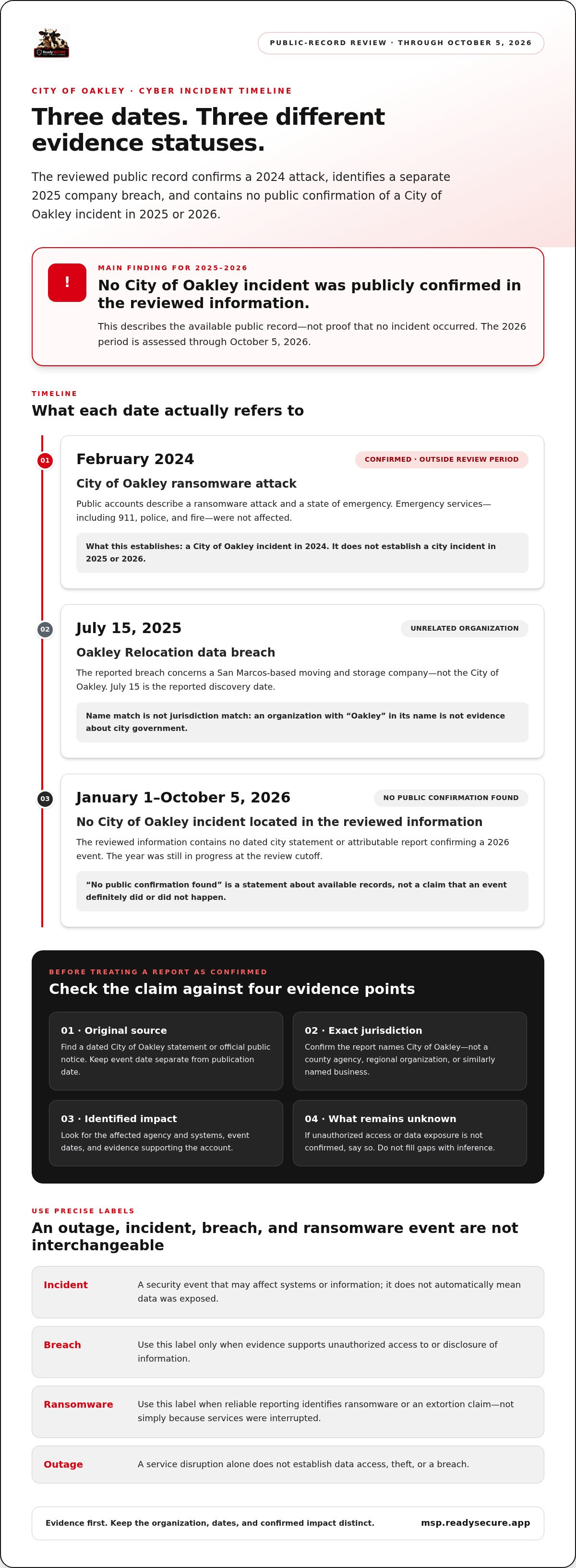
For the City of Oakley, the clearest cyber finding for 2025-2026 is the absence of publicly reported incidents, not proof that nothing happened. Searches for “city of oakley cyber incidents breaches ransomware 2025 2026” may surface the city’s February 2024 ransomware attack, incidents elsewhere, or Oakley Relocation’s separate 2025 breach. These are not interchangeable.
The City of Oakley’s 2024 attack led to a state of emergency, but emergency services, including 911, police, and fire, were not affected. As of October 2026, no publicly available records identify a cyber incident, breach, or ransomware attack specifically affecting the city in 2025 or 2026. That reporting gap does not prove an incident could not have occurred.
This review separates confirmed Oakley information from broader threat reporting. It explains why an outage, security incident, breach, and ransomware event are not the same, and outlines practical preparedness steps for local organizations. The goal is to establish what is known, avoid speculation, and strengthen response readiness into 2026.
Key Takeaways
- Use dated city statements and official notices to verify claims about city of oakley cyber incidents breaches ransomware 2025 2026 before treating them as confirmed.
- Check whether a report identifies the affected agency, systems, dates, and evidence. Similar place names and unrelated organizations can muddy search results.
- Separate phishing, credential compromise, ransomware, and service disruption. Each describes a different threat or impact, not automatic proof of a data breach.
- If an official notice calls for action, follow its instructions. Organizations should preserve relevant evidence and use their established incident response plans.
- MSPs can make readiness repeatable by reviewing vulnerabilities, identity settings, email security, and compliance across client environments.
What is publicly known about City of Oakley cyber incidents in 2025-2026?
As of October 5, 2026, no publicly available records located in the reviewed information confirm a cyber incident, data breach, or ransomware attack affecting the City of Oakley during 2025 or 2026. This describes the available public record, not proof that no incident occurred. The confirmed Oakley-specific incident in the available record dates to February 2024, outside this review period.
Keep the jurisdiction clear. A report about Contra Costa County or the Bay Area does not establish that Oakley’s city government was affected. Neither does an incident involving an organization with “Oakley” in its name. Before treating a result for city of oakley cyber incidents breaches ransomware 2025 2026 as evidence, confirm exactly which organization it names.
How to read the 2025-2026 Oakley incident timeline
This timeline separates city-specific evidence from similarly named organizations and regional reporting. The event date and publication date are different facts. Where the reviewed information does not establish a publication date, the gap is stated rather than filled with a guess.
- February 2024 | City of Oakley ransomware attack | Confirmed, outside the review period. Public accounts describe a ransomware attack and emergency response. The available summary does not provide a specific day or publication date. It does not establish an Oakley city incident in 2025 or 2026.
- July 15, 2025 | Oakley Relocation data breach | Unrelated organization. The breach concerns a San Marcos-based moving and storage company, not the City of Oakley. July 15 is the reported discovery date; a publication date is not established in the reviewed information.
- January 1 to October 5, 2026 | No City of Oakley incident located | No public confirmation found. The reviewed information contains no dated city statement or attributable report confirming a 2026 event. The year is still in progress as of the cutoff.
“No public confirmation found” describes the available record. It should not be turned into a claim that an event definitely did or did not happen. A stronger finding requires a dated city statement or credible report that identifies the affected agency, systems, event dates, and supporting evidence.
What counts as a cyber incident, breach, or ransomware event?
An incident is a security event that may affect systems or information. It does not automatically mean data was exposed. Call an event a breach only when evidence supports unauthorized access to or disclosure of information. Use ransomware when reliable reporting identifies ransomware or an extortion claim, not simply because services were interrupted. For a general overview of how ransomware works, see Ransomware.
How to verify Oakley breach and ransomware claims before drawing conclusions
A strong claim needs a traceable source. Before sharing a headline about the city of oakley cyber incidents breaches ransomware 2025 2026, check who made the claim, what evidence supports it, and whether it refers to Oakley city government. A post, screenshot, or outage report can raise a question, but it does not settle the answer.
Which sources can establish whether an Oakley incident was confirmed?
Start with dated City of Oakley statements and official public notices. Then compare credible local reporting with statements attributed directly to city officials. Check whether an article links to the original notice or quotes a named source. CISA and FBI materials can explain common threats and response steps, but general guidance is not proof that a local incident occurred.
- Find the original source. Record both its publication date and the date of the event it describes. Do not treat those dates as interchangeable.
- Confirm the jurisdiction. Look for the City of Oakley specifically, not a countywide agency, another Bay Area organization, or a business with Oakley in its name.
- Compare accounts. Check whether credible reports match the official statement on the affected agency, systems, timeline, and known impact.
- Mark what is missing. If no source identifies affected systems or confirms unauthorized access, state that clearly. Do not fill the gap with inference.
What evidence supports a breach or ransomware label?
Look for a formal disclosure, official confirmation of unauthorized access, or reliable reporting that identifies the affected system and the evidence behind the claim. A service outage alone does not establish data access or theft. A threat actor’s post is also an allegation until the affected organization or an independent source corroborates it.
Be cautious with claimed data volumes, ransom demands, and victim counts. Those figures may come from an attacker, change as an investigation develops, or lack independent confirmation. Attribute them clearly when relevant, and label them unverified when that is what the evidence supports. If a source confirms disruption but says nothing about data exposure, report the disruption without calling it a breach.
For organizations building a repeatable process, the NIST Cybersecurity Framework offers a risk-management structure. It can help teams organize evidence handling and response planning, but it does not verify a specific Oakley claim. MSPs can also standardize reviews across client environments with a multi-tenant security platform. Explore the MSP security platform.
What local-government cyber threats mean for Oakley without overstating the evidence
Municipal systems can face familiar cyber risks, but general exposure is not evidence of a City of Oakley incident. The threat types below provide context for interpreting reports. They are not claims that Oakley experienced any of them in 2025 or 2026.
| Threat type | What it means | Possible impact, if it occurs |
|---|---|---|
| Phishing | A deceptive message tries to prompt someone to disclose information, open a harmful attachment, or visit a fraudulent site. | An account or device could be exposed, depending on the recipient’s actions and the protections in place. |
| Credential compromise | An unauthorized person obtains or uses valid login details. | The attacker could access systems permitted to that account. This alone does not prove information was viewed or taken. |
| Ransomware | Malicious software can encrypt files or disrupt access. Some incidents also involve data theft or an extortion demand. | Systems might become unavailable, and recovery could require isolation, investigation, and restoration. Encryption, theft, and extortion are distinct actions. |
| Service disruption | A service becomes unavailable because of a cyber event, technical failure, or another cause. | Public-facing functions could be interrupted. An outage alone does not establish hacking, ransomware, or a breach. |
How municipal ransomware can affect services and recovery
If ransomware affects a municipal network, staff may isolate systems to limit spread, investigate what happened, and restore services. The disruption could affect internal operations or public-facing services, depending on the systems involved. Data theft may occur with or without encryption, and an extortion claim may be made with or without verified theft. Do not attribute any of these possible outcomes to Oakley without an attributable incident record.
How regional context differs from an Oakley incident
The City of Oakley discussed here is in Contra Costa County, California. A report about another county agency, a Bay Area organization, or a similarly named place is evidence about that entity, not the city. Check the affected organization and location before applying regional reporting to Oakley.
Regional threat exposure shows why preparedness matters; it does not prove that Oakley’s systems were compromised. Broad trend statistics add context only when the report, publication date, geography, and population measured are clear. Without those details, a percentage can mislead rather than clarify. For the city of oakley cyber incidents breaches ransomware 2025 2026, keep the distinction firm: context informs risk, while attributable evidence establishes an incident.
What residents and local organizations can do after a reported cyber incident
Start with the notice, not the rumor. The right response depends on what an official source says happened, which systems or information may be involved, and whether it asks residents to take action. A disruption notice without evidence of exposed personal information does not, by itself, mean residents need to change every password or monitor every account.
What residents should do when a public notice mentions exposed information
Verify the notice through an official city or agency channel. Follow its specific instructions about affected information, account security, or where to direct questions. Be wary of unexpected messages that use a reported incident to request passwords, payment, or personal details.
- Act on confirmed exposure. If the notice identifies an affected account or credential, change that password and any reused password. Enable multifactor authentication where available.
- Use the right reporting route. Follow the notice’s stated contact method for questions about your information. For suspected fraud or identity misuse, use the appropriate official reporting channel for that issue.
- Keep the notice. Save the original communication and note any deadlines or recommended steps. Do not assume information was exposed if an official source has not said so.
How organizations can prepare before an incident is confirmed
Preparation starts before an alert arrives. Document who receives reports, who can authorize containment decisions, how staff reach the response team, and who handles employee, customer, or public communications. Keep backup responsibilities and escalation contacts current. During a suspected event, preserve relevant emails, logs, alerts, timestamps, and affected-device details. Follow the established response plan rather than improvising or destroying evidence.
Build readiness into routine security work. Review vulnerability remediation, email protections, and Microsoft 365 security controls. Make sure teams know how to escalate a suspicious message, unusual login, or service interruption, and identify the appropriate official reporting channel for each incident type. A documented process helps teams respond consistently while the facts are still developing.
Preparation reduces response confusion; it does not reduce incident risk to zero. For MSPs, repeatable reviews across client environments make that preparation easier to manage. Standardize security reviews across client environments with a multi-tenant platform for vulnerability management, Microsoft 365 hardening, mail security, and compliance.
Turning Oakley incident lessons into stronger, repeatable MSP security
The practical lesson from reviewing the city of oakley cyber incidents breaches ransomware 2025 2026 is not to assume an unverified attack. It is to make security work repeatable, measurable, and improvable across client environments. MSPs can establish a consistent operating baseline, then focus attention where the evidence shows the greatest risk.
Build a repeatable baseline across client environments
Start with visibility. Run recurring vulnerability assessments, rank findings by risk, and track remediation through to closure. A scan without an owner or follow-up process creates a list, not a managed security outcome.
Apply the same discipline to identity and communications controls. Review Microsoft 365 accounts, access settings, and security configurations on a defined cadence. Assess mail protections and document how suspicious messages or account activity are escalated. Consistent reviews help teams spot gaps and make changes traceable across clients.
Connect technical work to governance. Record what was reviewed, what needs attention, who owns remediation, and when the issue will be revisited. Map that evidence to each client’s applicable compliance and governance needs. This supports oversight; it does not guarantee compliance.
Use MSP tooling to turn response readiness into a service
When each client is managed through disconnected workflows, visibility and follow-through can suffer. A multi-tenant platform can bring vulnerability management, Microsoft 365 hardening, mail security, and compliance capabilities into one console. MSPs can manage recurring work across client environments while keeping each client’s context distinct.
That operating model also supports a clearer response pathway. Teams can use documented findings and security context to inform incident handling, while expert-led incident response can support organizations dealing with an active event. vCISO support can help MSPs and clients strengthen security direction and governance. These capabilities support readiness; they do not establish that Oakley experienced an unverified incident.
Make the baseline repeatable: review, prioritize, remediate, and document. Use the results to guide the next cycle. MSPs looking to bring these workflows together can explore ReadySECURE for MSP security operations.
Turn clearer evidence into stronger readiness
The key lesson from the city of oakley cyber incidents breaches ransomware 2025 2026 review is to separate confirmed city information from regional threat reporting and unrelated organizations. A service outage alone does not prove a breach, and a ransomware claim needs reliable evidence. Clear sourcing helps residents avoid unnecessary alarm and gives organizations a factual basis for decisions.
Preparedness still matters. Local organizations can document response roles, preserve evidence, and routinely review vulnerabilities, identities, email protections, and compliance needs. MSPs can make that work consistent across client environments with a multi-tenant platform that consolidates vulnerability management, Microsoft 365 security, mail security, and compliance capabilities. Expert-led incident response and vCISO support can add focused expertise when clients need it.
Ready to streamline security operations across your MSP clients? Explore ReadySECURE for MSP security operations. Build repeatable processes, strengthen visibility, and give your team a more confident path forward.
Frequently Asked Questions
Did the City of Oakley report a cyber incident or ransomware attack in 2025 or 2026?
As of October 5, 2026, public confirmation of a 2025 or 2026 cyber incident affecting the City of Oakley was not found in the sources reviewed for this article. That does not establish that no incident occurred. Check dated city statements, official notices, and credible reporting for updates. Keep allegations and incidents involving other Bay Area organizations separate from confirmed information about the city.
How can I tell whether a report about an Oakley data breach is confirmed?
Look for an attributable city statement, formal notice, or credible reporting that names its sources and explains what information or systems were affected. A social media post or threat actor’s claim alone does not establish a breach. Check the event and publication dates, confirm that the report concerns the City of Oakley, and identify what remains unknown. An outage by itself does not prove that information was accessed or exposed.
What is the difference between a cyber incident, a data breach, and ransomware?
A cyber incident is a broad term for a security event. A data breach involves unauthorized access to or disclosure of information, which requires supporting evidence. Ransomware refers to malicious activity that may encrypt systems or involve threats to disclose data. Reports sometimes use these terms loosely. State what reliable sources actually confirm, and distinguish system disruption, unauthorized access, data exposure, and extortion rather than treating them as interchangeable.
What should Oakley residents do if they receive a breach notification?
First, verify the notice through an official City of Oakley or affected organization channel. Follow its instructions and check which information or accounts it says may be involved. If a notice identifies an affected password, change it and any reused password; enable multifactor authentication where appropriate. Be alert for follow-up phishing that refers to the event. Do not assume your personal information was exposed unless a reliable source says so.
Does a ransomware claim mean city services or personal data were affected?
No. A ransomware claim does not, by itself, confirm that city services were disrupted or personal information was accessed or disclosed. Look for a statement that identifies affected systems and explains the confirmed impact. Keep availability, data access, and extortion claims separate when describing the event. If officials or credible reporting have not established a detail, label it unknown or unverified instead of presenting it as fact.
Where can I find official information about a City of Oakley cyber incident?
Start with dated City of Oakley communications and any official public notice connected to the reported event. Compare them with credible local reporting that attributes information to officials. Record each source’s publication date and what it establishes about the event. CISA and FBI resources can help explain cybersecurity threats and response practices, but their general guidance does not confirm that a specific incident affected Oakley.
How can MSPs help clients prepare for ransomware without overstating local incident reports?
MSPs can build repeatable readiness through risk-based vulnerability remediation, Microsoft 365 security reviews, mail protection, response procedures, and evidence collection. These measures support risk management but cannot guarantee protection from compromise. Keep local reporting separate from each client’s assessment. ReadySECURE provides MSPs with a multi-tenant platform that consolidates security workflows, alongside expert-led incident response and vCISO support for MSPs and their clients.


