

A scan report isn’t a security outcome. A security vulnerability assessment is useful when it shows which findings matter to the business, who owns remediation, and how closure will be verified. For MSPs managing different client environments, that takes more than running a scan and forwarding the results.
Assessment scope varies by client, scan results can pile up, and technician time is limited. Chasing every alert equally wastes effort. Instead, use a consistent, risk-led process to separate urgent exposure from lower-impact findings and turn validated issues into accountable work.
This checklist walks your team through scoping each environment, validating findings, prioritizing risk by business impact, and tracking remediation through verification. It also covers how to present results with practical next steps instead of an overwhelming list. The result is clearer visibility, sharper prioritization, and assessment work your team can manage consistently across client environments.
Key Takeaways
- Define what the security vulnerability assessment must answer before scanning, and set clear scope, exclusions, and owners.
- Validate scan findings against asset context instead of treating every alert as a confirmed risk.
- Prioritize remediation using exploitability, exposure, asset criticality, and business impact, not severity scores alone.
- Give every validated finding an owner, target date, status, and clear retest path.
- Use consistent templates and status definitions to make reporting repeatable while keeping each client’s evidence distinct.
What a Security Vulnerability Assessment Should Tell an MSP
A security vulnerability assessment is a scoped process for identifying potential weaknesses, validating their relevance to a specific environment, and deciding what to address. It should leave an MSP with more than a list of alerts. It should identify affected assets, show what evidence supports each finding, explain how the risk relates to the client’s operations, and define what happens next.
That context matters across client environments. A vulnerability on an internet-facing server may pose a different business risk from the same issue on a restricted test system. The assessment objective, asset exposure, and client priorities all shape how findings should be interpreted and handled. For a broader overview of the process, see Vulnerability assessment.
What does a security vulnerability assessment cover?
Start by naming the assets in scope. Depending on the objective, these may include endpoints, servers, cloud services, and systems exposed to the internet. The agreed scope determines which assessment methods to use, what evidence to collect, and which exclusions or operational limits to record.
Keep a technical finding separate from a confirmed business risk. A detected weakness is a reason to investigate, not an automatic remediation decision. Connect it to the affected asset, its exposure, and the client’s priorities before assigning action.
How is an assessment different from a scan or penetration test?
A vulnerability scan uses automated checks to identify potential weaknesses. An assessment adds validation and context, helping distinguish relevant findings from false positives or issues with limited impact. Penetration testing is a separate method for testing whether weaknesses can be exploited within an agreed scope. For a deeper look at testing options, see the MSP penetration testing engagement guide.
A useful deliverable turns evidence into owned work. For each validated finding, capture:
- Evidence: The affected asset and the details that support the finding.
- Risk context: Exposure, likely impact, and relevance to the client’s business priorities.
- Next step: A remediation owner, status, and a path to retesting.
This gives technicians a clear route from discovery to validation, action, and closure. It also gives the client a defensible picture of what needs attention, why it matters, and how the team will verify the fix.
How to Run a Security Vulnerability Assessment: The MSP Checklist
A repeatable security vulnerability assessment starts before the first scan. Set the objective, boundaries, and owners first. Then gather evidence suited to the environment, validate what it means, and report decisions the client can act on. The NIST Technical Guide to Information Security Testing also provides a structured reference for planning, conducting, and reporting security assessments.
How should an MSP scope client assets and assessment objectives?
Record the client’s objective, relevant environments, asset owners, and assessment boundaries. Identify internet-facing assets and critical business systems for focused attention. Before work begins, document access requirements, timing, exclusions, operational constraints, and expectations for handling evidence. Confirm which assets are in scope and who can approve changes or remediation. Clear boundaries prevent surprises and help technicians choose methods suited to the agreed work.
Use this six-step sequence to keep each engagement controlled and actionable:
- Define the purpose. Clarify the decision the assessment should support, such as identifying exposed weaknesses or reviewing a defined environment.
- Confirm the scope. Agree on included assets, exclusions, access, timing, and operational limits. Assign client and MSP owners.
- Inventory assets. Build or verify the list of endpoints, servers, cloud services, and exposed systems covered by the work.
- Gather evidence. Collect relevant asset, configuration, exposure, and vulnerability details using methods suited to the environment.
- Validate findings. Check accuracy and relevance before determining whether an issue needs action or further investigation.
- Report results. Present evidence, risk context, ownership, and next steps in a format the client can use.
What evidence should technicians collect and validate?
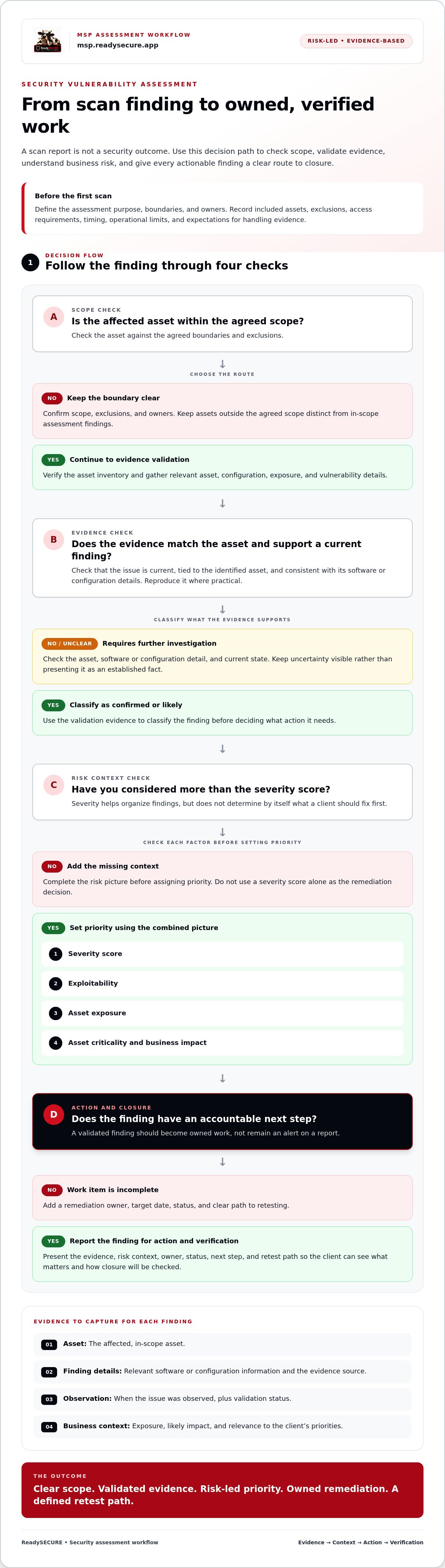
For each finding, capture the affected asset, relevant software or configuration detail, evidence source, and observation date. Check that the issue is current, reproducible where practical, and tied to the identified asset. Confirm that the affected asset is within scope and that the software or configuration detail matches the finding. Then classify it as confirmed, likely, or requiring further investigation. This keeps uncertain results visible without presenting them as established facts.
A strong assessment follows one sequence: define the objective, bound the scope, inventory assets, collect evidence, validate findings, and report owned next steps. No single tool covers every environment or answers every business question. Match methods to the scope, and make the evidence behind each conclusion clear. To bring assessment work into a more centralized vulnerability management workflow, explore vulnerability management for MSPs.
How to Prioritize Assessment Findings Beyond Severity Scores
A severity score helps organize findings, but it doesn’t determine what a client should fix first. In a security vulnerability assessment, combine the score with exploitability, exposure, asset criticality, and business impact. Record the evidence behind each judgment and flag assumptions so clients can distinguish verified facts from context-based conclusions.
How should MSPs interpret CVSS and vulnerability intelligence?
The Common Vulnerability Scoring System (CVSS) provides a standardized way to describe vulnerability severity. It supports triage, but it isn’t a complete, client-specific risk assessment. Add relevant vulnerability identifiers and trusted intelligence to findings where available, then verify that the information applies to the affected software and version. Don’t infer active exploitation or likely impact without supporting evidence.
Use these dimensions side by side rather than collapsing them into one score:
Severity score: What level of technical severity does the scoring framework indicate?
Exploitability: What evidence indicates whether the weakness can be exploited, and under what conditions?
Exposure: Is the affected asset internet-facing, internally accessible, or otherwise restricted?
Asset criticality: What role does the system play, and which services or dependencies rely on it?
Business impact: What operational consequences could follow if the weakness were exploited?
How do exposure and business impact change remediation priority?
Compare two findings with the same severity score. One affects an exposed server that supports a critical business service. The other affects a restricted system with limited operational importance. The first may warrant urgent action, while the second may fit planned remediation. The final priority depends on validated exploitability, access paths, and the client’s risk tolerance.
Identical severity scores can require different actions because exposure, asset role, dependencies, and business consequences differ between client environments.
Translate the analysis into a clear disposition:
- Urgent action: Evidence and business context support prompt remediation or mitigation.
- Planned remediation: Assign an owner and target date through the client’s agreed workflow.
- Accepted risk: Record the rationale, decision owner, and any conditions for review.
- Further investigation: State what remains uncertain and what evidence is needed to resolve it.
Make uncertainty visible. Separate confirmed technical evidence from assumptions about exploitability, exposure, or impact. That discipline gives clients a defensible priority order and technicians a clear next move.
How to Remediate, Retest, and Report Assessment Findings
A finding isn’t closed just because a ticket says “fixed.” Close the loop with a named owner, target date, status, and verification evidence. That turns a security vulnerability assessment into an active remediation process rather than a report that goes stale after delivery.
What should a useful vulnerability assessment report include?
Give clients enough context to understand the results and act on them. Start with a concise record of the assessment scope, date, methodology, exclusions, and limitations. Then present prioritized findings with supporting evidence, business impact, recommended action, owner, target date, and current status. Technical readers need enough detail to investigate; executives need a clear view of material risks, decisions, and progress.
Use consistent status labels so a mitigation isn’t mistaken for a permanent fix:
- Remediated: The underlying weakness has been corrected and verification supports closure.
- Mitigated: A control reduces exposure, but the underlying issue remains.
- Accepted risk: An authorized client decision records why the risk is retained and who owns that decision.
- Unresolved: The issue remains open, with its owner, next action, and target date documented.
White-label reporting helps MSPs present findings and remediation status under their own brand. Keep the details precise, and make residual risk visible rather than burying it in technical notes.
How should MSPs verify remediation and close the loop?
Match verification to the corrective action. Retest the affected asset when appropriate, or collect suitable evidence such as a configuration record or updated software version. Record what was checked, when it was checked, and the outcome. If the finding still appears, remains only partly addressed, or can’t yet be verified, keep it open and document the residual risk and reason.
Assessment and incident response serve different purposes. An assessment identifies and tracks weaknesses; it doesn’t replace a response plan for an active security incident. Use the MSP incident response plan template to build that separate workflow.
Keep ownership and status visible from discovery through retesting. Explore ReadySECURE vulnerability management to support centralized oversight and clear reporting across client environments.
How MSPs Make Security Vulnerability Assessments Repeatable Across Clients
Repeatability comes from standardizing the workflow, not pretending every client has the same risk. A consistent security vulnerability assessment gives technicians a reliable way to capture scope, evidence, ownership, and status. Client-specific asset context still determines which findings deserve attention first.
What should MSPs standardize across client assessments?
Build one assessment framework technicians can apply across accounts. Standardize the fields and definitions, then tailor each client’s priorities to its environment:
- Scope records: Include objectives, systems covered, exclusions, and relevant constraints.
- Evidence fields: Capture the affected asset, finding details, source, and observation date.
- Severity and status labels: Use consistent terms so teams and clients interpret findings the same way.
- Ownership and reporting: Record who is responsible for each action and use a consistent report structure.
- Follow-up cadence: Set review and reassessment timing around client needs, environment changes, and agreed risk requirements.
Keep risk decisions individualized. A shared template should make differences easier to see, not flatten them. An exposed system supporting a critical service may need different treatment from a similarly scored issue on a lower-impact asset. Preserve the reasoning behind each client’s priority and accepted-risk decisions.
How can a multi-tenant platform support assessment delivery?
A multi-tenant console gives MSP teams centralized visibility across managed environments, helping them track findings and remediation progress while keeping separate clients’ environments distinct. Keep each client’s assets, evidence, and decisions separate. Apply common prioritization principles across accounts while preserving the context that drives each client’s action plan.
ReadySECURE supports this operating model with vulnerability management that combines continuous scanning and risk-based prioritization, alongside white-label reporting tools. The workflow remains the foundation: define scope, validate findings, assign ownership, and report status. The platform helps MSPs operationalize that process across clients and present results clearly under their own brand. For more on platform evaluation, read the MSP white-label security platform guide.
For MSPs ready to bring assessment visibility and risk-based prioritization into a more consistent workflow, explore ReadySECURE vulnerability management.
Turn Assessment Findings Into a Repeatable MSP Advantage
A strong security vulnerability assessment does more than surface weaknesses. It gives your team a consistent process to scope client environments, validate evidence, and prioritize action by business risk. Clear ownership, retesting, and reporting then move findings from discovery to verified resolution.
Make the workflow repeatable, but keep decisions specific to each client. Standard templates and status definitions create consistency, while asset context and business impact shape remediation priorities. With the right operational foundation, assessment work becomes easier to track and communicate across managed environments.
ReadySECURE supports MSP delivery with a multi-tenant platform, continuous vulnerability scanning with risk-based prioritization, and white-label reporting tools. Explore ReadySECURE’s security platform for MSPs and build a clearer path from findings to action. Bring your vulnerability management workflow and client reporting together in one platform.
Frequently Asked Questions
What is a security vulnerability assessment?
A security vulnerability assessment is a scoped review that identifies potential weaknesses, validates relevant findings, and prioritizes action using asset and business context. Unlike raw scan output, it connects evidence to exposure, operational importance, and remediation decisions. For an MSP, the result should clarify which client assets were assessed, what needs attention, who owns next steps, and how remediation will be verified.
How do you perform a security vulnerability assessment?
Start by defining the assessment objective and agreeing on scope, boundaries, owners, exclusions, and operational constraints. Inventory the in-scope assets, then gather relevant vulnerability, configuration, and exposure evidence using methods appropriate to the environment. Validate findings against the affected assets and distinguish confirmed issues from uncertain results. Finally, prioritize actions, assign owners and target dates, report limitations, and set a method for verifying remediation.
How often should a vulnerability assessment be performed?
Set assessment frequency according to client risk, asset exposure, environment changes, and applicable requirements. Reassess after significant changes that could alter the security posture, such as new systems, major configuration updates, or changes to internet exposure. Continuous vulnerability scanning can help maintain visibility between structured reviews, but scan results still need validation and context. Document the cadence and the reasons behind it for each client.
What is the difference between vulnerability scanning and vulnerability assessment?
Vulnerability scanning uses automated checks to identify potential weaknesses in systems or software. A vulnerability assessment adds scope, validation, and context to determine which findings are relevant and how they should be prioritized. For example, an assessment considers whether a detected issue affects an exposed, business-critical asset or a restricted, lower-impact system. Scanning can supply evidence, but it doesn’t make the client-specific risk decision by itself.
Does a high CVSS score always mean a vulnerability must be fixed first?
No. A high CVSS score signals technical severity, but it doesn’t account for every client-specific factor. Consider exploitability, exposure, asset role, dependencies, and potential business impact before setting remediation order. A high-scoring issue on a restricted, low-impact system may rank behind a lower-scoring weakness on an exposed system supporting a critical service. Record the evidence and reasoning behind the chosen priority so clients can understand the decision.
How can an MSP reduce false positives in vulnerability assessment results?
Validate each alert against the asset’s identity, software version, configuration, and observation date. Check whether the finding is current and reproducible, and compare scanner output with other relevant evidence where available. Confirm that the affected system is within scope. Label unresolved uncertainty clearly instead of presenting a likely finding as confirmed. This focused review helps technicians direct limited time toward issues that warrant action or further investigation.
What should a vulnerability assessment report include?
A useful report records the assessment scope, date, methods, exclusions, and key limitations. For each prioritized finding, include the affected asset, supporting evidence, risk context, recommended action, owner, target date, and current status. Separate remediated, mitigated, accepted-risk, and unresolved items. Give technical readers enough detail to act, while making business impact and decisions clear to executives. Include how completed fixes will be verified and how open risks will be tracked.


