

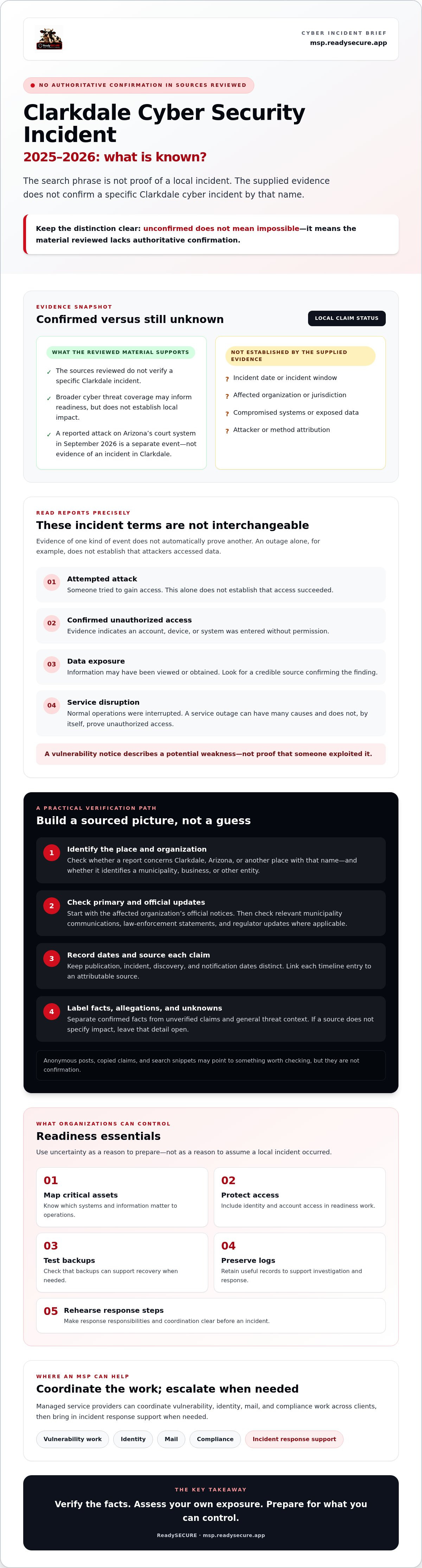
A cyber incident claim isn’t proof of a Clarkdale breach. A search for the clarkdale cyber security incident 2025 2026 may surface alarming or unrelated coverage, but the sources reviewed do not confirm a specific incident by that name.
It’s reasonable to want clear answers: Was an organization affected? When did it happen? Were systems or personal data involved? Those details matter, and shouldn’t be inferred from reports about attacks elsewhere. For example, a reported attack on Arizona’s court system in September 2026 is a separate event, not evidence of an incident in Clarkdale.
This article separates what’s confirmed from what remains unknown, then puts broader 2025-2026 threat patterns in context without presenting them as local evidence. It also offers practical steps for checking official updates, improving organizational readiness, and coordinating response work with an MSP. The goal is clarity, not alarm: verify the facts, assess your exposure, and act on what you can control.
Key Takeaways
- The clarkdale cyber security incident 2025 2026 isn’t confirmed by the authoritative sources reviewed. Verify the jurisdiction and affected organization before treating a claim as local fact.
- Distinguish an attempted attack from confirmed unauthorized access, data exposure, or service disruption. Build a timeline from sourced updates and label unknowns clearly.
- Broader cyber threat trends can inform preparedness, but they don’t establish that a Clarkdale organization was targeted or affected.
- Improve readiness by mapping critical assets, protecting access, testing backups, preserving logs, and rehearsing response steps.
- MSPs can coordinate vulnerability, identity, mail, and compliance work across clients, then bring in incident response support when needed.
Clarkdale cyber security incident 2025-2026: what is actually confirmed?
Was a Clarkdale organization hit by a cyberattack in 2025 or 2026? The supplied search evidence does not verify a specific Clarkdale cyber incident. That doesn’t prove no event occurred; it means the material reviewed lacks authoritative confirmation. The phrase clarkdale cyber security incident 2025 2026 is not evidence by itself.
Start by identifying the place and organization. A report should establish whether it concerns Clarkdale, Arizona, or another place with that name, and identify the municipality, business, or other entity involved. Without that context, national breach roundups and incidents elsewhere in Arizona shouldn’t be presented as Clarkdale events.
Keep four categories separate: confirmed facts stated by a credible source; reported allegations that remain unverified; unknowns not disclosed by reliable sources; and general threat context that may inform readiness but says nothing about a local incident. This disciplined approach aligns with the preparation, detection, response, and recovery phases of computer security incident management.
How to verify a reported Clarkdale cyber incident
Check the affected organization’s official notices first, followed by relevant municipality communications, law-enforcement statements, and regulator updates where applicable. For each source, record the publication date separately from the reported incident date, discovery date, and notification date. These dates may differ. Anonymous posts, copied claims, and search snippets can point to material worth checking, but they aren’t confirmation.
Build a timeline from attributable statements only. Link each entry to its source and note exactly what it confirms: an attempted attack, access to an account or system, service disruption, or information exposure. If a source doesn’t specify the affected systems or impact, leave those details open rather than filling in the gaps.
What remains unknown without authoritative reporting
A vulnerability notice identifies a potential weakness, not proof that someone exploited it. A service outage can have many causes, so it doesn’t establish unauthorized access on its own. Likewise, don’t name an attacker or method unless a credible source attributes it. If reliable reporting hasn’t disclosed affected records, systems, or people, state that plainly.
For the Clarkdale claim, the supplied evidence does not establish an incident date, affected organization, compromised systems, data exposure, or attribution. These are unknowns, not details to infer from broader cyber coverage. Until a primary source confirms them, keep local claims unverified and base decisions on your own organization’s evidence and established response process.
How a local cyber incident unfolds: evidence, impact, and disclosure
A cyber incident isn’t a single yes-or-no event. An attempted attack means someone tried to gain access. Confirmed unauthorized access means evidence indicates an account, device, or system was entered without permission. Data exposure means information may have been viewed or obtained, while service disruption means normal operations were interrupted. One event can involve several of these, but evidence of one doesn’t automatically prove the others.
For the clarkdale cyber security incident 2025 2026 claim, the supplied research provides no sourced local events to place on a timeline. Don’t fill that gap with dates or details from unrelated reports. A responsible timeline would list only documented milestones, such as the incident window, discovery, public disclosure, and any later notification, with a source for each entry. Mark dates that haven’t been reported as unknown.
Which incident details should a reliable report establish?
Look for the named organization, affected systems, incident window, and the source behind each technical finding. Check whether the organization, an investigator, or a regulator confirms unauthorized access, suspected exposure, or operational interruption. These terms describe different kinds of evidence. A report that says a service was unavailable, for example, doesn’t establish that attackers accessed data.
A breach is confirmed only when a credible source provides evidence of unauthorized access to protected systems or information; suspicion, a vulnerability, or an outage alone isn’t enough. This threshold keeps reporting precise and helps organizations make proportionate decisions.
Why disclosure timelines can leave gaps
Discovery, investigation, public announcement, and individual notification may happen at different times. An early statement may confirm an investigation while leaving the incident window, affected systems, or data impact unresolved. That uncertainty doesn’t prove concealment or a larger breach. Record what each update confirms, preserve earlier versions, and revise the timeline if an official statement corrects or adds details.
Potential consequences depend on what the evidence establishes. Unauthorized access could expose information or create a path to further activity; service disruption could affect operations. These are general possibilities, not confirmed Clarkdale impacts. Until a primary source identifies affected records, systems, or people, describe those details as undisclosed rather than assuming they were compromised.
For MSPs, a clear evidence trail also supports consistent client updates and response coordination. A multi-tenant security platform can help organize vulnerability, Microsoft 365, mail security, and compliance work across clients. Explore the MSP security platform as one possible readiness resource.
What 2025 cyberattack trends mean for Clarkdale, and what they do not
Reports about attacks elsewhere can help organizations identify risks worth reviewing. They cannot establish that Clarkdale experienced the same attack, weakness, or impact. Industry threat intelligence and recent summaries discuss identity security, social engineering, third-party access, SaaS configuration, and operational resilience. They provide context, not verified findings about a Clarkdale incident.
The distinction matters. An industry pattern can guide a security review, but it can’t identify the method behind a specific event. Threat-trend analysis tells you what to prepare for; incident attribution tells you what the evidence shows happened. For the clarkdale cyber security incident 2025 2026 claim, available evidence doesn’t connect these reported themes to a local organization.
| Observed trend in broader reporting | Cited example | Clarkdale local evidence | Practical implication |
|---|---|---|---|
| Identity, social engineering, and supplier access | Industry reporting mentions vishing and third-party exposure, alongside broader discussions of identity and supplier access. | No public or verified local evidence links these specific vectors to a confirmed Clarkdale incident. | Review account protections and supplier access. Don’t assign a method or actor without official findings. |
| SaaS exposure and misconfiguration | External breach cases describe software misconfiguration and data exposure. | No verified documentation confirms similar SaaS exposure or misconfiguration locally in Clarkdale. | Check configuration, permissions, and who can access sensitive information. |
| Operational resilience | Security analyses frequently draw lessons from municipal and enterprise breaches. | No local incident reports confirm similar operational disruptions in Clarkdale. | Assess service continuity and recovery plans separately from data confidentiality. |
Identity, social engineering, and third-party access
A compromised account can give an attacker access under a legitimate user’s identity. A supplier connection can also create risk for connected organizations, depending on the access granted. These are reasons for businesses, including those partnering with ReadySECURE, to review account safeguards, permissions, and vendor access, not proof that a Clarkdale entity was affected. Any claim about a local attack path should be based on confirmed findings from the affected organization or investigators.
SaaS exposure, misconfiguration, and operational resilience
External examples illustrate why configuration and access reviews matter: a weakness in software settings may affect information confidentiality. An outage raises a different concern, availability and continuity. These outcomes can overlap, but one doesn’t prove the other. A national example can suggest useful questions for a Clarkdale organization to ask; it can’t predict that organization’s experience or establish a local breach.
Use trends as a checklist, not a verdict. Review identity controls, supplier permissions, SaaS settings, and recovery plans. Keep local incident reporting tied to dated, attributable evidence.
What Clarkdale organizations and MSPs can do before an incident
Readiness turns uncertainty into a manageable process. Whether or not the reported clarkdale cyber security incident 2025 2026 claim is substantiated, local organizations can reduce confusion by knowing what matters most, who makes decisions, and how to preserve evidence.
A practical first-day readiness checklist
Build the plan before it’s needed. Assign incident contacts, escalation authority, backup access, and responsibility for preserving relevant evidence. Map critical systems and key dependencies so the response team knows what to prioritize. Then check that the plan works in practice:
- Map assets: Identify critical systems, accounts, data, and essential suppliers.
- Protect access: Review multifactor authentication, privileged accounts, and access that staff or vendors no longer need.
- Check exposure: Set a routine for patching and reviewing important system configurations.
- Test recovery: Confirm backups can be restored and recovery procedures are accessible to authorized staff.
- Rehearse response: Walk through who reports suspicious activity, who preserves logs, and who approves communications.
If something looks suspicious, use established internal reporting channels and preserve relevant logs. Avoid deleting messages, changing affected systems, or making public claims before the appropriate response lead assesses the evidence. Coordinate updates through approved communication channels.
Individuals who believe they may be affected should rely on official notices from the named organization and follow its verified instructions. Check the organization’s established website or contact channel rather than trusting an unsolicited message that asks for sensitive information.
How MSPs can coordinate client response
Set client-specific roles and reporting paths in advance. Define what clients should escalate, who at the MSP receives a report, and when the matter requires additional expertise. Keep contact details, system ownership, and evidence-handling responsibilities current. A clear playbook can reduce delays and prevent conflicting instructions.
MSPs can use vulnerability management to prioritize known exposure and Microsoft 365 security work to review relevant account and tenant settings. Match the work to each client’s systems and documented risks. If an event exceeds internal capability, consider expert incident response or vCISO support instead of improvising under pressure.
ReadySECURE’s multi-tenant platform can help MSPs coordinate vulnerability management, Microsoft 365 security, mail security, and compliance work across clients. Explore the MSP security platform as a readiness resource.
Turn Clarkdale incident uncertainty into stronger response readiness
Security decisions should follow verified facts, not the loudest claim in a search result. The available evidence doesn’t establish a Clarkdale incident, so it can’t justify assumptions about a local victim, attacker, or impact. For organizations and MSPs, the useful next step is to assess readiness against documented risks and keep response plans current.
What an MSP should assess in its security operating model
Start with consistency across client environments. Confirm that system ownership, security responsibilities, escalation contacts, and reporting paths are documented for each client. Then check whether your team can see remediation progress and outstanding exposure across tenants while retaining the client-level detail needed to act. Clear visibility supports better prioritization and more useful client communication.
Review how vulnerability findings, identity protections, mail security, and compliance work fit together. For example, can the team connect a known system weakness to its owner, track remediation, and report what remains unresolved? Can client contacts report suspicious activity through a clear, agreed channel? These checks can reveal coordination gaps before pressure rises.
Set a threshold for bringing in additional expertise. If an incident requires investigation or response beyond your team’s capabilities, expert-led incident response may be appropriate. If strategic direction, risk prioritization, or executive guidance is missing, vCISO support may help fill that need. Define those decision points before an incident, not during one.
A measured next step for MSPs
Use the clarkdale cyber security incident 2025 2026 search as a prompt to review your process, not as evidence of a local breach. Walk through a realistic scenario with your team: who receives the first report, who preserves relevant records, who updates the client, and who decides whether to escalate? Record gaps and assign owners to address them.
ReadySECURE is a multi-tenant security platform for MSPs that brings together vulnerability management, Microsoft 365 hardening, mail security, and compliance work. It also offers expert-led incident response and vCISO support, while white-label reporting tools can support client-facing security services. These are readiness resources, not evidence of involvement in a Clarkdale incident or a promise of round-the-clock coverage.
If you’re reviewing how your team coordinates security work across clients, explore the MSP platform and assess whether its capabilities fit your operating model.
Make verified facts the start of stronger readiness
The evidence reviewed doesn’t confirm a specific Clarkdale cyber incident in 2025 or 2026. That distinction matters: broader attack trends can inform preparation, but they can’t establish a local victim, cause, or impact. Verify claims through authoritative sources, and tie incident timelines to documented events.
For local organizations, readiness depends on clear ownership, tested recovery procedures, preserved evidence, and a response process people understand. MSPs can strengthen coordination by tracking vulnerability, identity, mail security, and compliance work across client environments, with escalation paths agreed in advance.
ReadySECURE is an MSP-focused, multi-tenant platform that brings vulnerability management, Microsoft 365 hardening, mail security, and compliance together. It also provides expert-led incident response support. These capabilities are readiness resources, not evidence of involvement in any Clarkdale incident.
Review your current workflow and identify where coordination or response expertise could help. Explore incident response support for MSPs. Clear evidence and practical preparation put your team in a stronger position to act with confidence.
Frequently Asked Questions
What happened in the Clarkdale cyber security incident in 2025 or 2026?
No specific Clarkdale cyber incident in 2025 or 2026 is established by the authoritative sources reviewed. The available evidence doesn’t identify an affected Clarkdale organization, incident date, compromised system, or impact. Reports about cyberattacks elsewhere, including other Arizona incidents, don’t confirm an event in Clarkdale. Treat the claim as unverified unless the named organization or another authoritative source publishes details.
Is the Clarkdale cyber security incident confirmed?
No. The clarkdale cyber security incident 2025 2026 claim isn’t confirmed by the authoritative evidence reviewed. That doesn’t prove no incident occurred; it means the evidence doesn’t substantiate one. Look for a direct statement from the affected organization, relevant municipality, law enforcement, or another credible authority. Search snippets, anonymous posts, and repeated claims aren’t confirmation on their own.
What information should I check about a reported Clarkdale data breach?
First, confirm the jurisdiction and identity of the organization named in the report. Then check official statements for the incident window, discovery date, affected systems, type of information involved, and whether access or exposure was confirmed. Note the publication date separately from incident and notification dates. Check who is making each claim and whether later official updates revise earlier details. If information hasn’t been disclosed, treat it as unknown.
Could a 2025 cyberattack trend explain a Clarkdale incident?
Not without local evidence. Trends such as social engineering, compromised accounts, supplier access, or SaaS misconfiguration can help organizations decide what to review. They don’t establish how a particular Clarkdale event happened, or even confirm that one occurred. Treat these patterns as preparation guidance. Attribute an attack method or actor only when credible incident findings support that conclusion.
What should a Clarkdale organization do after discovering a possible cyber incident?
Follow the organization’s established incident reporting and escalation process. Preserve relevant logs and records, note what was observed and when, and involve the people authorized to assess and respond. Avoid unsupported public claims or actions that could destroy evidence. If a third party may be affected, use agreed communication channels. Base notifications and next steps on verified findings and applicable internal procedures.
How can an MSP help a client prepare for a cyber security incident?
An MSP can document client-specific systems, responsibilities, contacts, reporting paths, and escalation thresholds before an incident. It can also coordinate vulnerability management, Microsoft 365 security, mail security, and compliance work across client environments. When internal capability isn’t sufficient, the MSP can consider expert incident response or vCISO support. A clear plan helps teams preserve evidence, communicate consistently, and make decisions based on verified information.
Does a reported cyber incident mean personal data was stolen?
No. A reported incident may involve an attempted attack, unauthorized access, service disruption, or another security issue. None of these alone proves that personal data was viewed, copied, or stolen. Check the organization’s official notice for what information, if any, was affected and whether exposure was confirmed or remains under investigation. If you may be affected, follow verified instructions from the organization rather than relying on unconfirmed claims.


