

The compliance management solutions with the most features aren’t automatically the right fit for your MSP. If evidence is scattered across client environments and audit preparation keeps pulling skilled staff away from recurring work, another complex platform can add friction instead of removing it.
You need a repeatable way to track controls, gather evidence, and deliver clear client-facing updates. That’s why the choice between broad GRC tools and MSP-oriented compliance management solutions matters. The right approach should fit your service model, support consistent workflows across clients, and help you deliver compliance as an ongoing service.
This guide compares solution approaches using practical MSP-focused criteria, including multi-client management, evidence collection, control mapping, reporting, and governance support. It also explains how ReadySECURE brings compliance capabilities into a white-label, multi-tenant security platform alongside other security functions. Use the framework to assess platform fit, organize evidence workflows, and build a compliance service your team can deliver consistently.
Key Takeaways
- Compare compliance management solutions by how well they support multi-client oversight, evidence workflows, reporting, and governance.
- Use a repeatable workflow to connect each control and evidence item to a client, an owner, and a review date.
- Assess platform fit against your MSP’s tenant model, service ownership, client requirements, and reporting needs.
- Standardize compliance delivery with reusable processes that help your team track progress across client environments.
- See how ReadySECURE’s multi-tenant platform brings continuous evidence collection, control mappings, governance resources, and white-label reporting together.
Why MSPs Need Compliance Management Solutions That Scale Across Clients
For an MSP, compliance is not a folder assembled just before an audit. It’s an ongoing operating process: identify the obligations relevant to a client, track the controls intended to address them, retain supporting evidence, and monitor progress. Governance, Risk, and Compliance (GRC) brings these connected disciplines into view. A structured process helps turn compliance work into a service the MSP can manage consistently across its client portfolio.
Quotable definition: Compliance management solutions are tools and workflows that help an organization organize obligations, controls, evidence, and progress. They support compliance work but don’t provide legal advice, audit assurance, or a guarantee of certification.
The distinction matters. Software can show that a control has an owner, a review date, and attached evidence. It can’t, by itself, decide whether a requirement applies to a client or certify that the client meets it. Those judgments require appropriate expertise and, where relevant, an independent assessment.
What compliance software helps an MSP manage
Think of each client’s compliance work as a connected set of records, not a pile of documents. Control tracking shows what needs attention. Evidence collection links records to the controls they support. Policy management keeps governance materials organized, while task ownership makes responsibility visible. Client-level views help an MSP separate environments, review open work by account, and maintain portfolio-wide oversight.
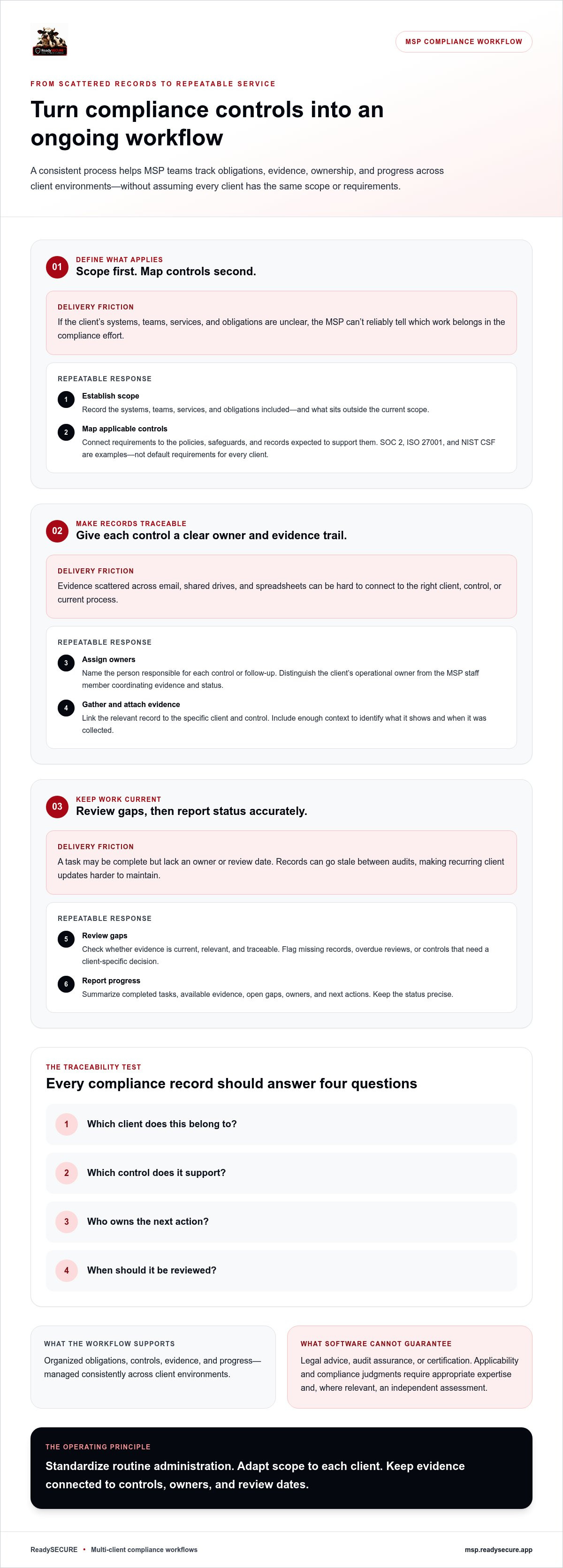
Useful records answer four questions: Which client does this belong to? Which control does it support? Who owns the next action? When should it be reviewed? That structure makes evidence easier to interpret and maintain. It also gives service teams a consistent operating model while leaving room for different client scopes and requirements.
Why audit-only work creates delivery friction
When evidence lives in email threads, shared drives, and individual spreadsheets, staff must reconstruct the story each time someone requests it. A document may be current but disconnected from its control. A task may be complete but lack a named owner or review date. If every account uses a different tracking method, recurring client updates become harder to compare and maintain.
That’s the weakness of treating compliance as a one-time audit-preparation project. Work spikes around a review, then records can go stale. An ongoing workflow keeps responsibilities and evidence in view between formal assessments, supporting steadier service delivery instead of last-minute document hunts.
Illustrative workflow, not a time-saving claim: A client asks for evidence of a control. The MSP locates the control record, checks its linked evidence and review date, flags any gap to the assigned owner, then reports the status in its regular client update. Without a shared process, staff may need to search multiple folders and ask colleagues to confirm which file is current.
How Compliance Management Solutions Turn Controls Into Ongoing Workflows
A control becomes operational when someone knows what it requires, who owns it, what evidence supports it, and when that evidence needs review. Build the workflow once, then adapt its scope to each client. This gives the MSP a consistent process without assuming every client has the same obligations or maturity.
Quotable takeaway: Continuous evidence collection supports audit readiness by keeping records organized and reviewable, but it can’t guarantee an audit outcome.
From scope to evidence: a repeatable workflow
Use a consistent sequence for each client. Standardize routine administration, and reserve interpretation for qualified people who understand the client’s context.
- Establish scope. Record the systems, teams, services, and obligations included in the client’s compliance effort. Define what sits outside the current scope, too.
- Map controls. Connect applicable requirements to the policies, safeguards, and records expected to support them. Frameworks such as SOC 2, ISO 27001, and NIST CSF are examples, not default requirements for every client. The National Institute of Standards and Technology (NIST) is a primary reference point for its cybersecurity resources and frameworks.
- Assign owners. Name the person responsible for each control or follow-up. Distinguish the client’s operational owner from the MSP staff member coordinating evidence and status.
- Gather evidence. Attach the relevant record to the specific control and client. Include enough context to identify what it shows and when it was collected.
- Review gaps. Check whether evidence is current, relevant, and traceable. Flag missing records, overdue reviews, or controls that need a client-specific decision.
- Report progress. Summarize completed tasks, available evidence, open gaps, owners, and next actions. Keep the status precise.
Make evidence traceable, then report it accurately
A useful control map links a requirement to the policy or process that addresses it, the evidence that supports it, and the accountable owner. Add a review date so staff can tell whether a record still reflects the client’s environment. For example, a policy document may support a control, but a reviewer may also need evidence that the relevant process is being followed. The control map should make that relationship visible, not imply that one file proves everything.
Apply the same discipline across client environments while validating the actual scope and mappings for each engagement. A framework name alone doesn’t establish applicability, and a generic mapping shouldn’t replace expert interpretation. Validate framework-specific mappings before presenting them as authoritative.
Client reporting should distinguish four different signals: a task is complete, evidence has been collected, a gap has been identified, or a formal audit outcome has been issued. These aren’t interchangeable. A clear update names the status, accountable owner, and next action, helping the client understand what needs attention without overstating compliance. MSPs building this process can explore a multi-tenant compliance workflow to support evidence and control tracking across client environments.
Compliance Management Solution Types Compared for MSP Use
Three operating models appear often in an MSP’s search: broad governance, risk, and compliance (GRC) platforms, specialist compliance tools, and MSP-oriented multi-tenant platforms. Their labels don’t guarantee specific capabilities. Use the comparison to identify likely trade-offs, then assess how each approach would support your actual client workflows.
| Comparison area | Broad GRC platform | Specialist compliance tool | MSP-oriented multi-tenant platform |
|---|---|---|---|
| Tenant separation | May support multiple entities or business units; assess how client boundaries are configured. | Often organized around a focused program or organization; managing several clients may require separate workspaces or processes. | Designed to manage multiple client environments in one operating model; assess how separation and access are handled. |
| Evidence workflows | May connect compliance evidence to broader risk and governance processes. | May prioritize evidence tasks for its specific compliance use case. | May provide a repeatable way to collect and track evidence across client accounts. |
| Reporting | Can suit governance-level views when those are supported and configured. | May focus reports on program status or defined compliance tasks. | Can help organize client-level updates alongside a portfolio view. |
| Governance support | Potentially broad, depending on the platform’s scope and configuration. | May be narrower, aligned to its specialist purpose. | May pair compliance workflows with MSP service delivery and related security operations. |
| Portfolio visibility | Depends on how multiple clients and reporting views are structured. | May require additional administration to compare separate client programs. | Portfolio oversight is a core design consideration, but implementation varies. |
Broad GRC and specialist tools serve different needs
A broad GRC approach may fit an MSP supporting clients with connected governance and risk-management needs, not just evidence tracking. A specialist tool may make more sense when the work centers on a focused compliance process. For instance, clients working toward ISO/IEC 27001 Information Security Management may need controls and documentation aligned to that standard. This example doesn’t mean every client needs it or that any platform automatically supports it.
Multi-tenant design changes the portfolio equation
Separate client tools can give teams distinct environments, but they may also mean repeated setup, separate task tracking, and multiple reporting routines. An MSP-oriented platform can centralize administration while keeping client work organized, if its access model and tenant boundaries fit the service. Test the routine itself: can staff move from portfolio-level oversight to a specific client’s evidence and next actions without mixing records or rebuilding reports?
ReadySECURE is a client-specific example of this approach. Its white-label, multi-tenant security platform includes compliance and governance capabilities, continuous evidence collection, control mappings, a policy library, awareness training, and client-facing reporting tools. The wider platform brings other security capabilities into one console. Assess framework coverage against each client’s actual needs rather than assuming it from the platform category.
Quotable takeaway: The operating model is a stronger comparison point than feature count alone. Choose the approach that makes client separation, evidence handling, governance, and portfolio oversight workable for your team.
How to Evaluate Compliance Management Solutions for Your MSP
Choose a platform by testing how it supports your service model, not by counting features. A polished dashboard matters less if staff can’t keep client records separate, trace evidence to controls, or turn open issues into clear next steps. Use a consistent scorecard, then test the workflow with a client scenario your team actually handles.
Build an MSP-focused solution scorecard
Rate each area against your requirements using a simple scale such as “doesn’t meet,” “partially meets,” and “meets.” Record the evidence behind each rating. Separate must-haves from desirable extras so an attractive feature list doesn’t distract from the work your team needs to deliver.
- Tenant model: Can staff move between client accounts while preserving clear separation and appropriate access?
- Evidence workflow: Can evidence be associated with the right client and control, with its owner and review status easy to find?
- Control mapping: Can your team understand how controls relate to client requirements and identify where expert review is needed?
- Reporting: Can you provide client-facing updates that show progress, gaps, accountable owners, and next actions?
- Service ownership: Does the platform support your team’s responsibilities without obscuring what the client must own?
Then assess portfolio visibility, repeatable administration, evidence traceability, and governance support. A solution should complement your delivery model, not force your team into a reporting or ownership process it can’t sustain. Treat reliable client separation and usable evidence records as distinct from helpful extras that aren’t essential.
Match solution scope to clients and service capacity
Run a client-fit test before settling on a standard service workflow. Segment accounts by their compliance drivers, environment complexity, existing maturity, and availability of internal owners. A client with established policies and a named compliance lead may need a different level of MSP coordination than one still defining responsibilities and documenting basic processes.
Next, test the platform against a representative task. For example, take a control with a pending evidence review. Can the assigned person locate the request, see the relevant client context, attach or update evidence, flag an issue, and show the next step in a report? Note where your staff must leave the workflow to interpret requirements or make a client-specific judgment. Those steps may call for expertise, not another software feature.
Use vCISO support to complement software-supported administration when a client needs expert-led guidance on governance, risk, or security priorities. The tool can organize records and responsibilities; professional judgment helps shape the program around the client’s circumstances. For broader service-model considerations, consult this IT compliance services buying guide.
For a practical comparison, explore the multi-tenant platform and consider how shared administration and client-level compliance work could fit together.
Build a Repeatable Compliance Service With ReadySECURE
A platform becomes valuable when its capabilities fit the work your MSP can deliver consistently. ReadySECURE brings compliance and governance functions into a white-label, multi-tenant security platform for managing multiple client environments. It gives MSPs a foundation for organizing recurring compliance work while keeping client service delivery under their own brand.
What ReadySECURE brings to MSP compliance delivery
ReadySECURE includes continuous evidence collection and control mappings, supported by a policy library and security awareness training. These capabilities help MSP teams organize evidence and governance activities as ongoing work rather than isolated preparation tasks. Use control mappings in context: confirm they align with each client’s requirements and scope before presenting them as a fit.
The multi-tenant console is designed for MSP management across client environments. Teams need to manage separate client work while maintaining an overview of activity across the portfolio. White-label reporting tools support client-facing communication under the MSP’s brand, so progress and outstanding actions can be presented as part of a consistent service.
Compliance doesn’t sit alone. The wider platform brings vulnerability management, Microsoft 365 hardening, and mail security into one console alongside compliance capabilities. This can help an MSP connect governance discussions with related security work in its service delivery. Clear ownership still matters: teams need to identify who supplies evidence, who reviews gaps, and who approves client-specific decisions.
For clients that need strategic guidance alongside platform-supported workflows, ReadySECURE provides expert-led vCISO support. Keep the roles distinct. The platform supports evidence and control processes; vCISO expertise can help guide governance and security priorities based on the client’s circumstances.
Turn platform capability into a client-facing service
Start with a repeatable service rhythm. Define the client scope, assign owners, review evidence and control status, then report progress in a format clients can understand. White-label reporting supports branded communication. Consistent workflows help make responsibilities and next actions visible, while the MSP can tailor the service to each client’s needs.
That operating model is the bridge between technology and a credible recurring service. For a broader view of how governance, risk, and compliance can shape MSP delivery, explore GRC platforms for MSPs.
Use the ReadySECURE platform to assess how its multi-tenant compliance capabilities fit your MSP’s service model.
Turn Your Compliance Model Into the Next MSP Advantage
Your next move is to define the service your team can deliver consistently. Set a clear scope, assign ownership, and decide how you’ll communicate progress to each client. Then judge whether your compliance management solutions support the work in practice, not just on a feature list.
ReadySECURE gives MSPs a multi-tenant platform that brings compliance and other security capabilities together. Evidence collection, control mappings, policies, and awareness training support governance workflows, while white-label reporting tools help you present updates under your brand. Use these capabilities to shape a service model around client needs and manage it with greater clarity.
Explore ReadySECURE’s platform for MSPs to assess how its capabilities fit your delivery approach and build a compliance service with a clear operating foundation.
Frequently Asked Questions
What are compliance management solutions?
Compliance management solutions are software and workflows that help organizations organize applicable requirements and manage the controls, evidence, accountable people, and status connected to them. For example, a team might record a policy review date, its approver, and the supporting document together. These tools support compliance operations, but they don’t independently establish legal compliance, award certification, or guarantee a successful audit.
How do compliance management solutions help MSPs manage multiple clients?
Compliance management solutions can give an MSP a portfolio view of open work while keeping records and reporting organized by client. For example, a service lead could spot overdue evidence reviews across accounts, then open an individual client view to see assigned tasks. The result depends on platform design. Compare how a tool handles tenant separation, staff access, repeatable workflows, and the client-facing reports your service requires.
Can compliance management software make a business audit-ready?
It can support preparation by keeping records organized, associating evidence with controls, and making responsibilities easier to track. A practical test is whether staff can retrieve a requested record and explain its context without relying on one person’s memory. Readiness still depends on the organization’s defined scope, how controls are implemented, evidence quality, and the auditor’s requirements. Software alone can’t promise an audit result.
What is the difference between GRC software and compliance management software?
GRC software commonly addresses governance, risk, and compliance as related management activities. Compliance management software may focus more narrowly on requirements, controls, evidence, and related tasks. In practice, the categories overlap, and product labels don’t reliably describe every workflow. Compare what the software lets your team do, such as track risk decisions, manage policies, or prepare client-specific evidence, rather than choosing by terminology alone.
Do MSPs need a separate compliance platform for every client?
Not necessarily. The right setup depends on each client’s environment, separation requirements, reporting needs, and the platform’s tenant architecture. A multi-tenant model may let an MSP manage client-level workflows from a shared operating environment while maintaining portfolio oversight. Separate tools can also be appropriate in some cases. Assess how access, records, and reports are kept distinct; don’t assume every platform handles client separation in the same way.
Which compliance frameworks should an MSP compliance solution support?
Framework needs depend on each client’s sector, geography, contracts, and audit goals, so no single set applies to every MSP portfolio. SOC 2, ISO 27001, and NIST CSF are examples, not universal requirements. Before selecting a tool or presenting a mapping to a client, confirm that the mapping fits the applicable framework and the client’s defined scope. A framework label alone doesn’t establish applicability.


