

Collecting documents on audit day is a poor foundation for a scalable compliance service. The right IT compliance services help your MSP build repeatable client workflows, so evidence, controls, and follow-up stay organized between assessments.
Evidence gathering and documentation take staff time, while requirements vary from one client engagement to the next. To deliver consistently, your team also needs clear ownership, the right expertise, and a process for tracking open actions. Without those pieces, compliance work can quickly become difficult to scale.
This guide compares common service models and the capabilities that matter, so you can choose an approach that fits your MSP’s expertise and client base. You’ll see how continuous evidence collection, control mappings, organized policies, and client-ready reporting can make delivery more repeatable. We’ll also look at how a multi-tenant platform and expert-led vCISO support can work together, helping you coordinate compliance with broader security services rather than relying on disconnected tools.
Key Takeaways
- Define clear service boundaries so clients understand that compliance support does not guarantee certification, audit success, or legal compliance.
- Compare internal, specialist-led, software-enabled, and blended delivery models against your team’s expertise and workload.
- Assess how IT compliance services can organize evidence, controls, policies, training, and reporting across client environments.
- Use automation to coordinate repeatable workflows, while reserving interpretation and client decisions for expert judgment.
- Start with your target clients’ needs, map a consistent workflow, then expand your offering as delivery capacity grows.
What IT compliance services do MSP clients actually need?
Your clients don’t all need the same compliance program. Their industry, contracts, data, and business goals shape which controls and activities matter. One client may need to organize evidence for a customer assessment; another may be working toward a specific framework or managing requirements tied to its operations. For your MSP, the practical starting point is to identify recurring client needs, then build repeatable support around them and coordinate it with the security work you already deliver.
IT compliance services provide ongoing support for organizing controls, policies, evidence, and activities against a client’s objectives and selected framework. They can make the work more manageable, but they don’t guarantee certification, audit success, or legal compliance. Be clear about that boundary. The client remains responsible for its decisions and obligations, while qualified professionals help interpret requirements that depend on its circumstances.
What work can IT compliance services cover?
Scope can include policy management, employee awareness training, evidence collection, control mapping, and readiness workflows. For example, your team might organize a client’s policies, map existing security practices to selected controls, and maintain evidence as those practices operate. That ongoing management differs from a one-time audit: it supports a continuing process of tracking activities and preparing documentation, rather than focusing only on a single assessment.
The right mix depends on the client’s goals and framework. Standardize how your team requests, collects, and organizes information, then tailor the work to each client’s environment. As you define the scope, specify which activities your MSP handles, which actions belong to the client, and how open items are reported and followed up.
Which frameworks might clients ask about?
Clients may ask about SOC 2, ISO/IEC 27001, HIPAA, or GDPR, among other frameworks and obligations. These examples aren’t interchangeable, and they don’t automatically apply to every organization. Requirements can depend on factors such as the client’s business, contracts, data, and operating context. The overview of Information security standards can help orient MSPs to the wider standards landscape, but it doesn’t replace client-specific interpretation.
Qualified interpretation matters, especially when a client’s obligations are unclear or involve legal or regulatory questions. Define what your team supports, document where expert guidance is needed, and avoid presenting operational assistance as a compliance guarantee.
For MSPs, the commercial opportunity is in disciplined delivery. Package recurring activities around needs clients share, such as maintaining policies, organizing evidence, or tracking mapped controls. Then connect that work to existing security operations, including vulnerability management and Microsoft 365 security where relevant. A coordinated service is easier to explain and repeat than a collection of disconnected documentation tasks.
Compare IT compliance service models before choosing a delivery approach
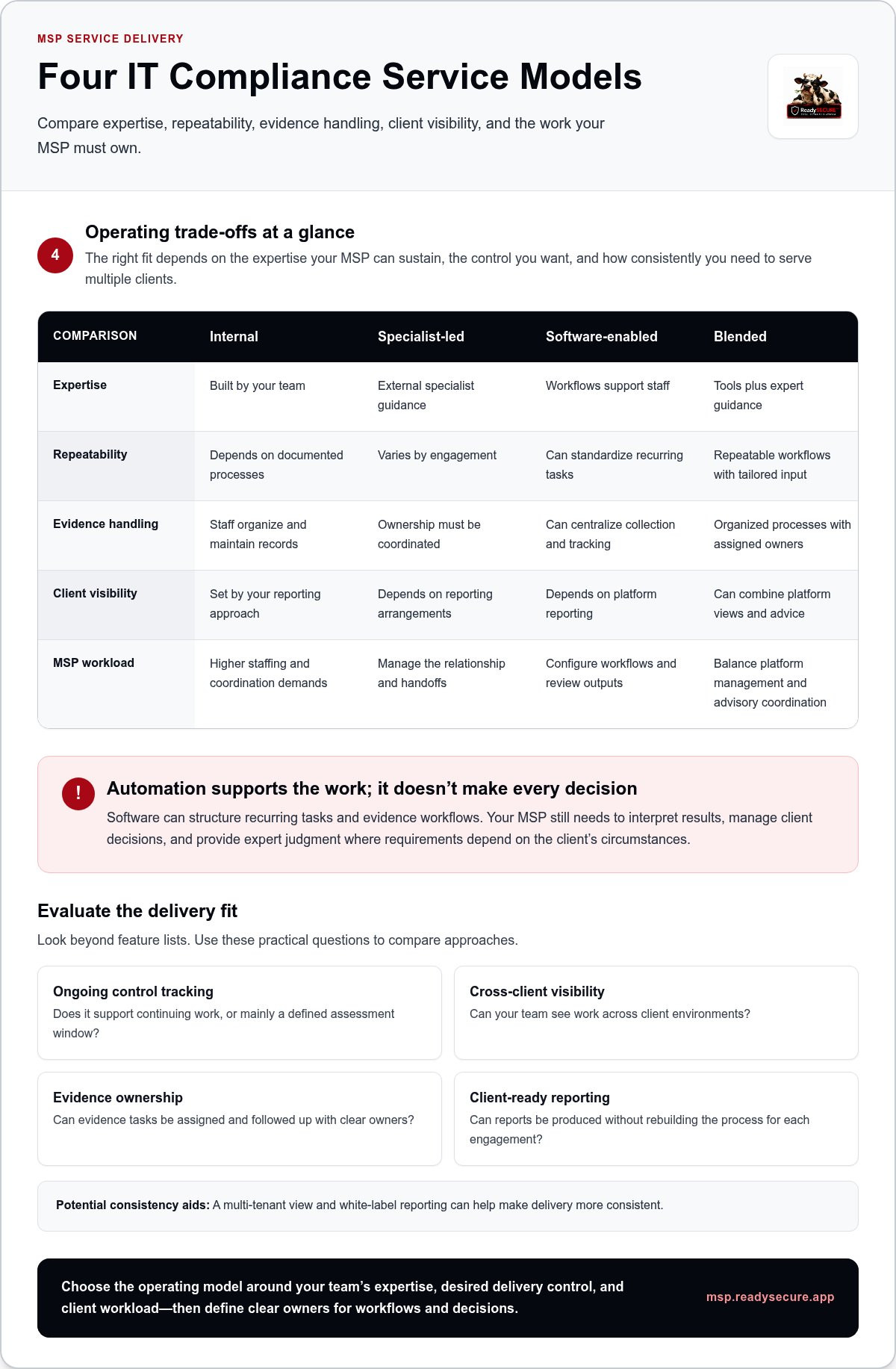
The right model depends on the expertise your MSP can sustain, how much control you want over delivery, and how consistently you need to serve multiple clients. A tool can structure tasks and evidence, but it can’t make every compliance decision for you. Compare the operating trade-offs before you build IT compliance services into your recurring offer.
In-house, outsourced, or platform-enabled compliance support?
Internal delivery gives your team direct control, but your staff must build expertise, assign ownership, and keep evidence organized. Specialist-led support adds focused guidance, though coordination and client reporting still need clear owners. Software-enabled workflows can standardize recurring tasks, but the MSP must interpret results and manage client decisions. A blended model combines workflow technology with expert-led guidance where judgment is needed.
| Model | Expertise | Repeatability | Evidence handling | Client visibility | MSP workload |
|---|---|---|---|---|---|
| Internal | Built by your team | Depends on documented processes | Staff organize and maintain records | Set by your reporting approach | Higher staffing and coordination demands |
| Specialist-led | External specialist guidance | Varies by engagement | Ownership must be coordinated | Depends on reporting arrangements | Manage the relationship and handoffs |
| Software-enabled | Workflows support staff | Can standardize recurring tasks | Can centralize collection and tracking | Depends on platform reporting | Configure workflows and review outputs |
| Blended | Tools plus expert guidance | Repeatable workflows with tailored input | Organized processes with assigned owners | Can combine platform views and advice | Balance platform management and advisory coordination |
How should MSPs compare service scope and delivery?
Look past feature lists. Does the approach support ongoing control tracking, or mainly help during a defined assessment window? Can your team see work across client environments, assign evidence tasks, and produce client-ready reports without rebuilding the process for each engagement? A multi-tenant view and white-label reporting can help make delivery more consistent, while expert input supports interpretation and client-specific decisions.
Frameworks and control sets also shape the work. The NIST Cybersecurity Framework is one reference MSPs may use to organize cybersecurity risk management, but the client’s scope still drives what applies. For a broader look at how platforms fit into an MSP offering, read the white-label security platform guide.
ReadySECURE provides a white-label, multi-tenant security platform for MSPs, with compliance capabilities that support organized workflows across client environments.
Which capabilities make IT compliance services practical at MSP scale?
Scale depends on more than having a place to store documents. Your team needs to know which evidence belongs to which client, which control it supports, who owns the next action, and how to show progress clearly. Strong IT compliance services connect these tasks in a workflow staff can repeat while keeping client-specific requirements visible.
Evidence, controls, and policies in one workflow
Continuous evidence collection helps teams keep relevant records organized as work happens, instead of scrambling to assemble them only before an audit or assessment. Control mapping adds structure by showing how a piece of evidence or a security activity relates to a selected control or requirement. It helps organize the relationship, but it doesn’t, by itself, prove that a control is effective.
A policy library can give teams a starting resource, but policies still need review, tailoring, approval, and implementation for the client. Awareness training supports the people side of the program. Reporting then turns collected information into a view that staff and clients can use. Assign owners for gathering evidence, reviewing mapped controls, updating policies, and communicating status so these capabilities connect to clear responsibilities.
Evidence shows what is documented, controls describe what should be in place, and remediation tracking shows what still needs action. Keep those functions connected, but don’t treat them as interchangeable.
Connect compliance with the wider security stack
Compliance work becomes more operationally useful when it reflects the security services already supporting the client. Vulnerability management can help identify and track security issues relevant to mapped controls. Microsoft 365 security work can inform evidence and control reviews tied to a client’s tenant. The M365 security hardening tools guide offers further context where tenant security intersects with compliance work.
A multi-tenant console can help MSP teams organize activity across client environments without losing sight of each client’s separate work. Pair that view with clear task ownership and white-label reporting, so staff can see what needs attention and clients can understand progress. The NIST Cybersecurity Framework provides a reference for organizing cybersecurity risk management, but each client’s selected framework and objectives should guide how controls and evidence are handled.
Choose capabilities that support the workflow you intend to deliver: collect, map, review, assign, report. Automation can make recurring steps easier to coordinate, while staff and expert advisors remain responsible for interpretation, follow-through, and client-specific judgment.
Can compliance automation replace expertise? Evaluate the limits before you buy
No. Automation can organize repeatable work, but it can’t take responsibility for interpreting requirements or making risk decisions. For MSPs building IT compliance services, that distinction matters: workflow tools can improve consistency, while people provide context, judgment, and accountability.
What automation can streamline, and what still needs people
Platforms can support evidence collection, control mapping, task tracking, and repeatable reporting. Those workflows help teams see what’s been collected and where follow-up may be needed. They don’t determine whether a control is appropriate for a particular client, whether a risk is acceptable, or which remediation should come first.
Keep the boundary clear. Your team or an appropriate advisor must assess scope, review exceptions, and account for the client’s environment and objectives. Client decision-makers remain involved in choices that affect their business. No automated workflow can promise compliance, certification, or a successful audit.
Expert-led vCISO support can complement the platform by helping MSPs address strategic questions and guide client discussions. It doesn’t remove the need to define who handles routine tasks, communicates status, and follows through on agreed actions. Technology organizes the work. People make and own decisions.
How to test operational fit for your MSP
Map the complete workflow before adopting a tool or service model. Start with client onboarding and scope definition. Then trace how evidence is requested, reviewed, mapped, and reported. Follow exceptions through remediation and client communication. If a task has no clear owner, the process isn’t ready to scale.
Use questions like these to expose gaps:
- Escalation: Who reviews an exception or a potential control gap, and when does it move to an advisor?
- Ownership: Which actions belong to the MSP, and which require a client employee or decision-maker?
- Communication: Who explains open items, decisions, and progress to the client?
- Capacity: Can your team maintain the workflow across clients without sacrificing review and follow-up?
Test the model against a representative client engagement. Check whether staff can identify outstanding evidence, assigned actions, and reporting responsibilities without relying on individual memory. A multi-tenant workflow and clear client-facing reports can help organize delivery, while expert guidance remains available for questions that need judgment.
ReadySECURE’s platform combines multi-tenant workflows with compliance capabilities and expert-led vCISO support for MSPs.
Build a scalable IT compliance service with a clear next step
Turn compliance demand into a service your team can deliver consistently. Start narrow. Choose client needs your MSP already understands, define the work you’ll own, and build a repeatable workflow before expanding the catalogue. That gives your team a clearer operating model and clients a more coherent offer.
A four-step launch plan for MSP compliance services
- Identify your target clients. Review the client segments you serve and the compliance questions they bring to your team. Look for needs that recur, rather than trying to serve every framework and industry at once.
- Set service boundaries. Define what your team handles, what the client owns, and where expert interpretation is needed. Document responsibilities, reporting cadence, and escalation paths so expectations are clear from the start.
- Map the workflow. Specify how your team will collect and review evidence, track controls, assign follow-up, and report progress. Make each step and owner visible across the engagement.
- Choose supporting capabilities. Select tools and advisory support that fit the workflow. Prioritize capabilities that make recurring tasks easier to manage across clients, then broaden the offer as your delivery process matures.
This sequence keeps IT compliance services grounded in work your MSP can repeat. Resist the urge to launch a broad menu before you’ve tested ownership, capacity, and client communication with a focused offer.
Turn the operating model into a client-ready offer
Package the workflow in language clients can understand. Explain what activities are included, how responsibilities are divided, what reports they’ll receive, and how follow-up is handled. A defined service makes ongoing work easier to communicate and manage, without implying that the MSP guarantees certification or an audit outcome.
ReadySECURE brings compliance and governance capabilities together in a multi-tenant platform for managing client environments. Continuous evidence collection and control mappings support organized workflows; a policy library and awareness training can support a broader GRC offer. White-label reporting tools help present updates under your MSP’s brand. For client engagements that need additional strategic guidance, expert-led vCISO support can complement platform workflows.
Make the offer operational before you scale it: establish ownership, standardize the workflow, and use client-ready reporting to show the work in progress. Then refine the service around what clients need and your team can consistently deliver.
Explore ReadySECURE’s MSP platform to see how its multi-tenant security platform can support your compliance service model.
Make compliance a repeatable part of your MSP offer
Build your compliance service around the needs your clients share, then define clear ownership, workflows, and reporting before expanding its scope. The right IT compliance services model pairs tools for repeatable work with expert judgment for client-specific decisions. Automation can organize evidence and controls, but your team still needs to guide priorities and follow-through.
ReadySECURE brings compliance capabilities, including continuous evidence collection and control mappings, into a multi-tenant platform with white-label reporting tools for MSPs. Expert-led vCISO support can complement those workflows when client engagements call for strategic guidance. Together, these capabilities can help you build a more coordinated, client-ready service.
Choose a focused starting point. Make delivery consistent. Then grow your offer with confidence. Explore ReadySECURE’s MSP platform and see how it can support your compliance service model.
Frequently Asked Questions
What are IT compliance services?
IT compliance services help organizations organize and manage the controls, policies, evidence, and activities associated with their compliance objectives. For an MSP, this can mean maintaining evidence, mapping controls to a selected framework, coordinating follow-up, and reporting progress to clients. The scope depends on each client’s industry, contracts, data, and objectives. These services support compliance work, but don’t guarantee certification, audit success, or legal compliance.
What do IT compliance services include?
IT compliance services can include policy management, awareness training, evidence collection, control mapping, readiness workflows, and reporting. The mix should reflect the client’s selected framework and goals. For example, an MSP may help organize evidence over time, map security activities to relevant controls, and highlight gaps that need follow-up. Clear task ownership matters: the platform can structure the workflow, while staff and client stakeholders review information and act on it.
How do MSPs deliver compliance services to clients?
MSPs can deliver compliance support internally, with specialist guidance, through software-enabled workflows, or with a blended model. A practical approach defines the client segment, service boundaries, responsibilities, reporting cadence, and escalation path. The MSP then coordinates recurring work such as evidence review and control tracking. Multi-tenant tools can help organize activity across client environments, while expert-led support can complement the team when interpretation or strategic guidance is needed.
Can compliance automation replace a compliance consultant or vCISO?
No. Automation can help collect evidence, map controls, organize tasks, and produce repeatable reports, but it can’t replace judgment about client context, risk, or remediation priorities. A consultant or vCISO can provide interpretation and strategic guidance, while the MSP and client retain defined responsibilities for decisions and follow-through. Treat technology and expertise as complementary: use workflows for consistency and people for oversight, advice, and decisions that require context.
How should an MSP compare IT compliance service providers?
Compare providers by the work their model supports, not by feature count alone. Assess expertise, repeatability, evidence handling, multi-client visibility, client reporting, and how responsibilities are divided. Check whether the approach supports ongoing control tracking or focuses on a defined assessment window. For example, ReadySECURE combines a multi-tenant platform and white-label reporting with compliance capabilities such as continuous evidence collection and control mappings, alongside expert-led vCISO support.
What is the difference between compliance software and compliance services?
Compliance software provides tools for organizing workflows, evidence, controls, and reporting. Compliance services add the people and processes that scope the work, interpret requirements, review progress, advise clients, and coordinate action. An MSP may use software to make recurring tasks more consistent, but the platform doesn’t automatically determine what applies to each client or guarantee an outcome. A blended model pairs structured tools with appropriate human oversight and advisory support.
Can one compliance platform support multiple client environments?
Yes. A multi-tenant platform can give an MSP a console for managing client environments and organizing compliance work across them. Separate client views and white-label reporting can help teams track activity and share updates under the MSP’s brand. The platform still needs clear workflows and ownership for each client. Requirements, evidence, and follow-up remain client-specific, so multi-client visibility should support tailored delivery, not treat every environment as identical.


