

A GRC platform for MSPs should do more than store policies and produce compliance reports. When risk findings, evidence, and client actions sit in disconnected tools, teams have to reconcile information manually, ownership gets harder to track, and recurring work is difficult to scale.
That challenge is familiar to MSPs. Clients have different business priorities, risk profiles, and compliance needs, while evidence gathering and policy reviews continue to come around. A repeatable service turns those tasks into a clear cycle: assess risks, agree on actions, assign owners, track progress, and review what has changed.
This article explains how governance, risk, and compliance fit together, what capabilities support a consistent MSP process, and how to present findings in terms clients can act on. It also covers how a multi-tenant console, policy library, security awareness training, continuous evidence collection, and control mappings can connect day-to-day security work to governance goals.
Key Takeaways
- Connect governance, risk management, and compliance to give client security work clear ownership and direction.
- Use a grc platform for msps to organize recurring workflows across clients while preserving each client’s context.
- Turn risk information into prioritized actions, documented decisions, and reviews clients can follow.
- Compare platforms with scattered tools by examining ownership, evidence, reporting, integrations, and repeatable workflows.
- Bring governance capabilities alongside technical security controls to make progress easier to track and explain.
What a GRC platform for MSPs does, and where risk management fits
One MSP may support clients with very different business priorities, security exposures, and governance responsibilities. A vulnerability that needs urgent attention for one organization may be less pressing for another. Meanwhile, policies, evidence, and reviews still need ongoing attention across the client base. Without a coordinated process, decisions can get scattered across tickets, spreadsheets, and separate tools.
GRC brings governance, risk management, and compliance together so teams can set direction, make informed decisions, and demonstrate how agreed controls are managed. The three responsibilities are connected, but they serve different purposes.
Governance, risk, and compliance: three connected responsibilities
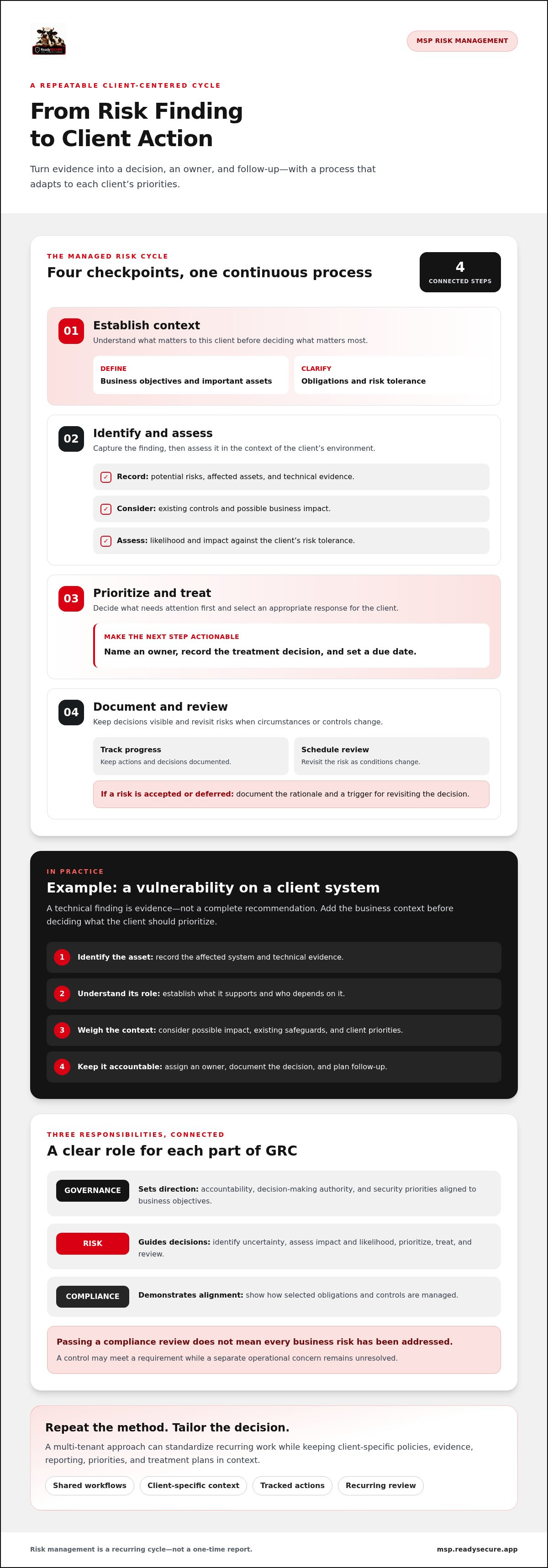
Governance sets direction. It establishes accountability, decision-making authority, and how security priorities support business objectives. Risk management identifies uncertainty that could affect those objectives, assesses its potential impact and likelihood, prioritizes what needs attention, and guides treatment and review. Compliance focuses on demonstrating alignment with selected obligations and controls, such as those in a framework, contract, or internal policy.
Compliance and risk overlap, but passing a review does not mean every business risk has been addressed. A control may satisfy a requirement while a separate operational concern remains unresolved. Risk management helps identify those gaps and determine a suitable response for the client.
Why MSPs need a client-centered GRC view
Clients do not share one risk profile. Their important systems, sensitive information, business dependencies, and obligations can differ. Technical findings provide useful evidence, but they are not recommendations by themselves. An exposed system, for example, needs context: what it supports, what could happen if it were compromised, and which actions the client should prioritize.
A GRC platform for MSPs organizes governance, risk, and compliance work across multiple clients, helping teams turn evidence into context-aware decisions, tracked actions, and clear progress. A client-centered view keeps the process consistent without assuming every client should have the same priorities or treatment plan.
That distinction is the foundation of a repeatable service. Apply a shared method, then tailor decisions to each client’s objectives and obligations. The result is more than a compliance record: it shows what matters, who owns the next step, and when progress will be reviewed.
How an MSP GRC platform turns risk information into a managed process
A finding creates value when it leads to a decision, an owner, and follow-up. A repeatable risk cycle helps MSPs move from raw information to client action:
- Establish context: Define the client’s objectives, important assets, obligations, and risk tolerance.
- Identify and assess: Record potential risks, affected assets, existing controls, and possible business impact.
- Prioritize and treat: Decide what needs attention first, then select an appropriate response.
- Document and review: Track decisions and progress, then revisit risks when circumstances or controls change.
From risk identification to treatment and review
Consider a vulnerability flagged on a client’s system. Record the affected asset and technical evidence, then establish what the system supports, who depends on it, and which safeguards are already in place. Asset inventories and vulnerability findings help show exposure, but they do not define the full risk. Business impact, existing controls, and client priorities matter too.
Assess likelihood and impact in light of the exposure and the client’s risk tolerance. Make the next step actionable by naming an owner, recording the treatment decision, setting a due date, and scheduling a review. If the client accepts or defers the risk, document the rationale and a trigger for revisiting the decision rather than letting it disappear into an old report.
Continuous risk management is a recurring cycle of decisions and follow-up, not a one-time assessment frozen in a report. This GRC Software for MSPs overview provides additional context on how MSP-focused tools support multi-client workflows.
What multi-tenant GRC changes for an MSP
A multi-tenant environment separates client records while giving the MSP a consistent way to organize recurring work. Shared workflows can standardize how teams capture findings and track actions. Client-specific policies, evidence, and reporting preserve the context each organization needs. This balance makes delivery repeatable without forcing identical risk decisions on every client.
Different security views can inform an assessment. Microsoft 365 security findings, vulnerability information, and mail-security activity may point to relevant exposures or controls. GRC connects those signals to governance through documentation, policies, training, and control mappings, creating a clearer path from evidence to accountable action.
ReadySECURE’s multi-tenant security platform brings security and GRC capabilities into one console for MSPs.
GRC platform or scattered tools? Compare workflows, not feature counts
More tools do not automatically create better risk management. A spreadsheet may work for a small client base with straightforward needs. As governance work grows, however, information spread across files and point tools can make it harder to see who owns an issue, whether evidence is current, and what needs review. Evaluate a grc platform for msps by how well it coordinates the work, not by the number of features on a product page.
A practical comparison framework for MSP workflows
Compare how each approach handles the tasks your service needs to deliver. Focus on where information is stored, how work is assigned, and how the team follows up. The right approach depends on your service maturity, client needs, and the friction you need to remove.
| Workflow | Fragmented tools | Coordinated GRC workflow |
|---|---|---|
| Evidence collection | Files and screenshots may sit in separate folders, with manual follow-up to confirm they are current. | Evidence can be organized by client and linked to relevant controls, making gaps easier to track. |
| Control mapping | Teams may map requirements in individual spreadsheets, repeating work when obligations overlap. | Mappings can connect evidence and activities to selected controls in a consistent structure. |
| Policy management | Versions, approvals, and review dates can be difficult to coordinate across documents. | Policies can follow a managed process while remaining specific to each client. |
| Risk ownership | Actions may lack a clear owner or become detached from the original finding. | Risks and treatment actions can be recorded with ownership and status. |
| Client reporting | Updates often require information to be gathered and rewritten from several sources. | Reporting can bring relevant risks, evidence, and progress into a clearer client view. |
A coordinated platform is most useful when it supports multi-tenancy, repeatable workflows, client-specific context, practical reporting, and integrations that reduce duplicate entry. Test the workflow against a real recurring task: can the team trace a finding to its evidence, decision, owner, and follow-up without searching several systems? Consolidation is worthwhile when it improves visibility or reduces time spent chasing and reconciling information. For a developing service, focused templates and disciplined spreadsheets may be sufficient. As reviews and client requirements expand, a shared platform can provide firmer process control.
How to avoid creating more process than progress
Start with the client outcomes you need to deliver consistently. Decide how to track policy reviews, control evidence, and open risk actions before enabling every available feature. Look for practical signs of friction: the same information entered in multiple places, unclear accountability, or repeated manual requests for evidence.
Automation can route tasks, organize records, and surface gaps. It cannot decide how much risk a client should accept, confirm that a control works in practice, or complete remediation on its own. A GRC platform supports compliance work and risk decisions; it does not automatically make clients compliant or eliminate risk. People still need to interpret findings, agree on priorities, and act.
Build a repeatable MSP risk-management workflow clients can follow
A dependable risk service needs a rhythm clients can understand and MSP teams can deliver consistently. Set a shared process, then tailor decisions to each client’s priorities. This makes reviews easier to repeat without turning them into a box-checking exercise.
A practical client risk review cycle
Start onboarding by establishing the scope: key assets and services, stakeholders, relevant obligations, and business priorities. Agree on who makes risk decisions, who owns remediation, and how often progress will be reviewed. A grc platform for msps can organize this work across client environments while keeping each client’s records and context distinct.
Then move through a clear review cycle:
- Assess the baseline: Gather relevant findings, policies, existing controls, and available evidence.
- Make decisions: Discuss business impact, assign accountable owners, agree on treatment actions, and document accepted risks with their rationale.
- Track progress: Record actions, owners, due dates, and evidence of completion.
- Review and improve: Revisit changed systems or priorities, overdue actions, new evidence, and previous decisions on an agreed cadence.
Policies clarify expected practices. Awareness training helps communicate those expectations. Evidence collection and control mappings help show how governance activities support selected controls. Keep the elements connected: a policy should have an owner and review point, while evidence should help show whether the related practice is being followed.
Turn risk reports into client decisions
Clients need to understand what a finding means for their business, not just its technical description. Lead with the affected service or asset, the potential impact, and a recommended next step. Then distinguish among three paths: urgent remediation, planned improvement, or documented risk acceptance. Each path should identify who is responsible and when the decision will be revisited.
Keep status reporting concise. Show the decision, owner, progress, remaining exposure, and any support or approval needed from the client. This turns a report into a working conversation and makes completed work visible without burying decision-makers in technical detail.
For a broader look at structuring compliance as an MSP service, see IT Compliance Services: An MSP Buying Guide for 2026. To put a multi-client security and GRC workflow into practice, explore ReadySECURE for MSPs.
Where an integrated GRC platform fits in the MSP security stack
GRC gives technical security work direction. It does not replace vulnerability management, Microsoft 365 security, or mail security. Instead, it connects findings from those capabilities to client priorities, decisions, and documented actions. A vulnerability finding can inform a risk assessment; the client’s business context helps determine its urgency, treatment owner, and review plan.
Connect governance with technical security work
Each security capability contributes a different view. Vulnerability findings can highlight weaknesses that need assessment and a treatment plan. Microsoft 365 and mail-security insights can add context about configurations, access, and email-related exposure. GRC connects relevant evidence to policies, control mappings, and client decisions, making it easier to explain how technical work supports governance.
That visibility is useful, but it is not a guarantee. A platform can organize evidence and show progress; it cannot, by itself, ensure that a client meets every obligation, that controls work as intended, or that incidents will not occur. People still need to assess evidence, make sound decisions, and complete remediation.
Move from explanation to an MSP service model
For MSPs, a grc platform for msps can bring governance and security activities into a multi-tenant operating model. Separate client environments help organize work across accounts, while a consistent process supports recurring reviews, evidence tracking, and reporting. ReadySECURE’s multi-tenant platform brings information security GRC, compliance, and governance together with vulnerability management, Microsoft 365 security, and mail security in one console.
A policy library and security awareness training support client expectations. Continuous evidence collection and control mappings help connect activities to selected controls. vCISO support adds expert-led strategic guidance for MSPs serving clients, including conversations about priorities, risk treatment, and governance. Together, these capabilities can help turn isolated technical tasks into a more coordinated client service.
For a broader look at service design, client experience, and platform strategy, read The Profitable MSP’s Guide to White Label Security Platforms in 2026. Then explore ReadySECURE’s MSP security platform to see how integrated security and GRC capabilities support multi-client operations.
Turn risk management into a service clients can see
Repeatable risk management is not about producing more reports. It is about connecting evidence to client priorities, assigning clear owners, and revisiting decisions as risks change. The right grc platform for msps helps bring that work into a consistent process across clients without treating every organization as if it has the same obligations or risk tolerance.
Look beyond feature counts. A useful platform coordinates governance with technical security work, reduces duplicated effort, and helps clients understand what needs attention and why. ReadySECURE brings GRC together with vulnerability management, Microsoft 365 security, and mail security in a multi-tenant platform. Its GRC capabilities include a policy library, awareness training, continuous evidence collection, and control mappings.
Explore ReadySECURE’s multi-tenant security platform for MSPs to see how connected security and GRC capabilities can support a more organized client service. Build the process around clear decisions and steady follow-through so clients can understand and act on risk management work.
Frequently Asked Questions
What is a GRC platform for MSPs?
A GRC platform for MSPs is a tool for organizing governance, risk management, and compliance work across multiple client environments. It can help an MSP manage client-specific policies, risks, evidence, controls, and reporting through a coordinated workflow. The aim is not to make every client follow the same plan. It is to apply a consistent process while tailoring decisions to each client’s business priorities and obligations.
How does a GRC platform help an MSP manage client risk?
A GRC platform helps an MSP turn risk information into decisions and trackable actions. Teams can document a finding, connect it to affected assets and business context, assess its likelihood and impact, then assign an owner and treatment plan. For example, a vulnerability finding becomes more useful when the MSP records what the system supports, what safeguards exist, and who will address the exposure or accept the risk.
Is GRC software the same as compliance software?
No. Compliance software focuses on managing and demonstrating alignment with selected obligations and controls. GRC software covers that work alongside governance and broader risk management. A client may meet a particular control requirement while still facing business or security risks outside that control. GRC provides a wider structure for setting accountability, assessing uncertainty, deciding on action, and recording how compliance efforts support the organization’s priorities.
Can an MSP use one GRC platform for multiple clients?
Yes, a multi-tenant GRC platform can help an MSP organize work for multiple clients within a shared operating environment. Client-specific records, policies, evidence, and reports should remain separated and relevant to each organization. Shared workflows can make recurring tasks more consistent, while each client’s obligations and risk priorities guide its decisions. This supports scalable delivery without treating every client as if it had the same risk profile.
What should an MSP track in a risk-management process?
Track the risk description, affected assets, business context, existing controls, and assessment rationale. Record how the risk is prioritized, the agreed treatment or acceptance decision, the accountable owner, actions, due dates, and review points. Keep supporting evidence and relevant control mappings connected to the record. This gives the MSP and client a practical view of what needs attention, who is responsible, what has changed, and what exposure remains.
Does a GRC platform guarantee compliance or prevent cyber incidents?
No. A GRC platform can organize policies, evidence, control mappings, and risk actions, but it cannot guarantee that a client meets every obligation or prevent every incident. Results depend on accurate information, appropriate decisions, effective controls, and completed remediation. Treat the platform as an operating tool for oversight and follow-through, not as a substitute for professional judgment, technical security measures, or the client’s own accountability.
How can an MSP explain risk-management findings to clients?
Start with the business impact, not a raw technical finding. Explain which asset or service is affected, why the issue matters, and what action you recommend. Separate urgent remediation from planned improvements and documented risk acceptance. Then show the decision-maker, owner, progress, due date, and remaining exposure in concise status updates. This helps clients understand the choices in front of them and connect security work to business priorities.


