

More point solutions won't make your MSP more resilient; they just bleed your bottom line dry. If your Tier 3 engineers waste billable hours tab-switching across seven disjointed consoles, tool sprawl is quietly eating your margins. Investing in a purpose-built cybersecurity platform for msps isn't about adding another layer to the chaos. It's about taking back complete control of your operational efficiency and your profit.
You already know the frustration. Per-tool licensing fees eat away at your contracts, while demonstrating clear security value to SMB clients feels like an uphill battle. Discover how consolidating your security stack into a unified multi-tenant platform cuts engineering overhead, streamlines onboarding, and scales high-margin monthly recurring revenue. Here are the five costly myths sabotaging your margins, and the exact blueprint to turn your security operations into a predictable growth engine.
Key Takeaways
- Eliminate console fatigue by replacing fragmented point solutions with a consolidated cybersecurity platform for msps.
- Protect your bottom line by automating vulnerability prioritization instead of hiring cost-prohibitive Tier 3 analysts.
- Convert technical risk assessments into lucrative monthly recurring advisory revenue using executive-ready white-label reports.
- Close critical identity loopholes across default cloud tenancies through centralized Microsoft 365 hardening and governance.
- Standardize your service delivery across standardized tiers to accelerate technician onboarding and maximize operating profit.
Myth 1: Stacking Disparate Point Solutions Provides Stronger Client Defense
More point solutions do not equal tighter defense. Many MSPs stitch together separate point products for email filtering, vulnerability management, and identity hardening under the assumption that best-of-breed tools create superior security. In practice, this Frankenstein approach fragments client data, spawns critical operational blind spots, and drains engineering productivity.
Every isolated vendor creates friction. Technicians waste hours jumping across half a dozen distinct portals, cross-referencing logs by hand, and chasing duplicate alerts. Aligning operations with standard frameworks, such as the NIST Cybersecurity Framework, becomes an administrative nightmare when controls are scattered across isolated consoles. Adopting a consolidated cybersecurity platform for msps cuts through this operational drag by pulling telemetry into a unified multi-tenant environment, transforming disconnected defensive silos into automated, high-margin posture management.
The Hidden Tax of Vendor Sprawl
Point-tool sprawl imposes a steep financial penalty on service operations. Disjointed licensing contracts trap capital in separate per-seat commitments, administrative minimums, and unpredictable annual price hikes. At the operational level, alert fatigue causes severe burnout; critical security warnings get buried beneath a mountain of repetitive, uncoordinated notifications. When engineers spend half their shifts logging into separate portals, billable utilization drops and margins collapse.
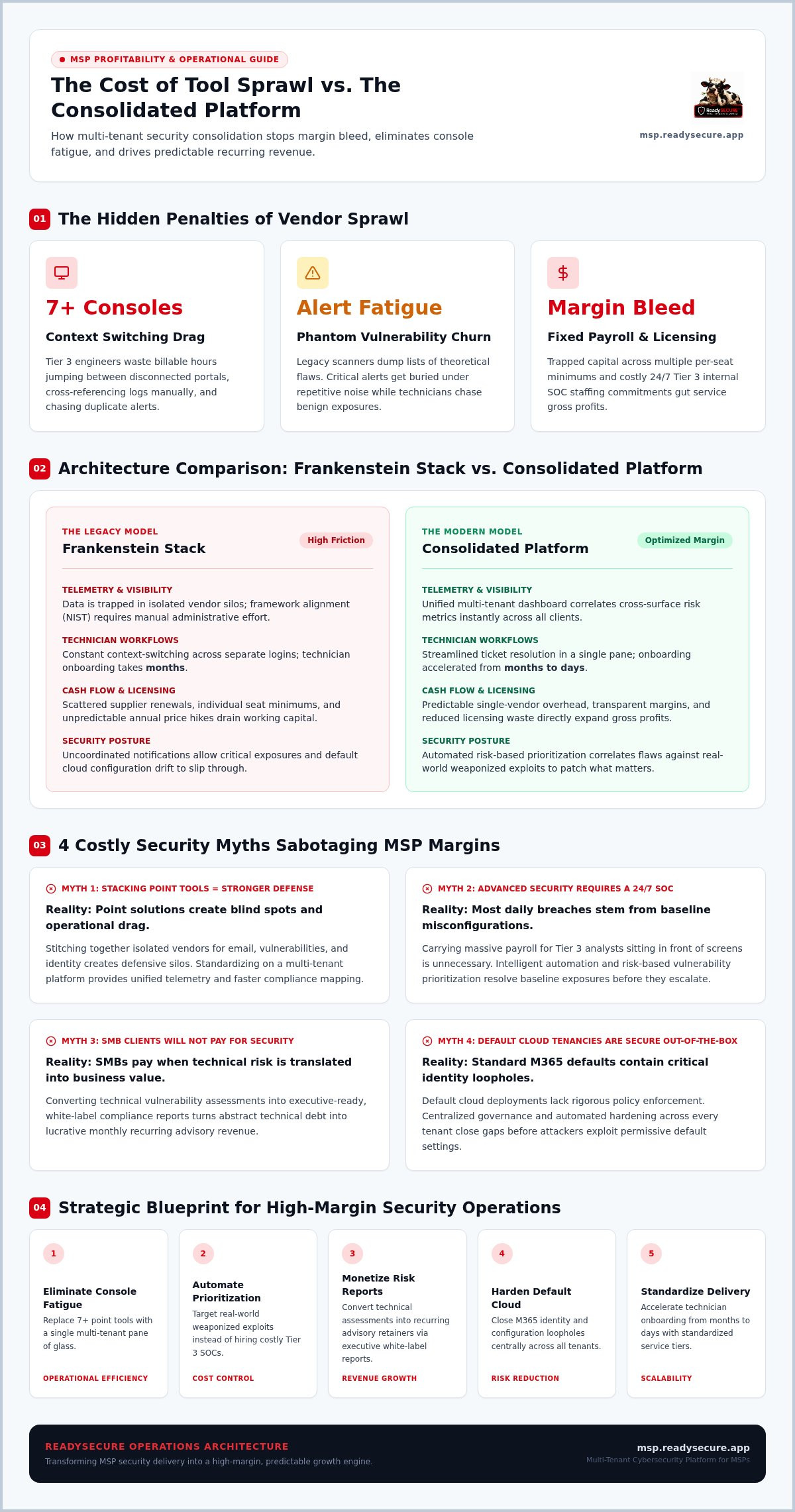
Consolidated Platform vs. Frankenstein Stack
Replacing siloed software with a purpose-built cybersecurity platform for msps restores both technical visibility and financial sanity. Look at the structural operational differences:
- Telemetry: Frankenstein stacks trap data in isolated vendor silos; consolidated platforms correlate cross-surface risk metrics instantly.
- Technician Workflows: Disjointed consoles force constant context switching; a unified pane streamlines ticket resolution and trims technician onboarding from months to days.
- Cash Flow Predictability: Juggling scattered supplier renewals drains capital; consolidated tooling establishes steady, predictable vendor overhead that directly expands your gross profit margins.
Unified architecture lets you deploy standardized controls across every tenant in minutes. You eliminate duplicate licensing overhead, reduce technician mistakes, and deliver consistent protection that scales seamlessly with your business.
Myth 2: Delivering Advanced Security Demands a Costly Internal SOC
Building an internal security operations center will gut your margins. Staffing a 24/7 team of Tier 3 security analysts requires massive fixed payroll liabilities, round-the-clock shift scheduling, and endless management overhead. Mid-sized service providers don't need dedicated security analysts sitting in front of screens all night to protect clients effectively. They need intelligent automation and operational leverage.
Most daily security incidents are completely preventable. They stem from unpatched flaws, cloud misconfigurations, and weak identity policies. The right cybersecurity platform for msps automates routine vulnerability management, flags risky policy drift, and resolves baseline exposures before they escalate into high-severity emergencies.
Vulnerability Prioritization Over Alert Churn
Legacy vulnerability scanners dump massive lists of theoretical flaws onto your service desk. Your technicians waste days chasing phantom vulnerabilities that pose zero actual operational risk. Modern risk-based scoring changes the equation entirely. It correlates discovered vulnerabilities against weaponized, real-world exploits, telling your team exactly what to patch right now.
Federal guidance, such as the FTC resource on Cybersecurity for Small Businesses, highlights preventative baseline controls as the primary defense against systemic compromises. By filtering out low-priority background noise, your engineers focus solely on active exposure pathways. You stop the alert churn, resolve critical weaknesses faster, and reclaim lost billable hours.
On-Demand Expertise Without Permanent Payroll
Enterprise-grade security doesn't mean carrying six-figure analyst salaries on your balance sheet. Smart MSPs separate continuous platform hygiene from elite, specialized interventions:
- Automated Posture Management: Let your unified platform handle continuous vulnerability tracking, Microsoft 365 hardening, and compliance governance across every tenant.
- On-Demand Penetration Testing: Validate defenses periodically by engaging external offensive security specialists without retaining in-house hackers.
- Strategic vCISO Advisory: Position leadership teams to deliver high-margin governance strategies, turning compliance requirements into lucrative recurring advisory fees.
- Scalable Incident Response: Access specialized forensic and recovery specialists on demand only when an active crisis demands deep investigation.
This hybrid approach lets you capture enterprise-tier margins while running a lean, agile technical team. Explore how you can modernize your security operations with a unified cybersecurity platform for msps that delivers powerful automated governance without bloated payroll costs.
Myth 3: Small Business Clients Will Not Pay for Comprehensive Security
Small business owners do not hate security; they hate incomprehensible technical jargon. When an MSP pitches port scans, CVE severities, and cryptographic hash protocols, the client hears unnecessary overhead. The sales conversation stalls because the business buyer cannot connect technical activity to commercial risk.
Position your services around financial liability and business continuity instead. Modern leadership wants operational resilience, regulatory adherence, and insurability. A comprehensive cybersecurity platform for msps equips your sales team to translate underlying system vulnerabilities into clear business impacts, transforming discretionary IT spend into non-negotiable operational insurance.
Commercial Packaging: Moving Beyond Basic Antivirus
Stop selling standalone security tools as a la carte line items. Inexperienced providers invite margin compression whenever they let clients pick and choose essential safeguards. Group your offerings into standardized commercial tiers:
- Core Hygiene: Automated vulnerability scanning, standard mail security, and continuous Microsoft 365 configuration auditing.
- Advanced Governance: Continuous compliance tracking, identity baseline hardening, and external risk assessments.
- Strategic Advisory: Ongoing vCISO support, executive risk roadmaps, and recurring penetration testing validation.
This packaging structure positions compliance and governance as high-margin, recurring deliverables. Instead of debating software utility, clients select an operational protection tier that safeguards their enterprise.
Quantifying Cyber Risk for Non-Technical Buyers
Executives sign proposals when the threat to their bottom line becomes measurable. Citing authoritative cybersecurity best practices from agencies like CISA reinforces that proactive hygiene is a fundamental business necessity, not an optional IT upgrade.
Use automated, white-label executive reporting during quarterly business reviews to make your protection tangible. Present clear data summaries showing unpatched identity risks resolved, inbound mail attacks filtered, and baseline compliance scores maintained. When you prove continuous remediation and demonstrate compliance readiness for mandatory cyber insurance audits, clients stop questioning your monthly invoices. A purpose-built cybersecurity platform for msps gives you the polished executive reporting needed to defend your pricing and command lucrative recurring advisory fees.
Myth 4: Standard Cloud Tenancies Are Secure Out of the Box
Default cloud environments favor user convenience over ironclad defense. Many service providers assume Microsoft 365 tenancies arrive hardened against intrusions straight from the vendor. In reality, factory-default settings leave critical authentication pathways wide open, giving threat actors an easy path to compromise corporate identities.
Relying on out-of-the-box settings creates silent liabilities across your client base. Legacy protocols linger unmonitored. Global administrator privileges sprawl unnecessarily. Unenforced security policies expose end users to account takeovers, session hijacking, and aggressive credential stuffing campaigns. A dedicated cybersecurity platform for msps automates tenant baselining across your entire client portfolio, eliminating manual policy drift and locking down exposed identity perimeters.
Eliminating Cloud Identity and Mail Blind Spots
Securing the modern workplace demands continuous, active enforcement rather than passive faith in platform defaults. Manual checklist auditing wastes technician hours and allows human error to slip through. Streamline protection by automating core security configurations across every managed tenant:
- Conditional Access Enforcement: Mandate robust phishing-resistant multi-factor authentication and block legacy authentication protocols instantly.
- Mail Security Hardening: Configure auditing rules, neutralize unauthorized inbox forwarding, and block malicious sender spoofing across all mailboxes.
- Privilege Containment: Monitor role elevation closely, review stale accounts, and restrict external sharing permissions systematically.
Automated tenant posture checks flag configuration drift before bad actors spot the opening. You protect corporate identities without drowning your engineers in repetitive setup tickets.
Automating GRC and Continuous Cloud Compliance
Manual compliance audits are brutal margin killers. Hunting through settings portals and capturing manual screenshots wastes days of senior engineering capacity. Turn governance into an operational asset by adopting automated continuous compliance checks.
Modern platforms map cloud configurations directly to established frameworks such as CIS benchmarks, HIPAA, and ISO 27001. System telemetry automatically collects verifiable digital evidence around the clock. When a client requires an audit review, your documentation is already complete, organized, and verified. You transform an administrative scramble into a predictable, recurring compliance deliverable that drives high-margin advisory retainers.
Stop fixing cloud misconfigurations by hand. Consolidate your M365 hardening and compliance governance inside a unified cybersecurity platform for msps to scale client protection without expanding technician headcount.
Standardizing Your Managed Stack on a High-Margin Platform
Operational chaos is a choice. MSPs that let technicians toggle between half a dozen vendor tools voluntarily surrender their profit margins. Sustainable growth demands ruthless operational standardization. When you standardize client deliverables around a purpose-built cybersecurity platform for msps, technician onboarding speeds up, ticketing workflows normalize, and service margins expand.
Every tool you add either multiplies your operational drag or delivers automated leverage. Enforce strict margin thresholds before adding any technology to your stack. If a solution doesn't streamline technician effort, eliminate redundant subscriptions, or create a clear path to billable recurring revenue, it doesn't belong in your business.
Key Criteria for Selecting an MSP Security Platform
Choosing the foundation for your managed security stack requires looking beyond standard feature checklists. Demand architecture designed specifically for service provider profitability:
- Native Multi-Tenancy: Manage configuration baselines, policy deployments, and risk telemetry across all customer environments from a single operational pane.
- 100% White-Label Reporting: Deliver branded executive reports and compliance scorecards that build long-term enterprise equity in your agency rather than marketing third-party vendors.
- Strict Channel Exclusivity: Partner exclusively with vendors committed to the channel. Never license tools from companies that market direct-to-consumer software or actively compete against you for SMB accounts.
- Consolidated Feature Breadth: Unify vulnerability management, Microsoft 365 posture auditing, and mail security within a single platform to eliminate overlapping per-user licensing fees.
Executing a Frictionless Client Stack Migration
Transitioning clients to a unified platform doesn't have to disrupt operations. Start by conducting an operational audit of your current tool sprawl. Map expiring vendor contracts, calculate your true administrative burden, and identify redundant software licenses across your client roster.
Roll out unified agents systematically during scheduled maintenance windows. Once baseline scanning completes, immediately produce clean, white-labeled risk summaries for client decision-makers. Highlighting immediate posture improvements validates your managed advisory role, eliminates pushback, and turns standard operational maintenance into an undeniable demonstration of business value.
Standardizing on a unified cybersecurity platform for msps transforms your security practice from a messy cost center into a predictable, high-margin recurring growth engine.
Reclaim Your Margins and Scale Your Security Practice
Fragmented point solutions drain your profits and exhaust your engineers. You don't need a bloated vendor roster or an expensive internal SOC to deliver enterprise-grade defense. Real operational leverage comes from simplifying your architecture. By automating routine vulnerability scanning, hardening cloud configurations, and delivering continuous compliance, you turn technical overhead into high-margin recurring advisory fees.
Standardizing on a unified cybersecurity platform for msps gives your team total visibility across every client tenant. You eliminate duplicate licensing costs, slash context switching, and present executive-ready reporting that proves continuous security value. Your agency deserves a modern platform built specifically for sustainable, profitable growth.
Stop letting vendor sprawl erode your hard-earned revenue. Accelerate your cybersecurity margins with ReadySECURE today and transform your security practice into a streamlined, high-profit engine.
Frequently Asked Questions
What is a cybersecurity platform for MSPs?
A cybersecurity platform for msps is a centralized, multi-tenant software system designed to deliver, manage, and monitor client security from one interface. Instead of juggling distinct tools, providers use it to execute vulnerability management, enforce Microsoft 365 hardening, manage mail security, and automate compliance governance across every account they protect.
How does a consolidated security platform improve MSP profit margins?
Consolidation eliminates overlapping per-seat licensing fees and reduces the billable hours wasted logging into separate consoles. With automated baselines and streamlined tenant monitoring, technicians resolve issues faster. This efficiency cuts operational overhead and lets MSPs package high-margin monthly recurring advisory services without expanding internal headcount.
Can a security platform replace the need for an in-house SOC?
Yes, for the vast majority of day-to-day threat defense and preventative hygiene. Intelligent risk scoring and automated posture management resolve critical configuration drift before incidents occur. For complex incidents or specialized audits, MSPs can leverage on-demand penetration testing and incident response specialists instead of carrying full-time security analysts on their permanent payroll.
Why isn't Microsoft 365 security sufficient on its own for clients?
Default Microsoft 365 configurations prioritize user ease of access over strict operational security. Out-of-the-box tenancies frequently leave legacy authentication active, allow unauthorized mailbox forwarding, and miss critical conditional access policies. A specialized cybersecurity platform for msps automates tenant baseline enforcement and flags configuration drift across multiple client domains continuously.
How do white-label security platforms benefit managed service providers?
White-label platforms replace third-party software logos with your agency's branding on executive risk summaries and audit reports. This builds equity in your firm rather than marketing another vendor's software. Delivering clean, branded risk metrics during client business reviews validates your advisory fee structure and prevents clients from shopping your tools directly.
What security features should a modern MSP platform prioritize?
Prioritize native multi-tenancy, risk-based vulnerability management, continuous Microsoft 365 posture hardening, and automated GRC evidence collection. The platform should also provide deep mail protection and offer access to specialized on-demand expertise like vCISO support to help you deliver enterprise-tier strategic leadership to growing businesses.
How does stack consolidation reduce technician alert fatigue?
Consolidated platforms correlate cross-surface telemetry into a single, unified alert stream. By evaluating active, weaponized exploits instead of listing theoretical CVEs, the system eliminates duplicate false positives. Technicians receive actionable, prioritized tickets within one console, freeing them from constant context switching across disconnected vendor portals.


