

A ransomware rumor isn’t proof of a Jonesboro breach. If you’re searching “jonesboro ar cyber security breach ransomware 2025 2026,” the key finding is specific: the research reviewed for this article has not identified a publicly confirmed Jonesboro-area ransomware incident in 2025 or 2026. That does not prove no incident occurred. It means claims need reliable evidence before they’re repeated.
Conflicting or incomplete reports can make it difficult to tell what happened, who may be affected, and what to do next. This article separates reported information from unverified claims and explains what public reporting can and cannot establish. Use it as a starting point, then check for updates from the organization involved or a relevant government agency.
We’ll also explain how ransomware can disrupt an organization, affect customers and partners, and create pressure beyond locked systems. Then we’ll cover practical response steps, including preserving evidence, limiting further exposure, and monitoring trusted updates. The goal is to help Jonesboro-area organizations make decisions based on reliable information and prepare with purpose.
Key Takeaways
- For the search “jonesboro ar cyber security breach ransomware 2025 2026,” distinguish confirmed disclosures from rumors before concluding that a local organization was affected.
- Ransomware can disrupt systems, involve data theft, or do both. Don’t assume what happened in a specific case without reliable reporting.
- Check which organization is identified, who may be at risk, and what remains unknown before deciding what action to take.
- If you receive a breach notice, verify it through an official channel, secure relevant accounts, and monitor for suspicious activity.
- Organizations can strengthen readiness by prioritizing exposed vulnerabilities, testing backups, and rehearsing recovery steps.
Jonesboro, AR ransomware search: what is confirmed about a 2025-2026 breach?
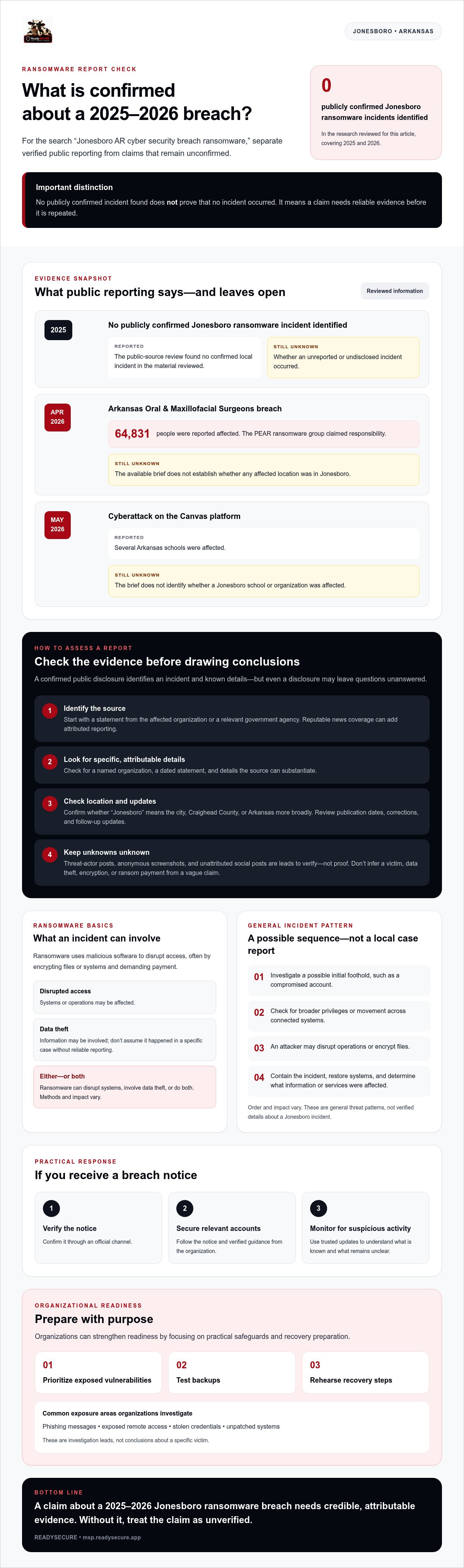
If you’re searching “jonesboro ar cyber security breach ransomware 2025 2026,” start with the evidence, not the headline. The research reviewed for this article found no publicly confirmed ransomware incident involving a Jonesboro organization during 2025 or 2026. This describes the available public reporting reviewed here; it does not prove that no incident occurred.
A cybersecurity breach is unauthorized access to information or systems. A ransomware incident involves malicious software used to disrupt access, often by encrypting files or systems and demanding payment. Ransomware methods vary; Ransomware offers a broad overview. A confirmed public disclosure is a statement or report that identifies an incident and its known details. Even a disclosure may leave important questions unanswered.
Evidence snapshot: Dated Arkansas incidents provide context, but the reviewed information does not establish a Jonesboro ransomware victim.
| Date | Source | Confirmed detail | What remains unknown |
|---|---|---|---|
| 2025 | Public-source review for this article | No publicly confirmed Jonesboro ransomware incident was identified in the reviewed material. | Whether an unreported or undisclosed incident occurred. |
| April 2026 | Arkansas breach reporting | Arkansas Oral & Maxillofacial Surgeons reported a breach affecting 64,831 people; the PEAR ransomware group claimed responsibility. | Whether any affected location was in Jonesboro; the available brief doesn’t establish that. |
| May 2026 | Reporting on the Canvas platform attack | The cyberattack affected several Arkansas schools. | Whether a Jonesboro school or organization was affected; the brief doesn’t identify one. |
What counts as reliable confirmation of a local cyber incident?
Start with a statement from the affected organization or a relevant government agency. Reputable news coverage can add useful, attributed reporting, but it is not automatically primary confirmation. Threat-actor posts, anonymous screenshots, and unattributed social media claims are leads to verify, not proof. Look for a named organization, a dated statement, and specific details the source can substantiate.
How to verify a Jonesboro ransomware report without amplifying rumors
Check the publication date, named sources, and any corrections or follow-up updates. Confirm whether “Jonesboro” means the city, Craighead County, or Arkansas more broadly. Don’t infer a victim’s identity, data theft, encryption, or ransom payment from a vague claim. Attribute details to the reporting that supports them, and label gaps as unknown.
Bottom line: A claim about a 2025-2026 local ransomware breach needs credible, attributable evidence. Without it, treat the claim as unverified.
How a ransomware breach can unfold, and what public reports may leave out
Ransomware incidents often develop in stages, but the order and impact vary. Investigators may look for an initial foothold, such as a compromised account, then check whether an intruder gained broader privileges or moved across connected systems. An attacker may disrupt operations or encrypt files. Recovery involves containing the incident, restoring systems, and determining which information or services were affected.
These are general threat patterns, not details about a confirmed Jonesboro incident. The public reporting reviewed for this article does not identify a confirmed Jonesboro ransomware incident in 2025 or 2026, so there is no verified local entry point, malware group, or recovery timeline to describe. Searches for “jonesboro ar cyber security breach ransomware 2025 2026” should keep that distinction clear.
Common ransomware entry points organizations investigate
Incident responders commonly examine phishing messages, exposed remote access, stolen credentials, and unpatched systems as possible ways in. These are investigation leads, not conclusions about a particular victim. Organizations can reduce common exposure by using multifactor authentication, applying patches promptly, strengthening identity controls, and limiting access privileges. Confirm the evidence before naming a cause.
What ransomware reports may leave out
Ransomware may involve encryption, data theft, both, or neither. A service outage alone does not establish that personal information was accessed or taken. Likewise, a threat actor’s claim is not independent proof of a breach, attribution, or payment.
Double extortion means attackers both encrypt or disrupt systems and threaten to publish data they claim to have stolen. That describes a tactic, not a confirmed Jonesboro event. Tie each claim to its original reporting, especially when a report names a group or malware family.
Why breach timelines and impact estimates change
Early notices may focus on operational facts while forensic work continues. Investigators can later identify an earlier start date, additional affected systems, or a different scope. An organization may also update its understanding of whether data was exposed. Treat initial figures as provisional unless the organization or an appropriate authority confirms them in a later update. A careful timeline distinguishes what was known at each point from what emerged afterward.
For response planning, CISA’s guide explains how organizations can prepare for a ransomware incident and manage response priorities. MSPs coordinating visibility and incident response across client environments may also find a multi-tenant security platform useful; see the MSP security platform.
Who may be affected by a Jonesboro-area cyber incident, and how to assess risk
Risk depends on what a confirmed incident touched, not simply where a headline places it. An organization might face disrupted operations. Employees, customers, or service users could be affected if their information or access was involved. The reviewed public reporting does not confirm that Jonesboro residents, city services, or local businesses were affected by ransomware in 2025 or 2026. For searches such as “jonesboro ar cyber security breach ransomware 2025 2026,” keep local evidence separate from incidents elsewhere in Arkansas.
The table distinguishes Arkansas reporting from confirmed Jonesboro impact. “Potentially affected” means a group could be relevant if a specific organization’s notice identifies it, not that the group is known to have been affected.
| Status | Who or what | How to interpret it |
|---|---|---|
| Confirmed in Arkansas reporting | Arkansas Oral & Maxillofacial Surgeons reported a breach affecting 64,831 individuals in April 2026. A cyberattack on the Canvas learning platform affected several Arkansas schools in May 2026. | The reviewed information doesn’t establish that either incident affected a Jonesboro organization or its residents. |
| Potentially affected, depending on the case | An organization’s employees, customers, patients, students, or people relying on its services. | Include a group only if the affected organization or a reliable agency identifies it, or explains why it may be at risk. |
| Unknown for Jonesboro | Whether any local residents, city services, businesses, or specific systems were affected by a 2025-2026 ransomware incident. | Don’t turn a statewide incident, service disruption, or online claim into a local impact finding. |
What a confirmed data exposure notice should clarify
Check that a notice names the organization and gives the incident or discovery dates, the information involved, and any recommended actions. Look for whether it identifies specific people as affected or says the investigation is ongoing. Credit monitoring or identity-protection offers may appear in some notices, but verify the terms and eligibility in the official communication for that case. Use the organization’s own site or a relevant agency to validate unexpected messages.
How to assess alerts and service updates
Read the source and date before acting. Compare an organization’s service notice with later investigative or regulatory disclosures, and check whether an update changes what is known. CISA’s Ransomware Prevention and Response Guide offers response context, but local impact still requires case-specific evidence. A system outage confirms a service problem, not data theft. Use “outage,” “security incident,” “ransomware,” and “confirmed breach” only when the available evidence supports the label.
Assess risk by matching the named organization, affected information, and notice date to your own connection with the incident. If those details aren’t confirmed, treat your status as unknown, not affected.
What to do if affected by ransomware or a data breach
If you suspect an incident, follow verified instructions and protect relevant evidence. A notice or service disruption does not by itself confirm what information was exposed. For searches such as “jonesboro ar cyber security breach ransomware 2025 2026,” rely on updates from the named organization and relevant authorities rather than assuming a local claim applies to you.
Immediate steps for individuals who receive an incident notice
- Verify the notice. Find the organization’s official website or contact details independently. Don’t use links or phone numbers in an unexpected message until you’ve confirmed they’re legitimate.
- Secure accounts. Change reused or potentially exposed passwords, starting with email and financial accounts. Use a trusted device and enable multifactor authentication where available.
- Watch for follow-up scams. Be cautious of messages that imitate the affected organization, support staff, or identity-protection services. Don’t share passwords, verification codes, or payment details in response to unsolicited contact.
- Follow the notice and monitor relevant activity. Keep a copy of the communication, review account activity, and follow the organization’s instructions. Contact the organization through an independently verified channel if the notice is unclear.
First response priorities for a business or MSP
Use the established incident response plan. Assign named owners for technical investigation, operations, communications, and escalation. Then work through the priorities:
- Contain: Coordinate with qualified responders to limit further access or spread. Avoid changes that could destroy useful evidence.
- Preserve: Retain relevant logs, alerts, messages, and system evidence. Record times, actions taken, and who made each decision.
- Escalate: Engage qualified incident responders and consult legal or regulatory advisers as appropriate. Assess applicable notification expectations with those advisers rather than relying on a generic deadline.
- Communicate: Share confirmed facts with employees, customers, partners, and authorities as appropriate. Follow instructions from the affected organization and relevant agencies. Clearly identify what remains under investigation.
Don’t rush to restore systems or publish a cause before responders assess the environment. Coordinate containment, recovery, and updates through designated owners, and keep a record as findings change. MSPs supporting affected clients can explore expert-led incident response support through ReadySECURE, which offers incident response services to MSPs and their clients.
How Jonesboro-area organizations can prepare for the next ransomware incident
Preparation works best as a repeatable operating program, not a document that sits untouched. Identify exposure, prioritize remediation, and rehearse the response. That discipline matters whether or not a local incident is confirmed. Searches for “jonesboro ar cyber security breach ransomware 2025 2026” can prompt a useful question for every organization: if systems went down tomorrow, would the team know who leads, what to protect, and how to recover?
A practical ransomware-readiness checklist for local organizations
- Assign incident leads. Keep current contacts for leadership, IT, legal advisers, communications, and key vendors. Make decision authority clear before an incident.
- Test backups. Keep backup copies isolated from routine network access where feasible. Practice restoring important systems and document the steps, dependencies, and responsible owners.
- Review access. Use multifactor authentication, remove unnecessary privileges, and review who can access sensitive systems. Pay particular attention to accounts with administrative access.
- Reduce exposure. Review vulnerabilities and apply patches based on risk. Strengthen email defenses and give staff a clear process for reporting suspicious messages.
- Exercise the plan. Rehearse a realistic disruption scenario. Test decision-making, internal communications, recovery priorities, and how the organization will update customers or service users.
Make each review produce an owner and a next step. A vulnerability without a remediation decision remains an open risk. A backup that hasn’t been restored in a test remains an assumption. Track findings and revisit them on a schedule.
How MSPs can coordinate security and incident response across clients
For an MSP, multi-tenant visibility can help organize client risks, track remediation, and keep incident information distinct by customer. A consistent process also helps teams gather relevant evidence, record actions, and coordinate updates with each client’s designated contacts. Clear separation matters: one client’s facts should never be presented as another client’s incident.
ReadySECURE is an MSP-focused platform and service provider. Its capabilities include vulnerability management, Microsoft 365 security, mail security, and compliance and governance, with multiple security capabilities consolidated in a multi-tenant console. It also offers expert-led incident response and vCISO support to MSPs and their clients. Define the required scope and availability directly before relying on any service in a response plan.
Build readiness before urgency takes over. MSPs can explore ReadySECURE security capabilities for coordinating visibility and support across client environments.
Turn verified information into stronger readiness
For anyone searching “jonesboro ar cyber security breach ransomware 2025 2026,” the key takeaway is to distinguish confirmed disclosures from unverified claims. The public reporting reviewed for this article found no confirmed Jonesboro ransomware incident for 2025 or 2026. That does not establish that no undisclosed incident occurred. Verify the source, date, affected organization, and reported impact before drawing conclusions.
Ransomware can disrupt systems, expose data, or involve both, but each case requires its own evidence. If you receive a notice, confirm it through an official channel and follow the organization’s guidance. If you lead an organization, prepare with tested backups, clear response roles, and practiced recovery steps.
For MSPs, coordinated visibility can help organize client security work and response. ReadySECURE offers a multi-tenant platform spanning vulnerability management, Microsoft 365 security, mail security, and compliance, alongside expert-led incident response and vCISO support for MSPs and their clients. Explore ReadySECURE’s security platform for MSPs and assess whether its capabilities fit your service model.
Reliable information and deliberate preparation give teams a stronger starting point. Take the next practical step and build readiness before an incident demands it.
Frequently Asked Questions
Was Jonesboro, Arkansas hit by a confirmed ransomware attack in 2025 or 2026?
Confirmation requires current, attributable reporting. The material reviewed for this article doesn’t establish that a Jonesboro organization was attacked in 2025 or 2026, so it can’t support a definitive local breach claim. For the search “jonesboro ar cyber security breach ransomware 2025 2026,” verify the status at publication time against a statement from the named organization and relevant government sources. Distinguish a reported security incident from confirmed ransomware, and both from confirmed personal-data exposure.
How can I check whether a Jonesboro data breach notice is legitimate?
Verify the named organization, publication date, contact details, and the specific information the notice says may be affected. Navigate independently to the organization’s official website or contact it using a phone number or email address you already trust. Don’t rely on links in an unexpected message. Local or state agency notices may add context, but confirm you’re viewing an authentic agency source before following instructions or sharing personal information.
What should I do if my personal information was exposed in a ransomware incident?
Start with the affected organization’s verified instructions, since the right response depends on what information was exposed. Change reused or potentially compromised passwords, enable multifactor authentication, and watch for unusual account activity or targeted phishing. If payment card or bank details may be involved, contact your financial institution through its official channel. Don’t assume every ransomware incident includes personal-data theft; look for a specific, verified statement about the information affected.
Does a ransomware attack always mean customer data was stolen?
No. Ransomware may encrypt or disrupt systems, involve data theft, or combine these tactics, but encryption alone doesn’t prove information was stolen. Early public reporting may be incomplete while investigators determine what happened. Look for a specific statement about data access or exposure from the affected organization or a credible authority. A threat actor’s claim isn’t independent confirmation, so don’t treat it as verified fact without corroborating evidence.
Who should a Jonesboro business contact after discovering a ransomware incident?
Activate the organization’s incident response plan and contact qualified incident response professionals. Coordinate with leadership, legal counsel, and relevant authorities as appropriate to the circumstances. If the business uses an MSP, notify its designated security and escalation contacts promptly. Preserve relevant evidence and document actions and decisions. Don’t assume one agency or reporting route applies to every case; confirm current requirements with qualified advisers who understand the incident and the organization’s situation.
Can an organization recover from ransomware without paying a ransom?
Recovery without payment may be possible, but it depends on the incident, tested backups, system integrity, and specialist findings. Payment doesn’t guarantee working decryption tools, prevent data disclosure, or restore operations. Organizations should preserve evidence, consult experienced incident responders and legal advisers, and prioritize a safe recovery plan based on verified facts. No general answer can promise a particular outcome; assess the available options for the specific environment before making decisions.


