

More services won’t save an MSP if every new offer adds cost, complexity, and pressure on the team. MSP strategies for surviving in 2026 start with a sharper choice: make fewer moves, and make each one protect margin while strengthening delivery. When sales take longer and buyers demand proof, growth can’t depend on adding another tool or hiring your way through every gap.
Security demand is rising, but building expertise and delivery capacity in-house can strain a small team. Which moves will help your MSP remain profitable and competitive in 2026? Focus on measurable value, repeatable services, and operating leverage, not growth for growth’s sake.
This playbook lays out practical ways to tighten service economics, show outcomes clients can see, and improve retention without turning operations into a maze. It also explains how a consolidated, white-label security delivery model can support services such as vulnerability management, Microsoft 365 security, mail security, and compliance, with specialist support where needed. Choose the right moves, track their impact, and scale what works.
Key Takeaways
- Use msp strategies for surviving in 2026 to prioritize measurable moves that strengthen margins and dependable delivery, not growth at any cost.
- Evaluate each strategic option by client demand, differentiation, delivery capacity, and implementation effort before committing resources.
- Build a focused 90-day plan: establish a baseline, choose a priority, package it, pilot it, then measure and adjust.
- Track a small set of indicators, including retention, service margin, workload, and client adoption, to see whether a strategy is working.
- Explore how a white-label, multi-tenant security platform can help extend security services and create repeatable workflows without building every capability in-house.
Why MSPs need a survival strategy for 2026, not just another growth target
New deals can take longer to close, buyers scrutinize what each service delivers, and smaller engagements can make the same workload less profitable. Meanwhile, clients expect stronger security and clear evidence of progress, while your team still has finite hours. Adding services without a delivery plan can turn growth into more handoffs, more tools, and thinner margins.
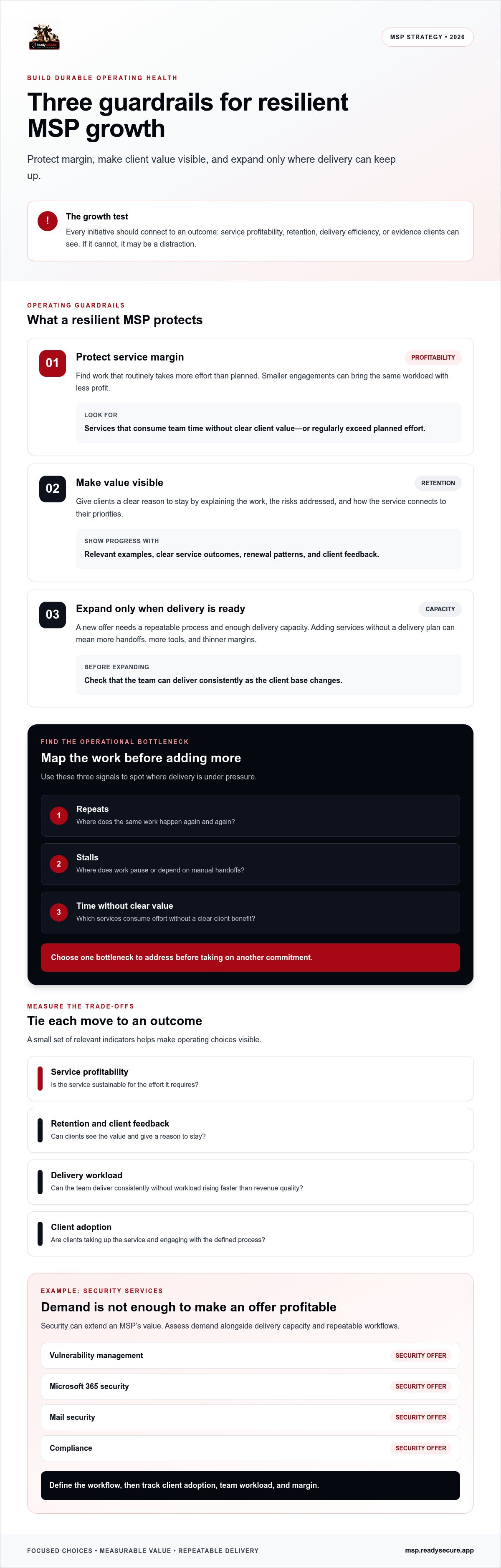
That pressure doesn’t mean growth is off the table. It means growth needs guardrails. An MSP survival strategy links market choices to margin, capacity, and client value. Before pursuing an initiative, define what it should improve: service profitability, retention, delivery efficiency, or the evidence clients see. If it can’t connect to an outcome, it’s a distraction.
Managed services are built around ongoing delivery and support, rather than one-off fixes; see What are Managed Services? for a foundational overview. In practice, the strategic question is how to make that ongoing model valuable for clients and sustainable for your team.
What is making MSP growth harder in 2026?
Buyers want more than a list of tools or a promise to keep systems running. They want to understand the work being done, the risks being addressed, and how the service connects to business priorities. Generic claims are easy to compare, so an MSP that can explain its process and show relevant evidence has a stronger basis for differentiation.
Capacity is another constraint, not a reason to abandon growth. If delivery depends on a few people remembering manual steps, new clients can raise workload faster than revenue quality. Map where work repeats, where it stalls, and which services consume time without clear client value. Then target one bottleneck before adding another commitment.
These are operating pressures, not survey statistics. Assess your own pipeline, service margins, workload, and client feedback to see which pressure is actually limiting the business.
What does a resilient MSP look like?
A resilient MSP builds repeatable revenue around services it can deliver consistently. It gives clients a clear reason to stay, differentiates through visible outcomes, and keeps workloads manageable as the client base changes. That’s durable operating health, not a temporary revenue spike or a contract won by discounting below the effort required to serve it.
Choose fewer initiatives, then connect each to an operating metric. A new security service, for example, should have a defined delivery workflow and a way to track client adoption, team workload, and margin. Tie a retention initiative to renewal patterns or client feedback. Metrics make trade-offs visible before complexity compounds.
- Protect margin by identifying work that routinely exceeds its planned effort.
- Improve retention by making service outcomes clear in client conversations.
- Expand only where delivery capacity and repeatable processes can support the offer.
That is the practical foundation for msp strategies for surviving in 2026: make deliberate market choices, prove value, and scale only what your operating model can sustain.
The 2026 MSP shifts that matter: buyers, automation, security, and talent
Four shifts are changing how MSPs win and deliver work: buyers want clearer evidence, automation can reshape team capacity, security expectations are broadening, and skilled people remain difficult to scale. Treat these as decision inputs, not a checklist to chase. A trend matters when it changes client demand or delivery economics. That test keeps attention on what can strengthen your offer and what your team can reliably deliver.
The MSP role is also expanding beyond basic IT support into broader business needs. Forbes outlines The Evolving Role of Managed Service Providers, a useful frame for understanding why buyers increasingly expect strategic guidance alongside technical work. Connect your services to outcomes clients recognize, then build delivery around the capabilities you can support.
How are buyer expectations changing MSP sales?
A service list tells a prospect what you do, but not why the work matters to their business. Buyers may want to understand how a proposed service relates to operational continuity, risk, or a specific business priority. Generic promises are difficult to distinguish, especially when several providers describe similar capabilities.
Make the value concrete. Scope the outcome, show a relevant example, and explain what evidence will demonstrate progress. For instance, present a security review as a defined process for identifying and prioritizing exposure, rather than as a vague promise to “improve security.” Use concise proof throughout sales conversations, not only in a final proposal. Validate patterns against your own prospect feedback and win-loss notes.
Where can automation and security create leverage?
Automation creates leverage when a repeatable process is documented first. Select a recurring task, record its current effort and error points, then automate a controlled step and compare the result. Track time saved, exceptions, service quality, and technician capacity. If the workflow is inconsistent, automation can simply make inconsistent work happen faster.
Security can extend an MSP’s value through vulnerability management, Microsoft 365 security, mail security, and compliance. But demand alone doesn’t make an offer profitable. Define its scope, delivery owner, review process, and client-facing evidence. Tools can consolidate information and reduce repetitive steps, but they don’t replace skilled judgment, clear ownership, incident planning, or communication when a finding needs action.
For MSPs seeking a repeatable way to present security capabilities, a white-label, multi-tenant security platform can bring vulnerability management, Microsoft 365 hardening, mail security, and compliance into a consolidated delivery model. White-label reporting can make the work visible under your brand, while specialist support can extend delivery capacity. Compare the platform’s workflows with your service processes and client needs.
Use these shifts to sharpen your msp strategies for surviving in 2026: respond to buyer priorities with proof, automate only stable work, and expand security where ownership and delivery economics are clear.
Compare MSP strategies for 2026 by margin, demand, and delivery capacity
Don’t choose a growth move because it sounds popular. Compare how well it fits your client base, operating model, and team. The ratings below are planning inputs, not guaranteed financial forecasts or universal benchmarks. “Delivery fit” reflects how readily a lean team might support the move using existing skills and workflows. Score your options against actual client demand and workload before committing.
| Strategy | Client demand | Margin potential | Delivery fit | Differentiation | Implementation effort |
|---|---|---|---|---|---|
| Specialization | Medium to high | Medium to high | Medium | High | Medium |
| Automation | Indirect | Medium to high | High for repeatable work | Medium | Medium |
| Security-service expansion | High where clients need it | Medium to high | Low to medium without expertise or support | High | High if built internally |
| Retention improvement | Existing-client driven | Medium to high | High | Medium | Low to medium |
| Partnerships | Depends on client fit | Medium | Medium to high with clear ownership | Medium | Low to medium |
Use the table to start a discussion, not to declare a universal winner. A high-demand service can still be a poor move if it requires skills you can’t support or creates unpriced support work. A modest automation project may deliver more value if it removes a recurring bottleneck across multiple clients.
Which growth moves fit a lean MSP team?
Favor initiatives that reuse what you already have: trusted client relationships, established workflows, technical skills, or service data. Automate stable, documented tasks before adding headcount to handle them manually. For capabilities that need specialist expertise, a partner model may extend delivery faster than hiring for every role. Make ownership explicit, keep tooling coherent, and price the support effort. Otherwise, handoffs and exceptions can erode the margin the initiative was meant to protect.
When should an MSP expand its security services?
Start with four checks: clients are asking for the capability, someone can deliver and review the work, the process is repeatable, and you can explain its value with clear reporting. Then compare building internally with reselling or partnering. Internal delivery offers control but requires skills and processes; a partner can extend capacity, provided responsibilities and client communication remain clear.
A white-label platform is one route to extending security delivery without assembling every capability in-house. This guide to white-label security platforms explores that approach. For Microsoft 365-focused evaluation, use the M365 security hardening tools guide to compare product-category considerations. The right choice for your msp strategies for surviving in 2026 is the one your team can deliver consistently and measure.
Turn MSP survival strategies into a focused 90-day operating plan
A plan matters only if it changes what the team does. Use the next 90 days to test a focused initiative, give it an owner, and track whether it improves business performance without overloading delivery. Keep the scope tight. One well-measured pilot will teach you more than several loosely managed projects running at once.
How should an MSP choose its first priorities?
Start with evidence you already have: client feedback, service profitability, sales friction, recurring work, and team capacity. Look for a clear point of leverage, such as a repeated delivery bottleneck or a client need you can address consistently. Choose a limited set of initiatives, each with an accountable owner, target clients, and a measurable hypothesis. Defer projects without demonstrated demand or a workable delivery model.
- Baseline. Record the current picture for the service or process you want to improve. Note relevant client feedback, workload, service margin, retention, adoption, and recurring revenue. Use available records and define how each measure will be calculated.
- Choose. Select a priority that addresses a real client need or operational constraint. Write a simple hypothesis, such as, “A standard workflow will reduce repeat handling while maintaining service quality.” Name the owner and target client group.
- Package. Define what the pilot includes, where responsibility begins and ends, how work will be delivered, and what the client should expect. Identify likely exceptions and how they’ll be handled. Clear scope helps prevent support tasks from quietly expanding beyond the offer.
- Pilot. Test the offer or process with a limited client group before rolling it across the base. Set an explicit start and review point. The owner should track workflow completion, client adoption, team effort, and issues that require escalation or a change in scope.
- Measure. Compare pilot results with the baseline. Review whether clients adopted the service, delivery stayed consistent, workload was manageable, and margin moved in the intended direction. Separate early activity from business results; a full pipeline doesn’t prove profitable delivery.
- Adjust. Decide whether to scale, refine, or stop. Document the reason, revise the workflow or scope where needed, and assign the next action. Keep the decision visible so the team doesn’t continue investing in a pilot simply because it has already started.
Which indicators show whether the plan is working?
Track a small set of leading and lagging indicators. Leading measures show whether the work is gaining traction: qualified client conversations, adoption, workflow completion, and capacity released. Lagging measures show whether that activity supports business health: retention, service margin, recurring revenue, and expansion. Choose only measures that connect to the pilot’s hypothesis.
Set a regular review rhythm. Check delivery signals with the owner during the pilot, then hold a monthly decision review to assess business outcomes. Record whether to scale, adjust, or stop, and why. These disciplined msp strategies for surviving in 2026 keep priorities tied to evidence instead of momentum alone.
For a security-service pilot, explore how ReadySECURE supports MSP security delivery with a white-label, multi-tenant platform and access to specialist services.
Scale MSP security services without turning growth into more operational drag
Security growth is valuable only when your team can deliver it consistently. More disconnected tools can mean more logins, handoffs, and reporting effort. A scalable model makes the work repeatable: define the service, establish who owns each step, and make results clear to clients. That’s how an MSP can broaden its security offer without letting every new client create a separate operating process.
What should a scalable MSP security service include?
Start with a defined scope, a repeatable workflow, client-facing reporting, and clear responsibility for follow-through. Vulnerability findings should be prioritized by risk, assigned to an owner, and tracked through remediation or an agreed next step. Match the service to the client environment: Microsoft 365 hardening, mail security, and compliance may call for different processes, evidence, and review conversations.
Keep the operating model explicit. Specify what the MSP reviews, what the client needs to decide or complete, and how unresolved issues are communicated. This prevents findings from becoming a list with no action behind it. It also gives the service team a consistent way to explain progress and value across client accounts.
How can a platform and expert support extend delivery?
ReadySECURE provides a white-label, multi-tenant security platform for vulnerability management, Microsoft 365 security hardening, mail security, and compliance. Its single multi-tenant console brings these security and compliance capabilities together, while white-label reporting lets MSPs present services under their own brand. A shared delivery view can support consistent workflows across managed client environments.
The platform can be complemented by expert-led vCISO support, penetration testing, and incident response. These services give MSPs access to additional expertise for defined needs without implying that a platform replaces internal ownership or that every capability must be built in-house. Set clear responsibilities for reviewing findings, communicating with clients, and coordinating follow-through. Expert input is most useful when it fits a specific service scope and operating process.
Before expanding, map the delivery path from visibility to action: review the findings, prioritize the work, communicate the decision, and track follow-through. Consolidated visibility and reporting can make that sequence easier to repeat. It also gives client conversations a stronger evidence base, helping explain what was identified and what action remains, without promising a particular security or compliance outcome.
For MSPs shaping msp strategies for surviving in 2026, the aim is not to add every security capability at once. Build a service model your team can explain, deliver, and review consistently. Connect the offer to recurring workflows and client value, then expand based on demand and delivery experience.
Explore ReadySECURE for your MSP and see how its platform and expert services can fit into your security delivery model.
Make your next move count
Resilience comes from turning a sound decision into a habit: choose a priority, give it an owner, and keep reviewing whether it earns its place. The strongest msp strategies for surviving in 2026 won’t be the ones with the most initiatives. They’ll be the ones your team can sustain, measure, and refine as client needs change.
Use your next planning cycle to identify where security services could strengthen client relationships and create a clearer path to value. A white-label platform designed for MSP resale, supported by a multi-tenant console and access to expert-led services, can help extend your delivery model.
Explore ReadySECURE and strengthen your MSP security offering. Pick a focused next step, build around what your team can deliver, and move forward with confidence.
Frequently Asked Questions
What are the biggest challenges facing MSPs in 2026?
MSPs are balancing buyer scrutiny, price pressure, rising security expectations, and limits on skilled staff. The challenge is deciding which pressure is hurting your business most. Review recent lost deals, client requests, and delivery bottlenecks together. If prospects consistently question a service’s value, improve the proof and positioning. If existing work is consuming unplanned hours, fix delivery economics before adding another offer.
How can an MSP protect its profit margins in 2026?
Protect margins by measuring the effort required to serve each client and service, then addressing recurring sources of unplanned work. Compare contracted scope with actual tickets, escalations, and project hours. Use the gap to tighten service boundaries, clarify change requests, or standardize repeat tasks. Review these patterns regularly with account and delivery leads so a client issue is addressed before it becomes a permanent, unpriced expectation.
Is cybersecurity still a growth opportunity for MSPs in 2026?
Yes, cybersecurity can create growth when an MSP matches a real client need with expertise and a workable delivery model. Start by looking for a recurring concern across current accounts, such as vulnerability remediation or Microsoft 365 security. Define what the service covers, what the client must do, and how progress will be reported. A focused offer is easier to explain and deliver than a broad security promise.
Can a small MSP scale security services without hiring a large team?
Yes. A small MSP can extend capacity by standardizing its delivery process and using specialist support or a platform partner for defined parts of the work. For example, the MSP can own the client relationship and coordinate follow-through while expert-led support contributes to needs such as vCISO guidance, penetration testing, or incident response. Document responsibilities and escalation paths so added capacity doesn’t create confusion about who acts next.
How can MSPs prove their value to prospective clients?
Show evidence that connects technical work to the prospect’s priorities. Instead of presenting a long tool list, use a concise example of a risk identified, the action taken, and the status of follow-through. Where relevant, support the story with service records, agreed project milestones, or trends in recurring issues. Be precise about what the evidence demonstrates, and don’t claim business outcomes that haven’t been measured.
What role will AI and automation play in MSP growth in 2026?
AI and automation can free staff from repetitive work, but they’re useful only when the process is stable and results are reviewed. An MSP might automate routine ticket categorization or use AI to draft an internal summary, then have a technician check accuracy before acting. Track exceptions, rework, and service quality alongside time saved. Keep human ownership for client decisions, sensitive communications, and security judgments.
How should an MSP decide which new service to offer first?
Choose the service with the clearest evidence of client demand and the most credible delivery path. Compare requests from existing accounts with the skills, workflow, and reporting the offer requires. Then test the service with a defined client group before a wider launch. These msp strategies for surviving in 2026 work best when each initiative has an owner, a measurable hypothesis, and a clear decision point to continue, revise, or stop.


