

What if the SOC 2 workflow that reduces evidence chasing for your MSP could also become a repeatable client service? The right soc 2 compliance software for msps can organize evidence, map controls, and make work across multiple clients easier to manage. It cannot perform an independent examination or guarantee a SOC 2 report.
Choosing a platform starts with defining the work. Does your MSP need to prepare for its own examination, support clients with readiness, or do both? When evidence and control tracking rely on manual follow-ups, technical and administrative time quickly goes to chasing updates instead of addressing gaps.
This guide explains what SOC 2 software can and cannot do, how readiness differs from implementing controls and undergoing an independent examination, and which features matter across client environments. You’ll also learn how continuous evidence collection, control mapping, and white-label reporting can support a consistent client service, with expert-led vCISO support as a complement. Build a practical path from readiness work to repeatable delivery without promising an audit outcome.
Key Takeaways
- Clarify whether your SOC 2 effort covers your MSP, your clients, or both before choosing a workflow.
- Use soc 2 compliance software for msps to organize control owners, evidence, gaps, and remediation across client environments.
- Prioritize multi-tenant separation, role-based access, control mappings, and clear client reporting when comparing platforms.
- Build a repeatable readiness service around four steps: define scope, assess gaps, assign remediation, and maintain evidence.
- Keep responsibilities clear: software supports readiness, client teams operate controls, and an independent examination is separate.
What SOC 2 Compliance Software Means for MSPs
An MSP can encounter SOC 2 from two directions. Its own organization may need to demonstrate how it manages services and customer data, while its clients may need help preparing for their own examinations. These are related opportunities, but they are not the same engagement. Define whose systems and controls are in scope before selecting a platform or describing the service you’ll provide.
What SOC 2 assesses, and what software does not do
SOC 2 is an examination and reporting framework developed by the American Institute of Certified Public Accountants (AICPA). An independent examiner assesses controls against applicable Trust Services Criteria, which address areas such as security, availability, processing integrity, confidentiality, and privacy. The criteria included depend on the organization’s services and examination scope. For a foundation on SOC 2 and the criteria, see SOC 2 Wikipedia.
Scope matters. If an MSP pursues its own examination, the defined system may include specific managed services, supporting processes, and systems that handle customer information. A client’s examination has a separate boundary based on the services and systems that client is evaluating. Don’t assume a tool, network, or control automatically falls within scope. The organization and its examiner determine the boundaries for the examination.
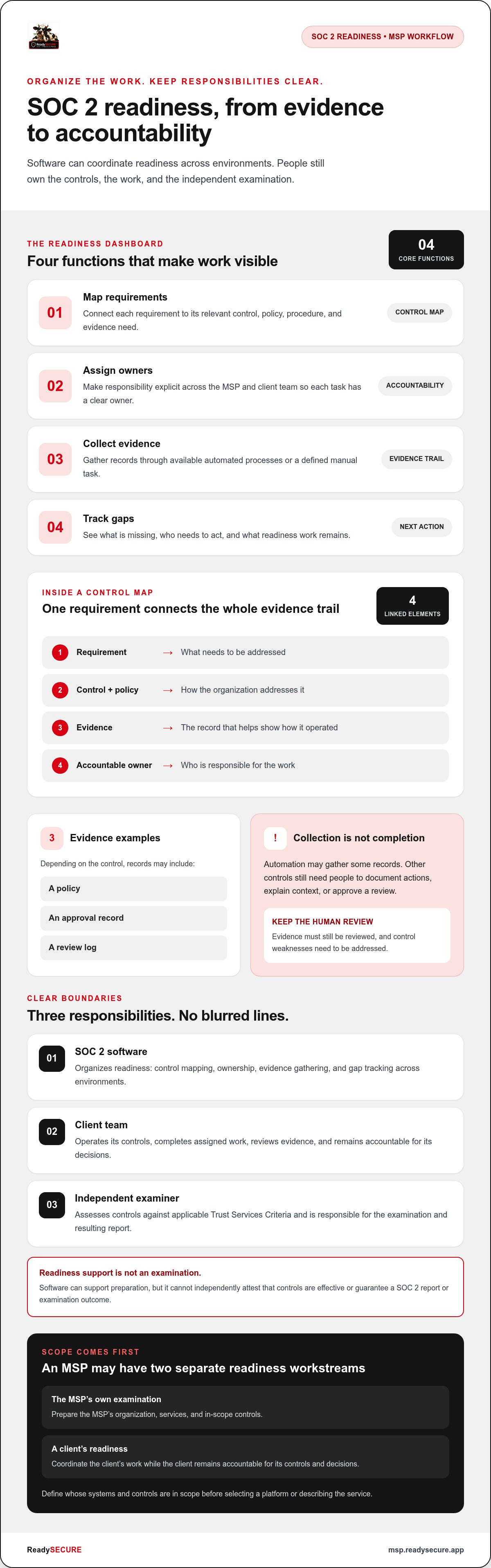
SOC 2 software organizes readiness work; the SOC 2 report is the result of an independent examination. Software can help map controls, assign owners, gather evidence, and track gaps. It can’t operate a client’s controls, independently attest that they’re effective, or guarantee a report or examination outcome. People still need to perform the work, review evidence, and address control weaknesses. An independent examiner remains responsible for the examination and resulting report.
Why MSPs encounter SOC 2 requirements
Prospective and existing customers may request a SOC 2 report to understand how a service provider manages relevant controls. That request can affect vendor reviews, renewals, or purchasing decisions. It doesn’t mean every MSP needs its own report or every client needs one. The business case depends on customer expectations, the services delivered, and the assurance a customer seeks.
Keep the two workstreams separate. An MSP pursuing its own report prepares its organization, services, and in-scope controls for examination. An MSP supporting a client’s readiness helps organize that client’s work, while the client remains accountable for its controls and decisions. Readiness support is not an examination.
That distinction should shape how you describe soc 2 compliance software for msps. Use it to coordinate readiness tasks across environments, clarify ownership, and make progress visible. Don’t present software access as proof of compliance or as a substitute for an independent examination. Clear boundaries protect trust and help your MSP deliver a consistent service.
How SOC 2 Compliance Software Organizes Controls and Evidence
Readiness work is easier to manage when every requirement has an owner, an evidence trail, and a next action. A platform brings these pieces into a shared workflow across MSP and client environments. Teams can see what’s mapped, what’s missing, and who needs to act, rather than piecing together status from scattered documents and follow-up messages.
Control mapping, policies, and ownership
Control mapping connects a requirement to the policy or procedure that supports it, the evidence used to demonstrate its operation, and the people responsible for the work. Control mapping links requirements to supporting evidence and accountable owners, giving each readiness task a clear destination. The AICPA’s AICPA SOC 2 Resources provide reference material on SOC 2 and its criteria. The organization still needs to determine how those requirements apply to its system and controls.
Policies set expectations. Procedures describe how people carry them out. Ownership turns both into action. For example, an access review might link a written access-control policy to review records and a named client manager responsible for checking permissions. The MSP can coordinate the workflow, but naming the client owner makes it clear who must complete the review and helps prevent the work from becoming something only the MSP understands or tracks.
ReadySECURE supports this process with control mappings and a policy library. These capabilities help MSPs organize requirements and policy materials across client environments. A responsible person still needs to check that documented procedures fit the client’s actual practices.
Evidence collection and ongoing readiness
Evidence is a record that helps show how a control operated during the relevant period. Depending on the control, it might include a policy, an approval record, or a review log. Continuous evidence collection can reduce last-minute document chasing by gathering records as work happens. But collection is only one step. Automated processes may gather some evidence; other controls still require people to document actions, explain context, or approve a review.
Use the workflow to move each mapped control through five practical stages:
- Map the requirement to the relevant control, policy, procedure, and evidence need.
- Assign an owner from the MSP or client team, and make the responsibility explicit.
- Collect evidence through available automated processes or a defined manual task.
- Review the record for relevance, completeness, dates, exceptions, and its connection to the control.
- Track remediation by recording gaps, assigning follow-up work, and monitoring its status.
A file in an evidence library doesn’t prove on its own that a control worked. Reviewers need to assess whether it relates to the right control, covers the relevant period, and makes exceptions or missed steps visible. For instance, a stale access review may show that a review once happened, but not whether the expected review took place during the period being evaluated.
For MSPs building this workflow across clients, ReadySECURE’s multi-tenant platform brings GRC capabilities, evidence collection, and control mappings into a shared operational layer. Use that structure to keep tasks visible and evidence moving, while leaving control judgments and approvals with the people responsible for them.
How to Evaluate SOC 2 Compliance Software for an MSP
For an MSP, a platform must work across client environments without blurring responsibility or visibility. Compare tools against the service you intend to deliver, not a generic feature checklist. Focus on how they separate tenants, manage evidence, map controls, and communicate progress. Those workflows determine whether readiness work can scale while keeping each client’s context clear.
Multi-tenant operations and client accountability
Start by examining tenant separation. Check whether each client’s evidence, controls, owners, exceptions, and reports remain distinct. Then assess how access is assigned: can MSP staff and client stakeholders see and act on the work relevant to their roles? A client-facing report should give that client a useful view without exposing another tenant’s information.
| Criterion | What to examine | MSP workflow supported |
|---|---|---|
| Multi-tenant separation | How client records, evidence, controls, and reports are partitioned. | Managing several client readiness programs without mixing their information. |
| Role-based access | Whether access can be assigned according to MSP and client responsibilities. | Delegating work while keeping ownership and visibility clear. |
| Evidence workflow | How records are collected, reviewed, and connected to controls. | Maintaining evidence and surfacing missing or outdated items. |
| Control mapping | How requirements connect to controls, policies, evidence, and owners. | Giving teams a consistent structure for readiness tasks. |
| Client reporting | Whether reports make status, exceptions, and follow-up actions understandable. | Sharing client-level progress and keeping remediation visible. |
Evidence workflows, mappings, and service fit
Test the workflow with a realistic client scenario. For example, follow an access-control task from its mapped requirement to the supporting policy, assigned owner, evidence record, exception, and remediation status. Can your team tell what needs attention and why? The NIST Cybersecurity Framework offers a reference point for organizing cybersecurity activities, but it doesn’t replace SOC 2 scope decisions or examination requirements.
Assess whether evidence collection suits the types of controls your clients operate. Some records may be gathered continuously; others require a client employee to document an action, explain an exception, or approve a review. Choose a workflow that makes these human tasks visible instead of treating every control as automatable. Policy resources and awareness training also matter when they support the way you intend to deliver readiness work.
ReadySECURE provides MSPs with a multi-tenant platform that includes continuous evidence collection, control mappings, a policy library, awareness training, and white-label reporting tools. Evaluate these capabilities against your delivery model, including how your team will handle exceptions and track remediation. Apply the same client-level workflow consistently. That’s the practical test for soc 2 compliance software for msps: does it help your team deliver organized readiness support while keeping client responsibilities and independent examination work distinct?
How MSPs Can Turn SOC 2 Readiness Into a Repeatable Service
A repeatable readiness service needs a consistent operating model, not a one-size-fits-all checklist. Use the same delivery stages for every client, then tailor controls, evidence, owners, and the work plan to that client’s services and examination scope. This gives your MSP a process to manage while keeping client accountability visible.
A practical client readiness workflow
Start each engagement by documenting what the client provides, which systems support those services, who makes key decisions, and what scope the client intends to pursue. Then move the work through four stages:
- Define scope. Record the services, systems, stakeholders, and intended examination boundaries. Keep assumptions and client decisions visible.
- Assess gaps. Compare the current state with applicable requirements. Identify missing evidence, control weaknesses, and unclear ownership.
- Assign remediation. Turn each gap into a tracked action with a responsible owner, priority, and status. Distinguish MSP tasks from work that belongs to the client.
- Maintain readiness evidence. Keep relevant records organized, review open items on an agreed cadence, and update the work plan as controls or responsibilities change.
For example, an MSP might coordinate evidence gathering and track a remediation item, while a client manager approves a policy change or completes an access review. Record those decisions and actions in the client’s work plan. That creates continuity between reviews and makes handoffs less dependent on individual memory.
Package the work without overpromising
Define the service boundary before delivery begins. Specify what the MSP manages, what the client owns, and where an independent examiner becomes responsible for examination work. The MSP can organize readiness activities and report progress; it shouldn’t imply that software, its team, or completed tasks guarantee an examination result or SOC 2 report.
Make reporting useful by showing completed activities, evidence still needed, open gaps, assigned owners, and next actions. A consistent report structure gives clients a clear view of progress while preserving the details that make each engagement specific. It also helps your team manage multiple client programs without presenting readiness as a promised outcome.
Some clients may need strategic security leadership to prioritize remediation or align security decisions with business goals. Expert-led vCISO support can complement the MSP’s readiness workflow in that situation. Keep the role clear: guidance can strengthen planning, but the client retains ownership where it operates the control, and examination remains independent.
Use soc 2 compliance software for msps to make this operating model easier to run across client environments. ReadySECURE’s multi-tenant platform, continuous evidence collection, control mappings, policy library, awareness training, and white-label reporting support organized client delivery. Explore the MSP compliance platform to build a more consistent readiness workflow.
How ReadySECURE Supports MSP Compliance and Governance Work
ReadySECURE gives MSPs an operational layer for managing security and compliance work across client environments. Its multi-tenant platform brings information security GRC into a broader security offering, helping teams organize readiness tasks alongside other client security activities. The aim is a consistent way to deliver the work, not a shortcut around client responsibility or independent examination.
Bring compliance workflows into a broader security platform
Compliance and governance capabilities include continuous evidence collection, control mappings, a policy library, and awareness training. Together, these support practical readiness steps: organize requirements, connect them to relevant evidence and policy materials, and keep client tasks visible. MSPs can manage distinct client environments through a platform designed for multi-tenant use.
The broader platform also includes vulnerability management, Microsoft 365 security, and mail security. This lets MSPs coordinate compliance work with related security services instead of treating readiness as a disconnected project. For example, Microsoft 365 security work may be relevant to a client’s control environment, while the client’s defined examination scope and control responsibilities determine how that work fits into readiness. MSPs building their Microsoft 365 offering can also use a Microsoft 365 security hardening tools guide to explore related security considerations.
Keep the division of responsibility clear. A platform can organize evidence, mappings, policies, and task visibility. It doesn’t establish that a control is operating effectively, make client decisions, or perform an independent SOC 2 examination. The client and its responsible personnel remain central to operating and approving their controls.
Build the next step around your MSP’s delivery model
White-label reporting tools support MSPs that want to present security and compliance work under their own service delivery. Use client-facing reports to show readiness activity, outstanding actions, and progress in a consistent format. Make sure reports communicate work status, not a promised audit result. That distinction supports a credible service clients can understand and your team can repeat.
Expert-led vCISO support can complement the platform for clients who need strategic security guidance. It can strengthen planning and help connect remediation priorities to broader security goals, while preserving clear ownership of client controls and independent examination responsibilities.
For MSPs evaluating soc 2 compliance software for msps, ReadySECURE combines multi-tenant operations with compliance and governance capabilities and a wider security platform. Build the workflow around each client’s needs, then use consistent reporting and task management to deliver it clearly. Explore ReadySECURE for MSP compliance workflows.
Make Readiness Part of Your MSP’s Delivery Model
Your next move is to decide how SOC 2 readiness fits your service strategy. Start with a defined client workflow, clear ownership, and reporting that shows progress without implying an audit result. The right soc 2 compliance software for msps should support that operating model and help your team deliver consistently as client needs differ.
ReadySECURE gives MSPs a multi-tenant platform for compliance and governance work, with continuous evidence collection, control mappings, a policy library, and awareness training. White-label reporting can bring that work into client-facing services, while expert-led vCISO support adds strategic security guidance where needed. Use these capabilities to shape a readiness service around your MSP’s strengths and each client’s responsibilities.
Explore ReadySECURE’s platform for MSPs and identify a practical next step for your client delivery model. Build the workflow, set clear expectations, and grow your compliance offering with confidence.
Frequently Asked Questions
Does SOC 2 compliance software make an MSP SOC 2 compliant?
No. SOC 2 compliance software supports preparation, but it can’t make an MSP compliant by itself. A dashboard may show that an access review is complete, for example, but the organization still needs to confirm that the review happened as intended and retain supporting records. The MSP remains responsible for its controls. An independent service auditor examines the relevant controls and issues the report. Treat software status as workflow tracking, not assurance.
Does every MSP need its own SOC 2 report?
No, an MSP doesn’t automatically need its own SOC 2 report. The decision depends on its services, customer expectations, contracts, and business strategy. If an MSP receives a procurement request, it can consider whether its own report addresses the assurance the customer seeks. Separately, it may help a client prepare for that client’s examination. Keep the efforts distinct, and identify the services and systems under consideration before committing resources.
Who performs a SOC 2 examination?
A qualified independent service auditor performs the examination and issues the SOC 2 report. The auditor evaluates the controls relevant to the defined examination scope; a software platform doesn’t take on that independent role. In client communications, describe your platform and MSP work as support for preparation and ongoing readiness. Don’t represent a completed checklist or collected evidence as the report itself. This distinction sets expectations before the examination begins.
Can an MSP use one SOC 2 software platform across multiple clients?
Yes, a multi-tenant platform can support readiness work across clients, provided each client’s information and responsibilities remain distinct. For example, if two clients both need access-review evidence, their records, owners, and progress should stay linked to the correct organization. Evaluate soc 2 compliance software for msps by how clearly it separates client-level work while giving your team a useful operational view.
Is SOC 2 compliance software the same as GRC software?
Not exactly, although the capabilities can overlap. GRC software supports broader governance, risk, and compliance activities, while tools marketed for SOC 2 often emphasize examination-readiness workflows. Look beyond the label and match your service needs to actual features. For instance, an MSP delivering governance support may need policy resources and risk workflows alongside SOC 2 evidence tracking. Client separation and useful reporting also affect whether a platform fits MSP operations.
What should an MSP do when a client requests SOC 2 support?
First, clarify whether the client wants help preparing for its own examination or is asking about your MSP’s controls. Then document the client’s intended scope, key stakeholders, evidence needs, and decision-makers. A practical starting point is a planning session that produces a shared list of open questions and assigned follow-ups. Keep the independent examiner’s work separate, and describe your support as readiness assistance, not a promise of a particular report.


