

Break-fix work can keep technicians busy while making growth difficult to predict. Moving from break-fix to a security-first MSP model means changing more than the billing: you’re shifting the conversation from fixing tickets to managing security as an ongoing business priority. The transition works best when clients understand the value and your team can deliver consistently.
Clients may resist recurring fees, and a broader security offer can stretch staff capacity. A rushed change can strain trust and operations, but staying reactive leaves revenue and workload dependent on the next urgent issue.
This guide lays out a staged transition plan to protect client relationships and cash flow while building repeatable security services. You’ll learn how to shape a clear offer, introduce it client by client, and scale delivery without building every capability in-house. A consolidated, multi-tenant platform and MSP-branded reporting can help extend security across client environments. Expert-led vCISO support, penetration testing, and incident response can add depth when specialist needs arise. The goal is a practical shift your clients can understand and your team can sustain.
Key Takeaways
- Distinguish break-fix support, managed services, and security-first delivery so clients can see what ongoing security responsibility involves.
- Organize security work into a repeatable lifecycle: assess exposure, prioritize, remediate, report, and improve.
- Compare operating models by revenue, work cadence, security scope, evidence, and scalability, while allowing for clients who aren’t ready to transition.
- Make moving from break-fix to a security-first msp model manageable by assessing clients, segmenting needs, piloting the offer, communicating clearly, and reviewing results.
- Reduce delivery friction with a platform that fits your needs for multi-tenant visibility, reporting, workflow, and client branding.
Why move from break-fix to a security-first MSP model?
Break-fix support starts with a problem: a user reports an issue, the MSP investigates, and the client pays for the work under the agreed arrangement. Managed services establish ongoing responsibilities and a planned service rhythm. Security-first delivery makes security a defined part of that work, rather than treating it as an occasional fix or one-time product sale. The models can overlap, but they aren’t interchangeable.
In a break-fix arrangement, revenue follows incidents. A quiet month can mean less billable work, while several urgent issues can disrupt schedules. Recurring service agreements create a more planned commercial cadence, but they don’t automatically provide security capability or predictable profit. The operating model must change too: define what’s included, assign ownership, schedule reviews, and show clients what’s complete and what remains open.
Security-first managed service replaces “call us when something breaks” with defined, recurring work to reduce exposure, track risk, and prepare for response.
What changes when an MSP leaves break-fix behind?
The work shifts from incident-triggered tickets to planned activities and regular reviews. For example, an MSP might schedule vulnerability assessments, prioritize remediation with the client, review Microsoft 365 security settings, and report on open actions. The contract and service description should specify the scope, each party’s responsibilities, exceptions, and reporting. Changing the billing model alone won’t establish this rhythm. It takes processes, capacity, and agreed expectations.
That distinction matters when moving from break-fix to a security-first msp model. Clients may question recurring fees, especially if they’ve only paid when something went wrong. Staff may need to balance scheduled reviews with incoming support requests, and the MSP may need specialist skills or tools. Treat these as transition design questions: explain the service in business terms, set a manageable scope, and identify where a platform or expert support can fill capability gaps.
Why make security central to managed services?
Security requires ongoing attention because exposure, business systems, and priorities change. Prevention work can reduce avoidable weaknesses; visibility helps clients understand unresolved risks; and response planning clarifies decisions if an incident occurs. These activities support business continuity without implying that any service can eliminate risk. The right controls and service level depend on the client’s environment, risk priorities, and capacity.
The broader managed services model is built around ongoing delivery rather than isolated fixes. Security fits that structure when the MSP defines and reports its responsibilities. One client might need regular vulnerability management and security reviews; another may prioritize compliance and governance support or strategic input from a vCISO. Avoid forcing every client into an identical package. Set a clear baseline, document tailored work, and make progress visible.
What does a security-first MSP model include?
A security-first MSP model pairs recurring IT delivery with clear, ongoing security responsibilities. It turns security from occasional fixes into work that is planned, assigned, documented, and reviewed. The offer should explain what the MSP manages, what the client needs to decide or provide, and how progress will be communicated.
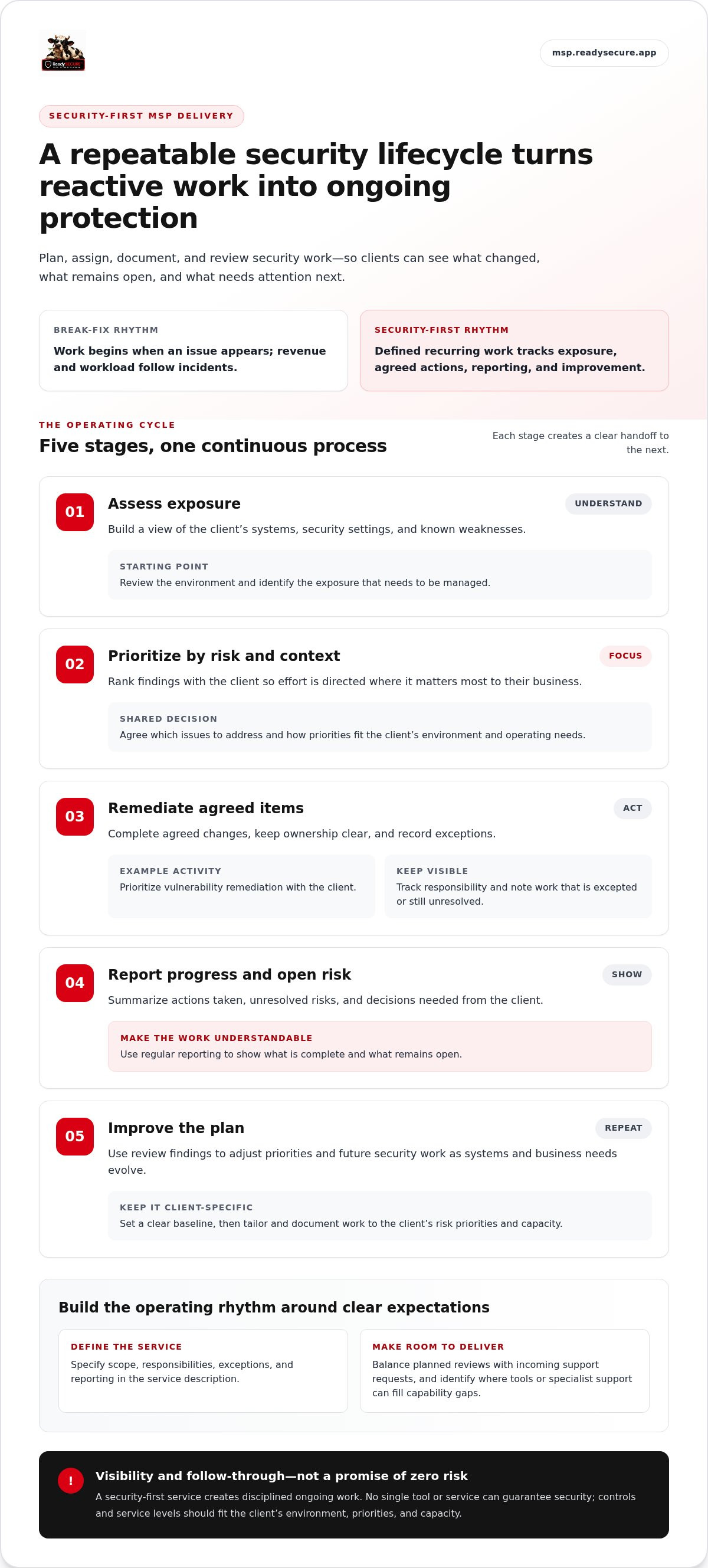
Build the service around a repeatable lifecycle. Assess the client’s environment and exposure, prioritize issues based on risk and business context, remediate agreed items, report what changed and what remains open, then improve the plan as systems and priorities evolve. The aim isn’t to promise that every issue will be prevented. It’s to create visibility and disciplined follow-through.
- Assess: Establish a view of systems, security settings, and known weaknesses.
- Prioritize: Rank findings so the client and MSP can focus effort where it matters most.
- Remediate: Complete agreed changes, track ownership, and record exceptions.
- Report: Summarize actions, unresolved risks, and decisions needed from the client.
- Improve: Use review findings to adjust priorities and future security work.
A security-first MSP combines recurring operational controls with clear reporting and expert support. Tools improve visibility, but no single tool guarantees security.
Which recurring security capabilities belong in the offer?
Start with repeatable operational coverage. Vulnerability management should give the MSP and client a shared view of findings, a way to prioritize remediation, and a record of what remains unresolved. For Microsoft 365, review identity and access settings, data protection, and relevant device security configurations. Set the scope according to the client’s environment, risk, and operating needs rather than applying a one-size-fits-all checklist.
Mail security, security awareness activities, governance, and evidence collection can extend that baseline when they fit the client’s needs. Practical cybersecurity best practices for small businesses also highlight areas such as risk assessment and employee training. For Microsoft 365, use a structured hardening approach rather than making isolated setting changes. This M365 security hardening tools guide can inform that work.
Where do specialist services fit?
Core operations won’t cover every need. vCISO support can provide strategic security guidance, help frame priorities, and connect technical decisions to business risk. Penetration testing, such as services provided by specialists like CyberOne, is a focused assessment of systems or applications, not a replacement for ongoing vulnerability visibility and remediation. Incident response supports an organization’s work to address and recover from a security breach. These capabilities add depth while keeping responsibilities distinct.
Be precise about service boundaries: security tools and incident response are not the same as a staffed 24/7 SOC. A consolidated, multi-tenant security platform can help MSPs coordinate capabilities and reporting across client environments. Explore how a multi-tenant security platform can support repeatable delivery while keeping client-facing reporting aligned with your MSP brand.
Break-fix vs. security-first MSP: compare the operating models
The difference isn’t simply “reactive” versus “proactive.” It’s the work the MSP commits to, how that work is scheduled, and what evidence the client receives. Standard managed IT can include ongoing maintenance without clearly assigning security responsibilities. A security-first offer makes those responsibilities explicit, measurable, and part of regular service conversations.
| Operating area | Break-fix | Security-first MSP |
|---|---|---|
| Revenue pattern | Work and billing are generally triggered by incidents or requests. | Recurring fees are tied to defined ongoing responsibilities, not a guaranteed profit level. |
| Work cadence | Technicians respond as issues arise. | Planned security activities sit alongside support and maintenance. |
| Security scope | Security work may be limited to the immediate problem. | Agreed controls, reviews, remediation, and response planning have clear ownership. |
| Evidence | Records tend to focus on completed tickets. | Reporting can show risks, actions, unresolved items, and current status. |
| Scalability | Capacity is harder to plan when workload follows incoming incidents. | Repeatable processes and shared visibility can support consistent delivery across clients. |
How do the models differ in client value and delivery?
In break-fix, a report may show that a device issue was repaired. In security-first delivery, the client also needs to know what risks were identified, which actions were agreed, what remains open, and who owns the next step. That visibility makes the service easier to manage. The label alone means little: define the work, reporting, and responsibilities behind the offer.
When making the business case, compare the economics of your own delivery model rather than relying on a generic break-even example. Consider your staffing, client mix, service scope, and the difference between incident-driven work and recurring commitments. This makes it easier to assess whether the offer is viable for your business and sustainable for your team.
How can an MSP assess its readiness to transition?
Don’t rely on a universal break-even threshold. Review your operating position before expanding the offer. Moving from break-fix to a security-first msp model is easier to manage when you know which clients are a fit, what your team can deliver repeatedly, and where specialist expertise is needed.
- Client mix: Identify concentration risks and clients whose expectations, systems, and needs are understood.
- Revenue baseline: Map current recurring revenue and distinguish it from incident-driven work.
- Team capacity: Check whether scheduled security work can fit alongside support demand without weakening delivery.
- Repeatability: Confirm that assessment, remediation tracking, and reporting follow a consistent process.
- Capability gaps: Separate work your team can own from specialist needs such as strategic guidance or penetration testing.
Some clients may remain on break-fix if that arrangement fits their needs and expectations. For clients who are ready to transition, assess platform fit across multi-tenant visibility, reporting, workflow, and client-branding requirements. A white-label security platform can bring capabilities and branded reporting together. Use this white-label security platform guide to consider the operational fit.
How to transition clients in practical, manageable phases
Move in controlled steps. A staged rollout gives you room to test the offer, understand the delivery effort, and refine client communication before expanding. Start with a manageable group whose environments and expectations you know. Before committing, document the service scope, client and MSP responsibilities, reporting cadence, and escalation paths. That groundwork protects trust and gives your team a service it can deliver consistently.
- Assess. Review current client environments, support patterns, known security needs, and existing agreements. Identify gaps between today’s work and the ongoing responsibilities you’re considering.
- Segment. Group clients by environment, needs, readiness, and service expectations. Select an initial cohort where the relationship is established and the likely work is understood.
- Package. Turn repeatable activities into clearly scoped options. Define included work, client responsibilities, reporting, and which specialist services need separate scope.
- Pilot. Introduce the offer to the initial cohort. Test the operating process and reporting in real client environments before widening adoption.
- Communicate. Explain the reason for the change, the service boundaries, what remains the same, and how questions or escalations will be handled.
- Review. Track client adoption, delivery effort, unresolved risks, and feedback. Use what you learn to adjust scope and process, not to chase an arbitrary conversion target.
How should an MSP package and price the new service?
Package around defined responsibilities, not a long list of tools. You might create scoped options that vary by security activities, reporting, or specialist input, but each should state what’s included and what falls outside the recurring service. Build the model around the client’s size, environment, agreed scope, and support needs. Explain the recurring fee in relation to the ongoing work. Scope items such as penetration testing or vCISO support separately when they aren’t part of the core offer.
How can the MSP communicate the change to existing clients?
Lead with what clients can see: clearer visibility into security work, agreed priorities, and a consistent way to review progress. Explain what changes and what doesn’t, including onboarding, reporting, responsibilities, and escalations. Invite a direct conversation about fit and timing. Offer a phased adoption path, but don’t pressure every client to convert at once. Some may remain on their current arrangement while you build the new service.
During the pilot, compare planned effort with actual delivery. Record where staff need more process or expertise, which risks remain open, and what clients say about the reports and service boundaries. Review those findings with the team, then revise the offer before bringing in the next group. This feedback loop ties growth to delivery capacity rather than assumptions.
Moving from break-fix to a security-first msp model is a sequence of decisions, not a single contract change. Explore security platform support for MSPs as you shape a repeatable, client-ready offer.
Scale security-first delivery with a repeatable MSP platform
Fragmented security tools can turn a growing service into a patchwork of consoles, exports, and separate reporting routines. Across client environments, that friction makes it harder to maintain a consistent view of findings and follow actions through. A platform won’t solve unclear scope or capacity constraints, but the right infrastructure can make repeatable delivery easier to manage.
Evaluate operational fit before adding another tool. Look for multi-tenant visibility across client environments, reporting that supports useful client conversations, and workflows that fit how your team assigns and tracks work. Confirm that the platform’s capabilities match the service you intend to deliver. A broad feature set has little value if it creates unused complexity or falls outside the agreed client scope.
What should an MSP look for in security delivery infrastructure?
Test your requirements against day-to-day delivery. Can your team view relevant security activity across multiple tenants without losing client-level context? Can reports present findings and progress under your MSP’s brand? Do the available capabilities map to your offer, such as vulnerability management, Microsoft 365 hardening, mail security, or compliance? These questions keep the evaluation tied to client value and delivery discipline.
- Visibility: Consider whether a multi-tenant view helps the team oversee work across clients while keeping environments distinct.
- Reporting: Assess whether client-facing reports make activity and status understandable and align with your brand.
- Workflow fit: Match platform functions to your service scope, team process, and client needs.
Before expanding use, map platform activity to your own processes. Decide who reviews findings, who coordinates remediation with the client, how unresolved items are recorded, and how reports feed into service reviews. The platform provides structure and visibility. Your MSP remains responsible for communicating scope, managing agreed work, and keeping client expectations clear.
How can ReadySECURE support the transition?
ReadySECURE provides MSPs with a white-label, multi-tenant security platform that brings vulnerability management, Microsoft 365 hardening, mail security, and compliance capabilities into one management view. Its MSP-branded reporting tools support client-facing delivery, helping you present security work within the relationship clients already have with your business. The platform supports the service you operate; it doesn’t replace MSP ownership or client-specific decisions.
Specialist needs can sit alongside platform-supported operations. ReadySECURE offers vCISO support, penetration testing, and incident response as services, providing expert-led options for strategic guidance, focused assessment, or breach response and recovery. Keep each responsibility clear: tools support visibility and coordination, while the MSP defines its commitments and how it delivers the service. Neither a platform nor incident response should be presented as a staffed 24/7 SOC.
As you move from planning to platform evaluation, compare capabilities against your actual service scope, reporting needs, and client mix. Explore ReadySECURE’s white-label security platform as an option for building more consistent security delivery across client environments.
Set the next phase in motion
The strongest next step isn’t a sweeping change. It’s a deliberate decision about what your team can deliver consistently, which clients are ready to take part, and how you’ll learn from the first stage. Use that clarity to turn moving from break-fix to a security-first msp model into an operating plan your team can own, not just a new line on a service sheet.
Choose a starting point. Define the responsibilities, assign ownership, and make client feedback part of the review. Then build on what works. A platform designed for MSPs, along with tools and specialist services that fit your approach, can support that process. Aim for steady progress: stronger client conversations, clearer delivery, and a business model built to grow with intention.
Explore ReadySECURE’s white-label security platform to see how it can support your next stage. Start with a practical step, learn from it, and keep moving forward with confidence.
Frequently Asked Questions
Can an MSP keep break-fix clients while moving to a security-first model?
Yes. An MSP can keep break-fix clients while introducing a separate security-first option for clients ready for ongoing work. Make the boundary visible in agreements and service records: which requests remain time-and-materials, which reviews or controls belong to the recurring scope, and how urgent issues are handled. Supporting different needs during the transition requires careful capacity planning and clear client expectations.
How do I convince break-fix clients to pay for recurring security services?
Explain the service in terms clients can verify: what gets reviewed, which findings are escalated, what actions need their approval, and what they’ll see in each report. When moving from break-fix to a security-first msp model, connect recurring work to a client priority, such as protecting email access or documenting open remediation tasks. Tailor the scope through conversation, not threat-based pressure or promises of complete protection.
What should a security-first MSP service include?
A security-first offer should define recurring oversight, not just name a bundle of tools. Depending on the client, it can include vulnerability visibility and remediation coordination, Microsoft 365 security reviews, mail security, governance tasks, and clear reporting of open actions. For example, a client preparing for an internal audit may need evidence tracking, while another may prioritize account settings. Set boundaries for specialist assessments or strategic advisory separately.
Does moving to a security-first MSP model mean hiring a security team?
Not necessarily. Decide based on the work promised, skills already on the team, client demand, and the complexity of specialist tasks. A platform can organize visibility and reporting across clients, while expert-led vCISO support, penetration testing, or incident response can extend delivery when needed. These options don’t replace qualified MSP personnel who own client communication and agreed actions. Tools and incident-response support also aren’t the same as a fully staffed 24/7 SOC.
How long does it take to move from break-fix to managed security services?
There’s no universal timeline. The pace depends on how varied your client environments are, whether service definitions and workflows are ready, how much team capacity is available, and how many clients enter the first rollout. Map dependencies before announcing dates: contract updates, access reviews, reporting setup, staff training, and client approvals can all affect sequencing. Set review points, then expand when delivery is stable enough to support the next cohort.
Is a security-first MSP model the same as a managed service provider model?
No. An MSP model describes recurring responsibility for a range of IT services, while security-first describes how explicitly ongoing security work is built into that relationship. An MSP might manage devices and support users yet leave security activities limited or separately scoped. To distinguish the offers, compare written responsibilities, review routines, and reporting commitments rather than relying on labels. The security-first designation should be supported by operational commitments.
How can MSPs measure whether the transition is working?
Use a small operating scorecard and review it consistently. Track client adoption of the recurring offer, staff effort against planned work, completion and aging of agreed actions, whether reports go out as intended, and client feedback or renewal concerns. Break results down by client segment to spot where delivery is smooth and where scope needs adjustment. These indicators guide decisions; they don’t prove revenue growth or guarantee lower security risk.


