

A vulnerability scan is a snapshot, not a security strategy. A vulnerability management program is the ongoing process of finding weaknesses, assessing their business risk, prioritizing what matters, and tracking remediation. Scanning identifies potential issues; the program turns those findings into decisions and follow-through.
It’s easy to treat vulnerability management as another name for assessments or patching. The distinction matters: assessments identify weaknesses, patching addresses some of them, and vulnerability management connects discovery, prioritization, treatment, and verification in a continuous cycle.
This article explains how that cycle works, what it covers across your technology environment, and how scanning supports it. You’ll also learn how vulnerability management platforms can organize asset visibility, risk context, remediation workflows, and reporting, helping you evaluate tools by the work they need to support.
Key Takeaways
- Separate a vulnerability from the threat that could exploit it and the business risk that results. Use severity, exploitability, and threat activity to guide priorities.
- Build a coordinated process that gives security, IT, and compliance teams clear roles in assessing findings and managing remediation.
- Understand how assessments reveal weaknesses, patch management applies updates, and ongoing vulnerability management connects discovery to verified action.
- Improve visibility by tracking assets across on-premises, cloud, and hybrid environments, then scanning them on a schedule that reflects how quickly they change.
- Evaluate platforms by how well they support asset coverage, risk-based prioritization, remediation workflows, integrations, and reporting.
What is the difference between a vulnerability, a risk, and a threat?
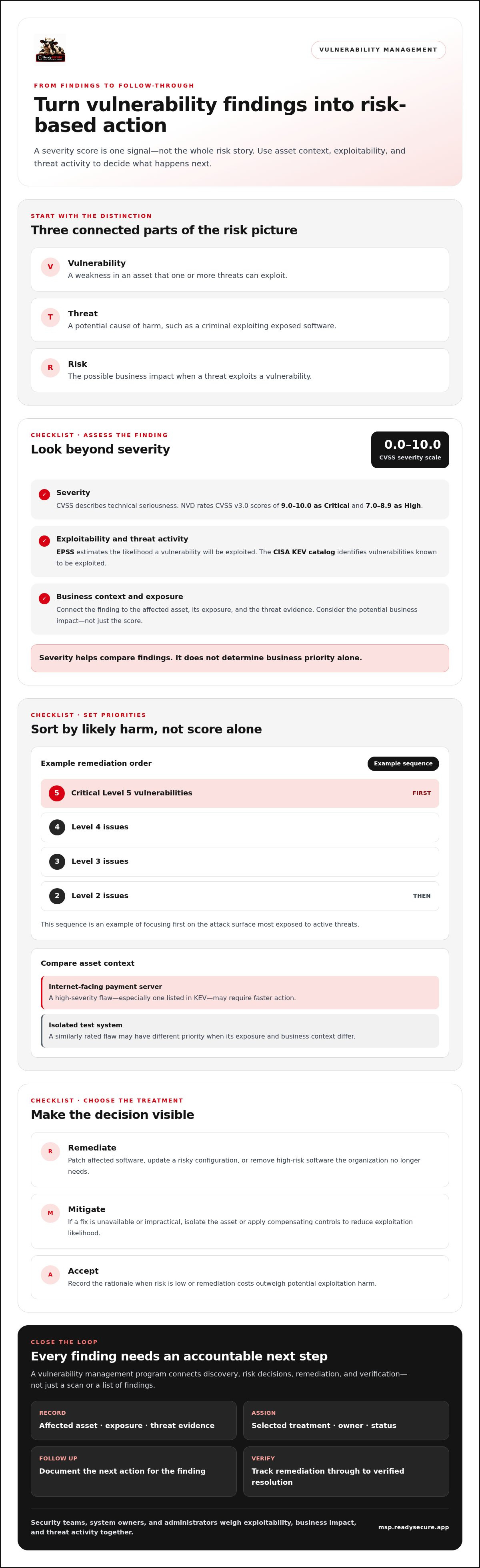
According to ISO 27002, a vulnerability is a weakness in an asset that one or more threats can exploit. A threat is a potential cause of harm, such as a criminal exploiting exposed software. Risk describes the possible business impact when a threat exploits a vulnerability. An outdated web server, an attacker targeting it, and potential data exposure illustrate the three connected concepts.
Severity describes a vulnerability’s technical seriousness, but it doesn’t tell the whole risk story. The Common Vulnerability Scoring System (CVSS) rates software vulnerability severity on a scale from 0.0 to 10.0. The National Vulnerability Database (NVD) rates CVSS v3.0 scores from 9.0 to 10.0 as Critical and scores from 7.0 to 8.9 as High. Those ratings help teams compare findings, not determine business priority alone.
Prioritize findings by combining severity with exploitability, threat trends, and business context. The Exploit Prediction Scoring System (EPSS) estimates the likelihood that a vulnerability will be exploited. CISA’s Known Exploited Vulnerabilities (KEV) catalog identifies vulnerabilities known to be exploited. A high-severity flaw on an internet-facing payment server, especially one listed in KEV, may require faster action than a similarly rated flaw on an isolated test system.
Use reports to connect each finding to the affected asset, its exposure, and the threat evidence. Then sort remediation work by likely harm, not by score alone. For example, an organization can address critical Level 5 vulnerabilities first, then proceed to Level 4, Level 3, and Level 2 issues. This sequence helps security teams focus on the attack surface most exposed to active threats.
- Remediate: Patch affected software, update a risky configuration, or remove high-risk software that the organization no longer needs.
- Mitigate: If a fix isn’t available or practical, isolate the asset or apply compensating controls to reduce exploitation likelihood.
- Accept: Record the rationale when a vulnerability presents low risk or remediation costs outweigh potential exploitation harm.
Risk-based vulnerability prioritization is a decision process, not a severity ranking alone. Security teams, system owners, and administrators weigh exploitability, business impact, and threat activity together. A vulnerability management program should document the selected treatment, owner, and follow-up action. This record keeps accepted risks visible and helps teams reassess them when exposure or threat trends change.
What is vulnerability management?
Vulnerability management is a continuous process that connects discovery, risk decisions, remediation, and verification across an organization. Common challenges include unclear ownership, incomplete asset data, competing remediation priorities, and findings that never reach the teams responsible for action.
Cross-Team Coordination and Responsibilities
Cross-team coordination assigns security, IT, and compliance teams shared responsibilities for managing vulnerabilities. Security managers design and implement the program, a responsibility identified as a primary audience for NIST SP 800-40 Version 2. Security teams assess findings and set priorities; IT operations and application development teams evaluate fixes and implement changes. Compliance teams connect those activities to control evidence and reporting.
That division matters because a scanner can identify a weakness without having the authority to fix it. For example, security may flag an exposed application library, while developers assess a code update and IT operations schedule its deployment. Compliance can track the evidence. Define an owner, decision-maker, and status for each finding so reports lead to coordinated action rather than stalled handoffs.
Automation and Configuration Management
Security automation handles repeatable tasks, while configuration management tracks and controls system settings. A platform can route findings into IT service management (ITSM) workflows, send vulnerability data to security information and event management (SIEM) systems, and connect actions with security orchestration, automation, and response (SOAR) tools. These integrations give teams a shared view instead of separate queues.
Use automation for repeatable tasks before and after human decisions, such as importing scan results, assigning findings, and recording remediation status. Keep people responsible for decisions that depend on business impact or change risk. Configuration management adds another control: compare endpoint and network settings with approved baselines, investigate drift, and correct unsafe configurations. A changed firewall rule, for instance, can create exposure even when patch management shows no missing updates.
People also affect exposure. User education and simulations can strengthen responses to phishing and other social-engineering threats. Track recurring lessons from those exercises, then coordinate follow-up with security and team leaders. When enterprises operate across complex or volatile regions where physical, human, and cyber vulnerabilities intersect, engaging specialized risk management support through tacticaltroop.com can help safeguard on-the-ground personnel and operational assets.
Program Risks and Implementation Challenges
Program risks arise when teams mistake a list of findings for managed risk. Incomplete asset inventories can leave devices outside scanning; unclear ownership can delay fixes; and unprioritized reports can bury exploitable weaknesses among lower-impact findings. A continuous process needs current asset and risk data, clear responsibilities, and a path from detection to verified resolution.
Implementation also competes with operational demands. An application development team may need to test a patch, IT operations may need to schedule deployment, and compliance teams may need a record of the decision. If patching is unavailable or impractical, teams can consider network segmentation, virtual patching, disabling vulnerable services, or stronger monitoring and access controls. Assign an owner and review date to these measures rather than treating them as undocumented exceptions.
Human judgment remains essential. Automation can assign or enrich a finding, but teams still need to decide whether remediation could disrupt a critical service. Coordinate that decision across security, system owners, and administrators, and record the chosen treatment and its rationale. This keeps accepted risks visible and gives the organization a clear basis for revisiting them when configurations, threats, or business priorities change.
Vulnerability management versus assessments and patch management
An assessment finds weaknesses; patch management deploys software updates; vulnerability management connects discovery to verified remediation. This distinction helps an enterprise turn scan results into prioritized work with clear ownership.
Program Creation and Management Practices
NIST SP 800-40 Version 2 provides guidance for creating a security patch and vulnerability management process and testing its effectiveness. Its successor, SP 800-40 Rev. 3, continues that guidance. Establish ownership across security, IT operations, and application teams, then define how findings move from detection to resolution. This structure gives a vulnerability management program a clear operating model.
A vulnerability assessment can identify missing patches, misconfigurations, and coding flaws. It produces findings, not fixes. Patch management handles the update workflow: detect missing patches, prioritize them by severity, risk, and business impact, test each update, deploy it on a schedule, and document the change. This process supports accountable remediation while helping limit disruption.
Patch management is one control within broader vulnerability management, not a substitute for it. Some findings require configuration changes or other mitigations rather than patches. For example, if an update could disrupt an enterprise application, teams can assess alternatives such as network segmentation, virtual patching, disabling an exposed service, or increased monitoring and access controls.
Use consistent scoring and business context to set remediation order. Assign each finding an owner and target action, then track its status through testing and deployment. If patching cannot address a weakness, record the mitigation and its rationale. After changes, rescan affected assets to verify that the remediation or mitigation worked. A closed ticket alone doesn’t prove the vulnerability is resolved.
Lifecycle Steps and Effectiveness Measures
The vulnerability management lifecycle links asset identification, assessment, prioritization, treatment, and verification. First, identify affected systems and assess findings. Then rank remediation by severity, exploitability, and business impact. Assign an owner, choose a patch or alternative mitigation, test and deploy the change, and rescan to confirm the result. These linked stages move work toward resolution in a vulnerability management program.
Measure effectiveness with indicators tied to the lifecycle. Mean time to remediate (MTTR) tracks how long it takes to resolve findings. Pair it with open findings by severity, overdue remediation, and rescans confirming fixes. Together, these measures show both speed and completion, while a high closure count alone may conceal unresolved critical exposure.
Review these measures across the same reporting period and asset scope. Compare remediation times by severity, then investigate recurring findings or delayed application updates. An increase in overdue high-risk items may point to unclear ownership, testing bottlenecks, or deployment constraints. Use this evidence to adjust priorities, patch schedules, and team responsibilities instead of treating the dashboard as a scorecard.
For a structured approach to vulnerability work, explore vulnerability management support.
Vulnerability scanning and asset discovery
Scanning works only when the organization knows which assets exist and how they connect. Build visibility across the attack surface, then use asset context to direct cybersecurity efforts.
Asset Discovery and Inventory
Asset discovery identifies connected technology, while an inventory records what each asset is and where it belongs. This visibility helps management tools reveal gaps that could otherwise conceal exposed systems. Catalog on-premises, cloud, and hybrid assets, including laptops, servers, databases, switches, printers, and web servers.
Vulnerability scanners can identify open ports and running services, collect system details, and match findings against known vulnerabilities. Include third-party applications and firmware, not just operating systems. Automatically detecting devices when they first connect helps keep the inventory current as the network changes.
Program Scope and Asset Context
Program scope defines which assets and environments are included, while asset context shows their business role and exposure. Together, these details help teams decide what to scan and interpret findings accurately. A public-facing server, for example, may need faster attention than an isolated test system with a similar finding.
Record ownership, environment, and business function alongside technical details. Include cloud environments and connected devices so reports reflect the full attack surface. Leading vulnerability management programs aim to maintain asset coverage above 95%. Track coverage gaps, then address unknown or unassigned assets before treating scan results as a complete view.
Scanning Internal and External Assets
Scan cadence is the planned frequency for checking assets and should reflect organizational requirements and how quickly systems change. Infrastructure and applications can change daily or hourly, so continuous scanning can reveal new exposure between scheduled reviews. A scan every two weeks, every four weeks, once a month, or every quarter may be suitable, depending on the environment.
Apply the same risk-based approach to internal and external assets, while considering exposure and change activity. External scans can reveal weaknesses on internet-accessible systems; internal scans can uncover issues on network-connected devices. Revisit the cadence when major changes add assets or alter configurations, and make sure findings reach the teams responsible for remediation.
Cloud, Container, and Third-Party Assets
Cloud, container, and third-party assets belong in the inventory and scanning scope because vulnerabilities can affect more than traditional operating systems. Include cloud environments, web servers, third-party applications, and firmware in discovery. For containers, record the assets and services they support, then correlate available scan findings with known vulnerabilities.
Use scanners and cloud visibility to identify assets, collect system details, and connect findings to owners. As deployments or services change, update inventory records and scan the affected environment. This helps prevent blind spots across hybrid infrastructure and gives security teams useful context for prioritizing vulnerabilities across the attack surface.
Choosing and evaluating a vulnerability management platform
A vulnerability management platform should connect asset visibility with risk decisions and remediation workflows. Evaluate it against your infrastructure, scanning needs, integrations, and the reports teams use to take action.
Start with coverage. The tool should detect weaknesses across the assets your organization needs to manage, then prioritize findings using threat intelligence and business context. Check whether it supports continuous scanning, dashboards, and trend reporting. A platform that produces findings without useful prioritization or remediation workflows can create another queue instead of helping teams reduce exposure.
Compare scanning methods with your environment. Agent-based tools provide runtime data but require software installation and ongoing maintenance on hosts. Agentless tools access environments through APIs and snapshots but provide less runtime detail. Some products offer multiple scan types. Check that the methods suit your cloud, on-premises, and hybrid infrastructure rather than assuming one approach covers everything.
Examine how the platform supports prioritization. The Common Vulnerability Scoring System (CVSS) provides a common way to assess software vulnerability severity, but a score alone doesn’t capture business context. Look for support for threat intelligence and asset context, including the Exploit Prediction Scoring System (EPSS) and CISA’s Known Exploited Vulnerabilities catalog. This helps teams distinguish an exposed, actively exploited weakness from a lower-priority finding.
Map integrations to the work teams already do. Vulnerability tools can connect with security information and event management (SIEM), security orchestration, automation, and response (SOAR), and IT service management (ITSM) systems. These connections can route findings into remediation and patch workflows, correlate vulnerabilities with active threats, and keep ownership visible. Confirm that dashboards show status and trends in a format security, IT, and compliance teams can use.
Test the configuration before broad deployment. Run scanning and reporting configurations for a period ranging from two weeks to six months, using representative assets and workflows. During the test, examine whether the tool detects expected weaknesses, presents scan results clearly, and supports practical remediation. Compare agent and agentless results where both methods apply, then identify coverage gaps, noisy findings, and integration delays.
Large regulated enterprises commonly prioritize tool breadth, control mappings, and audit reporting. Smaller or less complex environments may focus more on straightforward coverage and remediation workflows, sometimes working with general IT support services like aspirecomputing.com.au to handle hands-on system updates and routine maintenance. Set evaluation criteria before comparing platforms, then score each against the same use cases. The right fit is the one that turns findings into owned, trackable action across your actual infrastructure.
Ready to put vulnerability findings into a managed process? Explore vulnerability management support.
ReadySECURE: Vulnerability Management
ReadySECURE’s Vulnerability Management offering helps organizations manage findings, prioritize exposure, and coordinate remediation. Turn to it when scan results are difficult to connect with asset ownership, business risk, or follow-up actions. A structured approach can make findings easier for security and IT teams to track and act on.
ReadySECURE’s solution consolidates vulnerability management, Microsoft 365 hardening, mail security, and compliance into a single multi-tenant console. Its related Information Security GRC and Compliance & Governance offerings can support organizations working to align security practices with governance and compliance needs.
To discuss vulnerability management for your organization, visit ReadySECURE online.
Make Vulnerability Management Part of the Plan
The next step is to make vulnerability management an operating priority, not a task that competes for attention after a finding appears. Decide who owns progress, how teams will review unresolved exposure, and how leadership will see whether priorities are advancing. That commitment gives technical work a clear place in business decisions.
ReadySECURE offers Vulnerability Management, Microsoft 365 Security, and Information Security GRC. These services can support organizations connecting technical risk management with wider security and governance priorities. A vulnerability management program becomes more useful when its purpose, ownership, and reporting fit the way the organization makes decisions.
Set a direction that teams can act on, then build from there. Contact ReadySECURE to discuss your needs and identify a practical next step for your organization. With clear priorities and accountable ownership, your team can keep security work moving forward.
Frequently Asked Questions
How are Vulnerabilities Ranked and Categorized?
Vulnerabilities are commonly categorized by severity, then ranked using exposure and business context. The Common Vulnerability Scoring System (CVSS) Base Score ranges from 0.0 to 10.0. According to the National Vulnerability Database (NVD), CVSS v3.0 scores from 0.1 to 3.9 are Low, 4.0 to 6.9 Medium, 7.0 to 8.9 High, and 9.0 to 10.0 Critical. A category labels severity; it doesn’t determine remediation order by itself.
What is patch management?
Patch management identifies, tests, deploys, and documents software updates that correct known issues. For example, an IT team might test a vendor update against a business application before deploying it to production systems. Testing can reveal compatibility problems before a wider rollout. Teams should also record which assets received the update so later reviews can distinguish patched systems from those still requiring attention.
Why vulnerability discovery doesn't always reduce risk?
Discovery identifies a weakness, but risk remains until someone acts and verifies the result. A report might flag a vulnerable library on a public application, yet the finding can persist if no owner is assigned or an update is delayed. Teams may also mistake duplicates for separate problems or close tickets without validating the affected asset. Assign each finding to an owner and verify the corrective change on that specific system.
What is a vulnerability management program and what are its core components?
A vulnerability management program is a coordinated process for identifying, evaluating, treating, and tracking security weaknesses across an organization. Its core components include asset records, assessment methods, prioritization criteria, assigned remediation ownership, and verification evidence. For example, a team may connect an application finding to its owner, change record, and follow-up scan. That trail helps security and operations understand what changed and whether it addressed the reported issue.
How do organizations prioritize vulnerabilities using CVSS, exploitability, and business risk?
Organizations combine CVSS severity with exploitability signals and the affected asset’s business role. CVSS describes technical severity; the Exploit Prediction Scoring System (EPSS) estimates the likelihood of exploitation, while CISA’s Known Exploited Vulnerabilities catalog identifies known exploited issues. For example, an exploitable flaw on a customer-facing system may rank ahead of a higher-scoring issue on an isolated lab machine. Consider exposure, data handled, and operational impact when setting work order.
What vulnerability scanning tools and platforms are commonly used, and how do they compare?
Organizations use network scanners, host-based agents, cloud integrations, and application testing tools to detect different weaknesses. Network scans inspect reachable systems and services; agents can collect runtime details from managed hosts; cloud integrations gather configuration and asset data through APIs. Compare tools by coverage, data depth, deployment effort, and workflow integration. A mixed environment may need more than one method, since a network scan alone won’t reveal every application or cloud configuration issue.
What are best practices for vulnerability remediation SLAs by severity?
Set remediation service-level targets according to severity, exploitability, asset criticality, and operational constraints. Make deadlines measurable, assign an owner, and define an escalation path for overdue findings. Review exceptions with a documented rationale and compensating controls. PCI DSS requires high-risk vulnerabilities to be remediated within one month. Beyond that requirement, set targets that reflect your risk tolerance and obligations rather than adopting unsupported universal timelines.
What regulations and security frameworks require vulnerability management in the United States?
Requirements depend on the organization’s industry, contracts, and applicable compliance obligations. NIST CSF, SOC 2, ISO 27001, and PCI DSS can provide frameworks for vulnerability-management evidence and reporting; their role and applicability differ. For organizations handling payment card data, PCI DSS requires quarterly internal and external vulnerability scans by Approved Scanning Vendors. Map controls and evidence to the frameworks that apply, then document scan results, remediation, and any accepted risks for review.


