

Treating cybersecurity as a defensive line item is quietly destroying your service margins. Point-tool sprawl eats operating cash, manual spreadsheets burn dozens of engineering hours per client, and your buyers still view security spend as a grudge purchase. Modern cyber risk management is not administrative overhead; it is the highest-margin recurring revenue engine your MSP can deploy in 2026.
You already know the frustration of translating technical vulnerabilities into language executive boards actually care about. Pitching patchwork tools rarely wins budget. We will show you how to transform cyber risk management from a compliance headache into a predictable profit center that commands premium retainers. You will discover how to eliminate unbillable audit hours, deliver board-ready risk assessments in minutes, and package scalable governance services that drive long-term business equity.
Key Takeaways
- Shift from static annual audits to continuous, automated vulnerability prioritization that maps technical flaws directly to business impact.
- Eliminate margin-eroding point-tool sprawl by unifying Vulnerability Management, Microsoft 365 Security, and compliance tracking into a single pane of glass.
- Package high-margin recurring retainers by backing technical cyber risk management with structured vCISO Support and risk governance deliverables.
- Deliver professional, board-ready executive reports in minutes rather than burning unbillable engineering days on manual spreadsheets.
- Scale operational capacity and client trust using automated multi-tenant oversight paired with expert-led penetration testing and incident response.
What Is Cyber Risk Management in the Modern Threat Landscape?
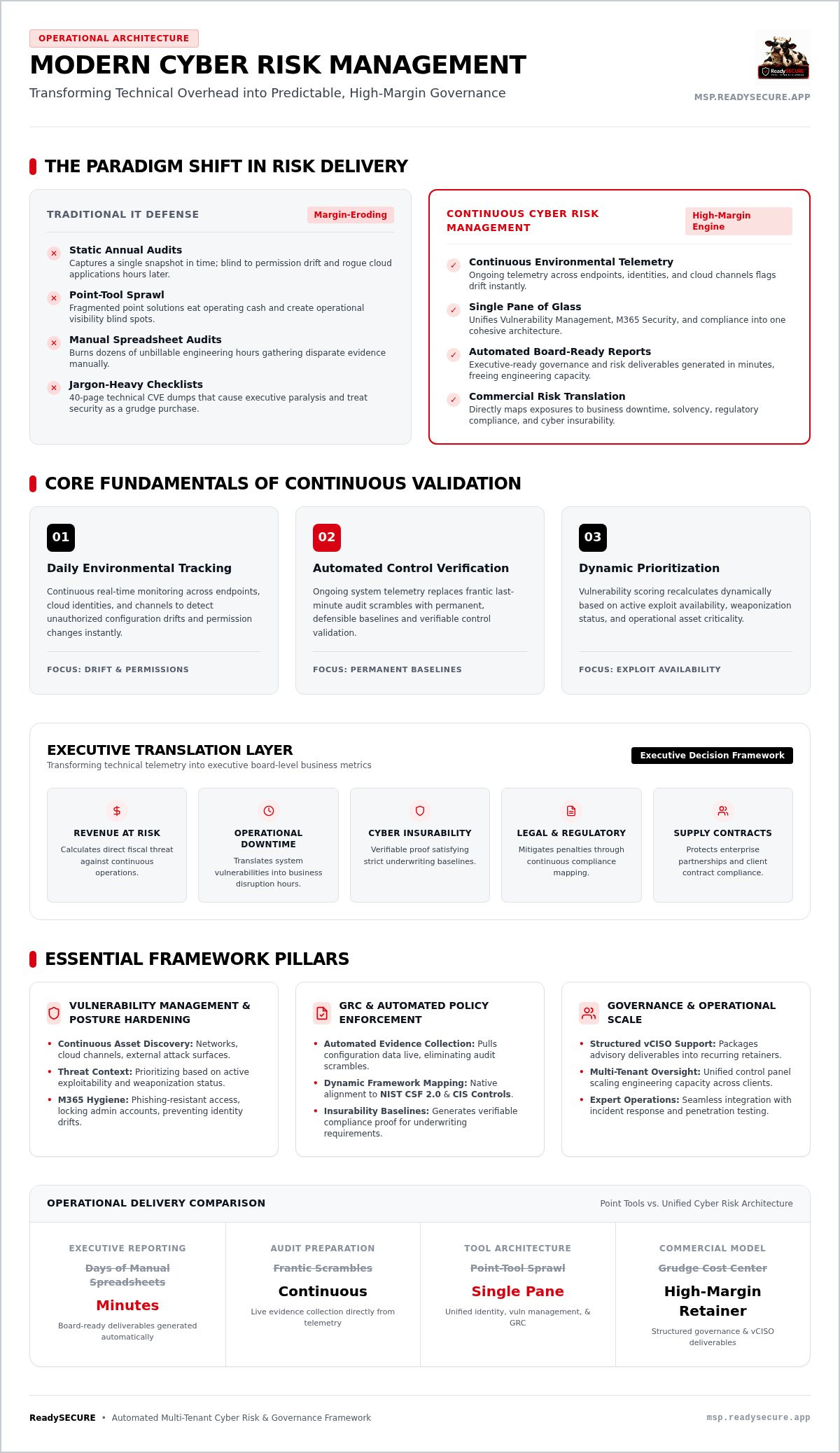
Traditional IT defense relies on a broken premise: run a scan, patch what looks critical, and repeat next year. That checklist model fails to protect modern businesses. Real cyber risk management identifies, assesses, and remediates security threats directly against business impact. It moves beyond technical hygiene, anchoring security controls directly into operational continuity.
Static audits create a dangerous, false sense of security. An annual audit measures one snapshot in time, yet a single misconfigured permission or rogue application can compromise an entire tenant hours later. Effective IT risk management requires replacing subjective guesswork with real-time telemetry, continuous validation, and defensible security postures.
The Shift from Checkbox Compliance to Continuous Risk Management
Static checklists miss the vulnerabilities that cause catastrophic breaches. Attackers thrive on identity drifts, unauthorized cloud permissions, and subtle mailbox forwarding rules created between audit cycles. Continuous risk management operates around three non-negotiable fundamentals:
- Daily environmental tracking: Continuous monitoring across endpoints, identities, and cloud channels flags unauthorized changes instantly.
- Automated control verification: Ongoing system telemetry replaces frantic, last-minute audit scrambles with permanent, defensible security baselines.
- Dynamic prioritization: Vulnerability scoring recalculates continuously based on active exploit availability and asset criticality.
Quantifying Cyber Risk into Measurable Business Impact
Executive boards don't buy technical jargon; they buy risk reduction. Handing a non-technical CEO a forty-page vulnerability report showing thousands of Common Vulnerabilities and Exposures (CVEs) triggers paralysis, not budget approval. High-performing service providers translate these raw metrics into commercial realities: revenue at risk, potential operational downtime, and legal liability.
Tie technical exposures directly to commercial requirements. Show stakeholders how unpatched flaws jeopardize cyber insurance coverage, violate supply chain contracts, or trigger regulatory penalties. When you articulate cyber risk management in terms of corporate solvency and commercial resilience, security shifts instantly from a disputed cost center to an essential operational investment.
The Essential Pillars of an Effective Cyber Risk Management Framework
Fragmented security controls create dangerous visibility blind spots. An effective cyber risk management framework bridges technical telemetry directly with commercial governance. Instead of treating identity management, patching, and audit readiness as separate operational silos, high-performing service providers unify them into a cohesive defense architecture. This approach eliminates blind spots, protects recurring margins, and delivers total environmental transparency.
Continuous Vulnerability Management and Posture Hardening
Asset discovery must happen continuously across internal networks, cloud environments, and external attack surfaces. Raw CVSS scores alone don't tell the full story. Prioritize remediation based on active threat intelligence, weaponization status, and asset exploitability.
Cloud identity hygiene is just as critical as software patching. Misconfigurations inside Microsoft 365 represent primary entry points for credential harvesting and lateral movement. Hardening tenant settings, enforcing phishing-resistant access policies, and locking down administrative accounts form the technical bedrock of modern posture management.
Information Security GRC and Automated Policy Enforcement
Governance fails when it lives in disconnected, static spreadsheets. A structured Information Security GRC program automates policy management and operational validation in real time. This operational discipline provides three direct business advantages:
- Automated evidence collection: Pull configuration data directly from active environments, eliminating frantic manual scrambles during annual regulatory audits.
- Dynamic control mapping: Map operational configurations automatically against frameworks like NIST CSF 2.0 and CIS Critical Security Controls.
- Insurability verification: Generate verifiable proof of enforced security baselines to satisfy stringent cyber insurance underwriting standards.
Advanced Email and Human-Layer Threat Reduction
Attackers exploit people far more often than software vulnerabilities. Sophisticated business email compromise (BEC) and targeted social engineering easily bypass legacy secure email gateways. Defending clients demands integrated mail protection that detects identity spoofing, malicious links, and unauthorized inbox routing rules before delivery occurs.
Pair automated defensive controls with ongoing risk reduction workflows. Review the modern vulnerability management process to align dynamic technical scanning with client-facing remediation cycles. Unifying these capabilities under a structured cyber risk management workflow transforms unbillable engineering maintenance into defensible, high-value service delivery. If you want to streamline these delivery workflows, explore how ReadySECURE unifies multi-tenant security operations to protect client environments while maximizing operational margins.
Evaluating Risk Management Delivery: Disparate Point Tools vs. Unified Platforms
Operational complexity quietly destroys service delivery margins. When your team manages thirty client accounts across four disconnected security portals, engineering efficiency grinds to a halt. Delivering scalable cyber risk management requires an infrastructure engineered for unified control, not a patchwork of isolated consoles.
The Hidden Operational Costs of Security Tool Sprawl
Every point tool introduces administrative overhead. Technicians waste hours logging into disparate dashboards, extracting CSV files, and cross-referencing conflicting vulnerability scoring models. Stacking multiple vendor contracts drains cash flow while introducing training bottlenecks that slow technician onboarding.
Understanding the operational reality of vendor consolidation is essential. Discover how busting common cybersecurity platform myths protects service margins from the friction inherent in bloated application stacks.
Comparing Disparate Tools with Unified Multi-Tenant Command Surfaces
Siloed tools force engineers into manual reconciliation. A vulnerability scanner flags a server flaw, a separate identity tool identifies unmanaged admin accounts, and a compliance sheet tracks neither in real time. Technicians spend days assembling basic summaries instead of executing billable remediations.
Unified platforms flip this dynamic through operational consolidation:
- Single-pane environmental visibility: Multi-tenant consoles aggregate posture data across all customer tenants, surfacing critical risks across your entire portfolio on one screen.
- Synchronized operational telemetry: Cloud configurations, endpoint exposures, and governance controls correlate automatically without custom API maintenance.
- Fewer vendor dependencies: Replacing multiple disparate tools with a consolidated command surface simplifies licensing, reduces overhead, and stabilizes service delivery costs.
Enhancing Client Retention Through White-Label Executive Reporting
Handing clients reports plastered with three different vendor logos damages your authority. It signals that you are merely reselling commoditized third-party tools rather than delivering proprietary strategic expertise. Executives question markup when vendor branding dominates the deliverables.
White-label reporting reinforces your brand equity directly with executive decision-makers. Clean, branded risk scorecards demonstrate measurable security improvements quarter over quarter. Translating technical remediations into professional governance reviews elevates your positioning. You stop competing as a reactive IT vendor and establish your team as an indispensable business risk partner.
How MSPs Package and Price Cyber Risk Management for Maximum Margin
Stop packaging security as an unbilled support feature. When you bundle continuous assessment into general IT overhead, you bleed engineering profit. Modern service providers monetize cyber risk management by transforming technical hygiene into premium, recurring governance retainers that protect margins and scale account value.
Structuring Tiered Risk Management and vCISO Packages
Create clear separation between standard maintenance and strategic oversight. A tiered model anchors basic compliance while driving clients naturally toward high-value advisory tiers:
- Core Assurance: Delivers automated Vulnerability Management, baseline Microsoft 365 Security posture checks, and foundational Mail Security policies.
- Advanced Governance: Adds continuous Information Security GRC tracking, automated audit evidence collection, and quarterly configuration hardening reviews.
- Strategic vCISO: Delivers structured vCISO Support, board-ready risk scoring, custom roadmaps, and prioritized remediation governance.
Check out our guide on white-label security platform deployment strategies to launch these service tiers without operational delay.
Monetizing Regular Security Reviews and Risk Assessments
Turn routine Quarterly Business Reviews (QBRs) into predictable revenue engines. Instead of presenting generic ticket resolution metrics, lead executive discussions with dynamic risk scorecards. Walk leadership through concrete posture improvements and active exposure vectors.
These recurring reviews consistently uncover shadow IT risks, configuration drift, and unmanaged cloud permissions. Use these findings to generate targeted, high-margin remediation proposals outside your standard service agreement. Connecting risk discovery to insurance renewal obligations justifies project scope and keeps clients compliant.
Augmenting Internal Skills with Expert Professional Services
Scaling high-tier security advisory services shouldn't require hiring six-figure specialists. Maintaining in-house red teams or dedicated incident responders spikes payroll overhead and crushes service margins. Strategic providers leverage on-demand partner capabilities to expand their commercial catalog.
Augment your internal technicians by reselling expert Penetration Testing and on-demand Incident Response alongside structured vCISO Support. You capture lucrative professional service margins, solve complex regulatory demands, and keep your core engineering team focused on daily operations. Ready to turn governance into recurring profit? Deploy ReadySECURE to operationalize your high-margin risk management practice today.
Operationalizing Cyber Risk Management with ReadySECURE
Executing scalable security delivery requires software engineered around provider workflows. ReadySECURE provides a purpose-built, multi-tenant security platform built specifically for service providers. Instead of stitching together disparate vendors, you consolidate Vulnerability Management, Microsoft 365 Security, Mail Security, and Compliance & Governance into a single operational command center.
Unified Multi-Tenant Control Across Your Entire Client Base
Eliminate repetitive portal hopping. Manage vulnerability scans, tenant hardening configurations, and mail protection policies across your entire client roster from one master console. Standardizing security baselines globally prevents manual configuration drift and slashes routine administrative labor.
Automated telemetry collection updates continuous risk scores across all client tenants in real time. For actionable steps on locking down cloud tenants, review our specialized guide to M365 security hardening tools to implement standardized configurations at scale.
Unlocking High-Margin Recurring Revenue Without Extra Overhead
Transitioning from reactive troubleshooting to proactive governance hinges on automated delivery. ReadySECURE operationalizes cyber risk management to maximize partner profitability through three distinct operational capabilities:
- 100% white-label reporting: Generate clean, executive-ready risk scorecards branded entirely with your firm's identity, cementing your role as an indispensable strategic advisor.
- On-demand expert augmentation: Expand your commercial capabilities instantly by leveraging expert-led Penetration Testing, specialized Incident Response, and structured vCISO Support without adding payroll overhead.
- Automated audit workflows: Accelerate client onboarding and eliminate manual assessment fatigue with continuous policy tracking that maps active configurations directly to compliance standards.
Scale your recurring revenue engine, protect operating margins, and deliver authoritative governance from one unified surface. Take command of your client security stack today with ReadySECURE.
Turn Cyber Risk Management into Your Strongest Growth Engine
Treating security as a reactive checklist will continue to erode your margins. Transforming cyber risk management into a structured, proactive discipline eliminates tool sprawl, ends audit fatigue, and turns commodity support into lucrative governance retainers. Unifying vulnerability prioritization with cloud posture hardening protects client operations while creating predictable recurring revenue.
You don't need a bloated engineering staff to deliver high-tier security. ReadySECURE consolidates Vulnerability Management, Microsoft 365 Security, Mail Security, and Information Security GRC into a single multi-tenant console. Deliver 100% white-label reporting that cements your authority in boardrooms, and access expert-led vCISO Support and Incident Response on demand to close enterprise deals with total confidence.
Stop letting point tools drain your operational profitability. Take total command of your security practice, elevate client retention, and build lasting business value today. Scale your MSP's security revenue with ReadySECURE.
Frequently Asked Questions
What is the primary difference between a vulnerability assessment and cyber risk management?
A vulnerability assessment scans systems to produce a raw inventory of missing patches and technical flaws. Modern cyber risk management goes further by evaluating those technical exposures against actual business operations, threat exploitability, and potential financial impact. It prioritizes remediation based on real-world asset criticality rather than arbitrary CVSS severity scores alone.
How do MSPs turn cyber risk management into a recurring revenue stream?
Service providers monetize risk governance by packaging continuous assessments into monthly service tiers instead of running one-off audits. By bundling continuous Vulnerability Management, policy compliance tracking, and structured vCISO Support into recurring retainers, providers secure predictable cash flow while establishing regular strategic touchpoints with executive leadership.
Is cyber risk management software suitable for small and mid-sized businesses?
Yes, small and mid-sized businesses face the same regulatory mandates, supply chain vendor audits, and phishing vectors as enterprise corporations. Consolidated platforms make comprehensive risk governance accessible by replacing complex enterprise architectures with automated multi-tenant oversight that standardizes baseline controls efficiently.
Can cyber risk management help clients satisfy cyber insurance policy requirements?
Continuous risk governance directly satisfies strict insurance underwriting requirements by validating mandatory safeguards in real time. Underwriters routinely require active proof of multifactor authentication, verified patch schedules, and hardened cloud configurations. Automated platforms provide verifiable historical reporting that validates policy adherence without manual record gathering.
How much engineering time does a multi-tenant security platform save compared to manual audits?
Centralized multi-tenant consoles eliminate the dozens of unbillable hours engineers spend manually gathering configuration data across disconnected tools. Automated data aggregation surfaces exposure trends across your entire customer roster on a single command screen, cutting assessment delivery from days of manual spreadsheet work down to minutes.
What role does Microsoft 365 posture hardening play in overall cyber risk reduction?
Cloud identity misconfigurations represent the most common entry point for account takeovers and data theft. Enforcing standardized baseline policies across tenant access controls, administrative privileges, and external sharing rules stops credential compromises before attackers gain an initial foothold inside client organizations.
How often should an organization perform cyber risk assessments?
Risk evaluations must run continuously rather than relying on an annual review. Daily configuration drifts, software zero-days, and sudden permission changes create immediate attack vectors between static audit intervals. Real-time telemetry ensures that client security postures remain defensible every day of the year.


